1.11 Temperature Is Not Thermal Energy: A CER on the Flat Line
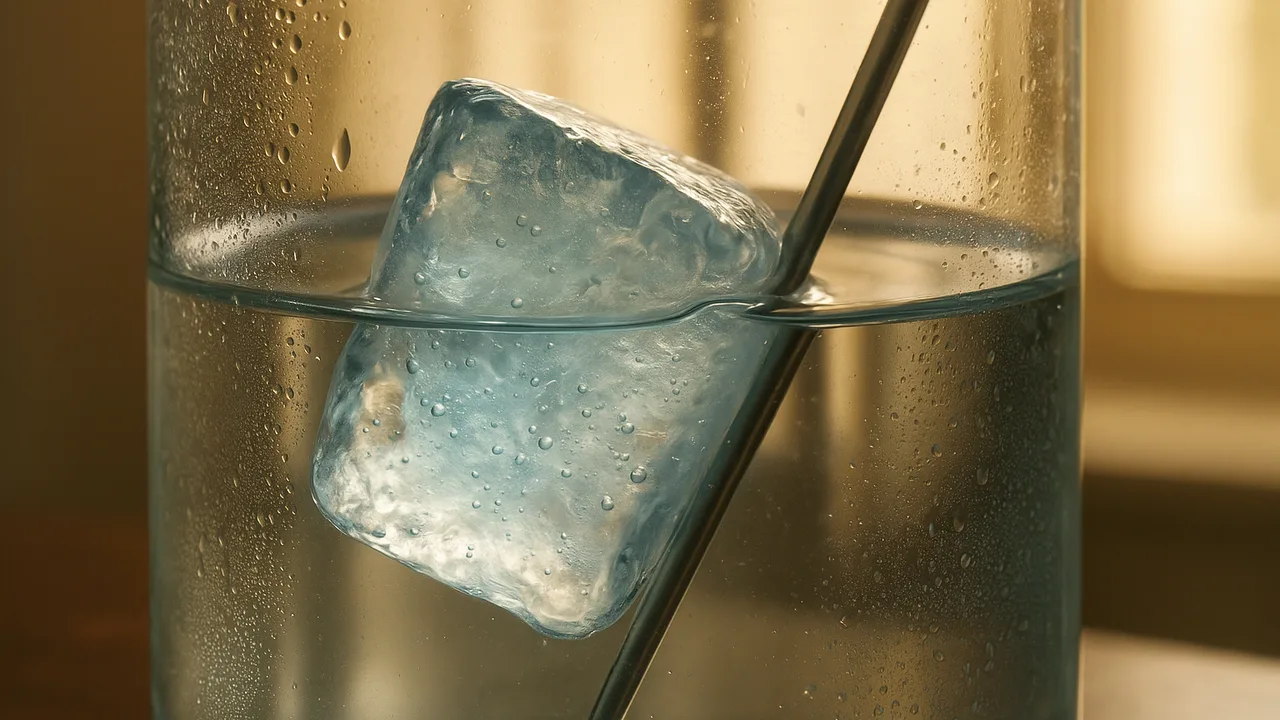
write a claim-evidence-reasoning argument explaining why melting ice stays at 0 degrees Celsius, and distinguish temperature from thermal energy.
- I can use my model to explain how adding or removing thermal energy changes the average kinetic energy of the particles in a substance.
- I can use my model to explain how the motion of particles is related to their kinetic energy and the temperature of the system.
- I can describe how adding or removing thermal energy changes the kinetic energy of particles and can cause a change in state.
- I can use my model to show how the state of matter (solid, liquid, gas) is connected to how particles move and interact.
Phase 3: Make Sense
Warm-Up ~5 min
Do Now. Picture a full bathtub of warm water at 38°C and a small mug of hot cocoa at 70°C. Which has the higher temperature? Which could melt more ice?
Which could melt more ice before cooling down?
Instruction ~10 min
Two ideas that sound alike. Temperature measures the average kinetic energy of the particles. Thermal energy is the total kinetic energy of all the particles in a sample. A bigger sample at the same temperature has more thermal energy.
Worked example 1: two cups. Ava has two cups of water, both at 20°C. One holds 100 mL and the other holds 500 mL. They have the same temperature. The larger cup has about five times the thermal energy, because it has about five times as many particles.
Today’s question. In 1.05, the hot plate added thermal energy the whole time. Why did the temperature stay at 0°C while the ice melted?
Worked example 2: a model CER. Here is how Diego answered a different question, “Why did the hand warmer’s probe get warmer?”
- Claim: the hand warmer added thermal energy to the probe.
- Evidence: the probe rose from 22°C to 50°C in ten minutes (sample data).
- Reasoning: adding thermal energy makes particles move faster on average. Temperature measures average particle motion, so the reading rose.
Sentence starters for your CER. Claim: “The temperature stayed at 0°C because ___.” Evidence: “Our graph showed ___ from minute ___ to minute ___.” Reasoning: “Thermal energy was still being added, but it ___. This means ___.”
The big idea for coolers. Melting ice absorbs a lot of thermal energy while staying at 0°C. As long as ice remains, energy that leaks in goes into melting it, not into warming the food. Insulation slows the leak; ice soaks up what gets through.
Guided Exercises ~15 min
Check your understanding before you write your CER.
Independent Practice ~10 min
Write your full CER.
CER: Why did the temperature stay at 0 degrees Celsius while the ice melted, even though the hot plate stayed on? Use the sentence starters and a particle sketch.
How confident are you that you can I can explain the difference between temperature and thermal energy.
Closure ~5 min
Ice is a cooler’s secret weapon: it soaks up energy without warming up. Next time, we look inside the cooler’s walls at the molecules that make foam work.
Exit ticket: why would two frozen water bottles keep a lunch cold longer than one? Use the words thermal energy and melting.
Teacher notes
Materials: class graphs from 1.05, data from 1.07, CER template with sentence starters.
Setup: project the class graph. Have partners trade CERs and check that the reasoning names particles, not just “because it melted.”
Listen for: “temperature and heat are the same”; “the ice was absorbing cold.” Keep it qualitative (MS-PS1-4): no calculations of energy. The five-times comparison is approximate on purpose.
Support / stretch: provide a partly completed CER. Stretch: explain why a large ice block lasts longer than the same mass of crushed ice (less surface touching warm air).