2.14 Ideate: Lander Concepts and Exhibit Model Plans
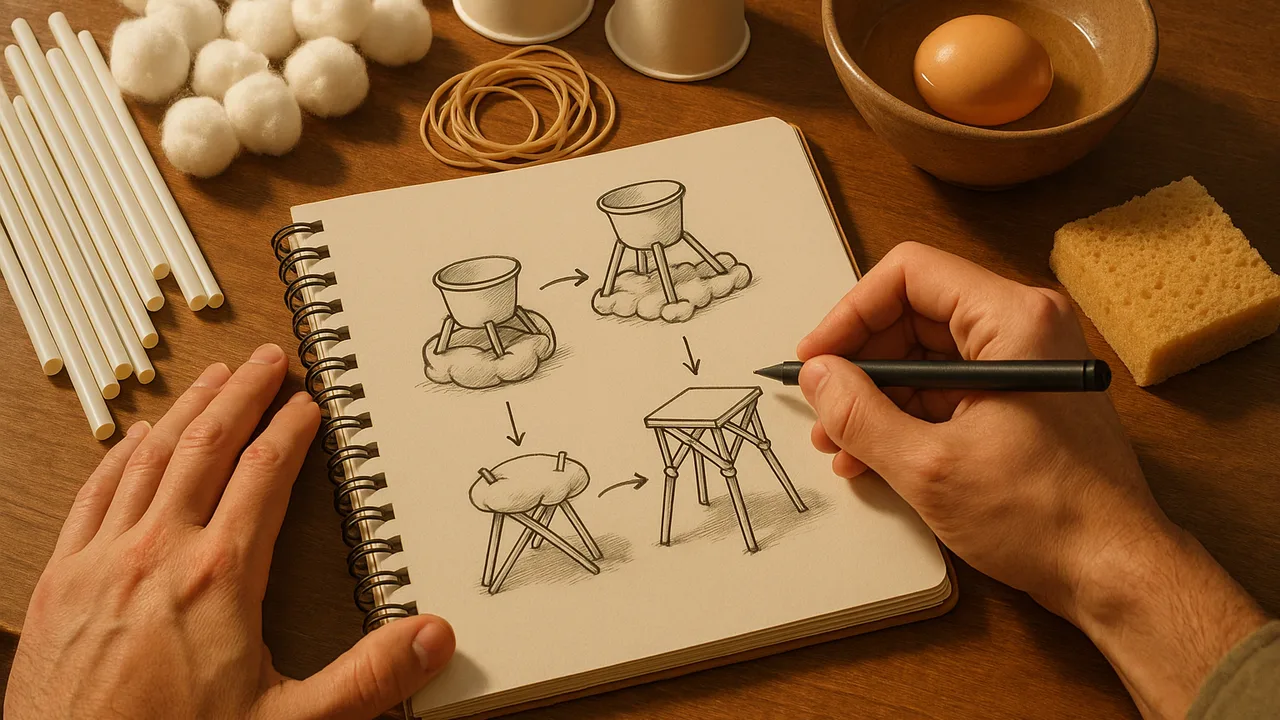
brainstorm at least three lander ideas and two scale model plans grounded in our science, and check each against the exhibit’s criteria and constraints.
- I can explain how the constraints of the problem and current technology limits affect the technologies I choose for my design.
- I can describe how different ways of showing data, like pictures, graphs, or models, highlight different characteristics and scales of objects in the solar system.
Phase 3: Make Sense
Warm-Up ~5 min
Do Now. Real lander teams have used parachutes, rockets, airbags and crushable legs. Which of these could we use for an egg dropped in a museum?
Which landing technology fits our classroom constraints best?
Instruction ~10 min
Mission engineers, now we ideate. To ideate means to come up with many ideas before choosing one. Each team brainstorms at least three lander concepts and two plans for the exhibit’s scale model. Every idea must use what we learned about forces or scale.
Worked example 1: three lander concepts.
- Crumple Legs: four paper-cup legs that squash on impact, making the stop take longer.
- Bubble Bag: an egg pod wrapped in bubble wrap, like a small airbag lander.
- Drag Canopy: a plastic-bag parachute to slow the fall, plus light padding.
For each, the team wrote the third-law reason: “The ground pushes back as hard as the lander hits; our design stretches the stop so the push on the egg is smaller at any instant.”
Worked example 2: choosing technology under constraints. Jamal loved the parachute. Then he checked our constraints: the drop height is short, and the real Moon has no air, so a parachute would not work there. The team kept it but wrote “not Moon-realistic” beside it. Constraints and the limits of available technology shape every choice.
Choosing a way to show scale. A picture can show what planets look like. A bar graph compares diameters clearly. A walk-through hallway model shows distance best. Each way of showing data highlights a different property, so the exhibit may need two.
Brainstorm rules. Sketch quietly for 5 minutes. Then share with “Yes, and…” No idea is judged until the checking step.
Guided Exercises ~15 min
Check ideas against our criteria and constraints chart from 2.02.
Independent Practice ~10 min
Fill in a team idea chart with a check or an X for every criterion and constraint.
Sketch three lander concepts. For each, explain how it uses Newton's third law, name the criterion it meets best, and name the constraint or technology limit that worries you most.
Describe two ways the exhibit could show solar system scale. What does each one show well, and what does it hide?
Closure ~5 min
Your team has lander concepts and scale model plans grounded in science. Next, in the Build phase, you will compare ideas fairly and test, then improve, your lander. First, take the 3DX field trip into space.
Exit ticket: describe your favorite lander concept. Which feature protects the egg, and which constraint will be hardest to meet?
Teacher notes
Materials: sketch paper, the criteria and constraints chart, a sample materials bin (paper cups, straws, bubble wrap, plastic bags, tape, cardboard), team idea chart template.
Setup: run a 5-minute silent sketch, then a 6-minute “Yes, and” round. Teams keep all ideas; part 2 compares, tests and refines them (MS-ETS1-2, -3, -4).
Listen for: ideas with no force reasoning, and “more padding is always better” (mass constraint). Keep third-law reasoning in one dimension.
Support / stretch: offer a menu of lander parts with the force idea each one uses. Stretch: design the exhibit sign that explains the third law to a young visitor in two sentences.