1.22 Revise and Retest: Version 2
make one evidence-based change to my cooler, retest it fairly, and decide which version the data supports.
- I can identify the design solution that is supported by the information given.
- I can use evidence and reasoning to make a claim about which solution works best, based on their strengths and weaknesses.
- I can use my model to explain how adding or removing thermal energy changes the average kinetic energy of the particles in a substance.
Phase 4: Build
Warm-Up ~5 min
Do Now. Jamal’s team wants to change the lid, the lining AND the insulation all at once. If the cooler improves, what will they not know?
Why change only one thing between version 1 and version 2?
Instruction ~10 min
Design engineers, revision is where good designs become great ones. Use your critique notes and data to pick ONE change. Then retest with the exact same setup as 1.19.
Check constraints before you change. A thicker foam wall might keep food colder, but will it fit the $5 budget? Will a student still carry it? A change that breaks a constraint is not an improvement.
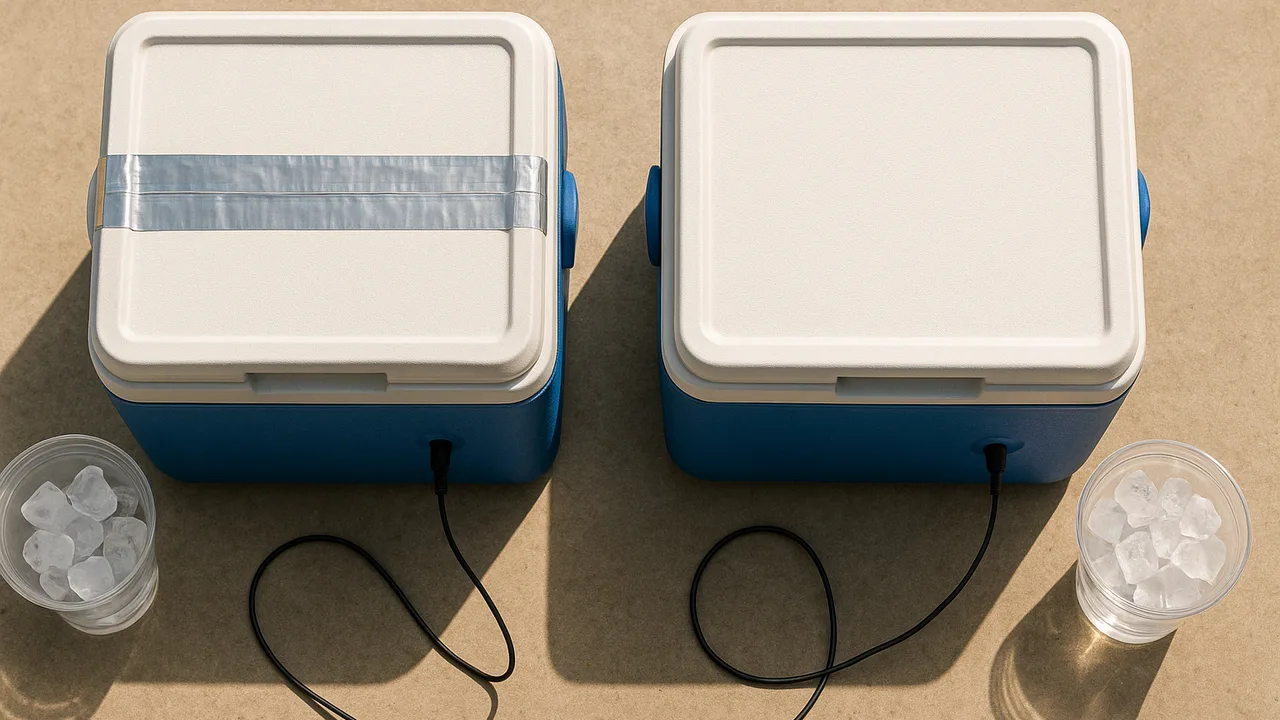
Worked example 1: Ava’s revision. Version 1 rose 2.5 °C in 40 minutes, and the lid had a gap. Her team added a felt strip around the lid edge for $0.50. New total cost: $4.00, still under budget. Version 2 rose only 1.0 °C, with 18 g of meltwater instead of 35 g. These are sample numbers.
Worked example 2: a claim the data supports. Ava wrote: “Version 2 is the better solution. Its temperature rose 1.5 °C less and about half as much ice melted. Sealing the gap stopped warm air from flowing in. Fewer fast-moving air particles reached the ice, so less thermal energy entered and the ice particles stayed in their solid pattern longer.”
| Measure | Version 1 | Version 2 | Difference |
|---|---|---|---|
| Starting temperature (°C) | |||
| Temperature at 40 min (°C) | |||
| Temperature rise (°C) | |||
| Meltwater (g) | |||
| Total cost ($) | |||
| Mass of cooler (g) |
Guided Exercises ~15 min
Plan your change, then answer these while the retest runs.
Independent Practice ~10 min
Complete your comparison table, then argue from evidence.
Which version does your data support? Write a claim with at least two numbers as evidence and a particle-based reason.
Explain how your change affected the thermal energy entering the cooler and the average kinetic energy of the ice particles.
Closure ~5 min
Version 2 is ready. Next class, meet the people who design cold packaging for a living, and learn to judge what sellers claim about it.
Exit ticket: name one constraint your revision had to respect, and how you stayed inside it.
How confident are you that you can I can use test data to decide which design solution works best.
Teacher notes
Materials: version 1 coolers, the materials store (teams spend leftover budget), fresh 200 g ice bags, fridge water bottles, probe thermometers.
Setup: 15 minutes to revise, 30 minutes to retest in the same spot as 1.19. Note room temperature both days; if it differs a lot, discuss it as a limitation.
Listen for: teams changing several things at once; claims with no numbers.
Support / stretch: give a claim frame: “Version ___ is better because ___ (data). This happened because ___ (particles).” Stretch: compute temperature rise per 10 minutes for each version.