1.27 Catch-up and Stretch: Atoms, Particles and States
practice the particle and atom ideas I found hardest, and stretch my thinking with a new challenge.
- I can use my model to explain how the motion of particles is related to their kinetic energy and the temperature of the system.
- I can describe how adding or removing thermal energy changes the kinetic energy of particles and can cause a change in state.
- I can use my model to show how the state of matter (solid, liquid, gas) is connected to how particles move and interact.
- I can use my model to explain how decreasing pressure means less energy is needed for a liquid to become a gas, and increasing pressure means more energy is needed for this change.
- I can use models to describe how pure substances are made of atoms or molecules, and how these can be arranged in different ways, like repeating patterns or single atoms.
- I can explain, using my models, how the way atoms and molecules are arranged affects what a substance is like, even though we cannot see them.
Phase 5: Prove It
Warm-Up ~5 min
Do Now. Look at your checkpoint. Circle one question you missed or felt unsure about. That is your focus today.
How confident are you that you can I can explain how particle motion relates to temperature and state.
Instruction ~10 min
Design engineers, today is a choice board. Your teacher will point you to a Catch-up station or a Stretch station. Everyone starts with the simulation below.
Re-teach: one picture, three states. In a solid, particles vibrate in place in a repeating pattern. In a liquid, they stay close but slide past each other. In a gas, they are far apart and move fast. Adding thermal energy moves matter from solid toward gas; removing it moves matter back.
Worked example 1: pressure in a sealed container. Heat a sealed container of gas, and its particles move faster. They hit the walls more often and harder, so pressure rises. Cool it, and the pressure falls.
Worked example 2: boiling and pressure. At sea level, water boils at about 100 °C. In a mountain town with lower air pressure, it boils at a lower temperature, because less energy is needed for particles to escape. In a pressure cooker, higher pressure means more energy is needed, so water boils hotter.
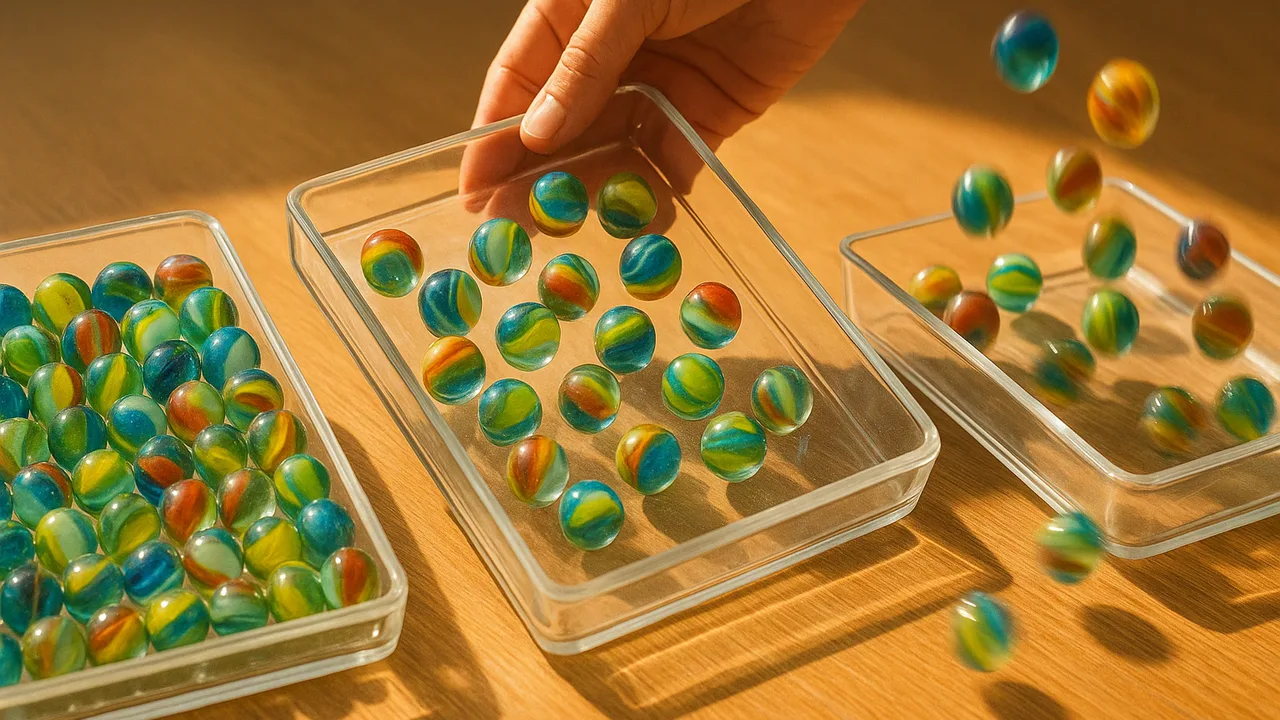
Choice board. Catch-up A: build solid, liquid and gas models with beads or paper dots. Catch-up B: sort molecule cards into “same atoms” and “different atoms.” Stretch A: explain why a bag of chips puffs up on a mountain road. Stretch B: model how frost forms on a cooler lid in winter.
| Station | What I did | What I learned | Question I still have |
|---|---|---|---|
Guided Exercises ~15 min
Use the simulation, then try these.
Independent Practice ~10 min
Show your growth.
Draw a particle model of a sealed bottle of air at two temperatures, hot and cold. Use arrows to show particle speed and explain the difference in pressure.
Answer the checkpoint question you circled again. Explain what you understand now that you did not before.
Closure ~5 min
Nice work. Next class, the second catch-up and stretch day: materials and better designs.
Exit ticket: explain, using particles, why the same substance can be a solid, a liquid or a gas.
How confident are you that you can I can use particle models to explain state, temperature and pressure.
Teacher notes
Materials: devices for the PhET sim, beads or paper dots, molecule cards (O2, N2, H2O, CO2, CH4), station signs.
Setup: group students using 1.26 results. Run the sim together for 8 minutes, then 25 minutes at stations. Early finishers move to a Stretch station.
Listen for: “molecules change when water boils”; “cold particles don’t move.”
Support / stretch: pair Catch-up students with a model kit and a partner. Stretch: explain why a sealed bag of chips may puff up when driven up a mountain.