1.04 Salt Crystals: Patterns That Repeat
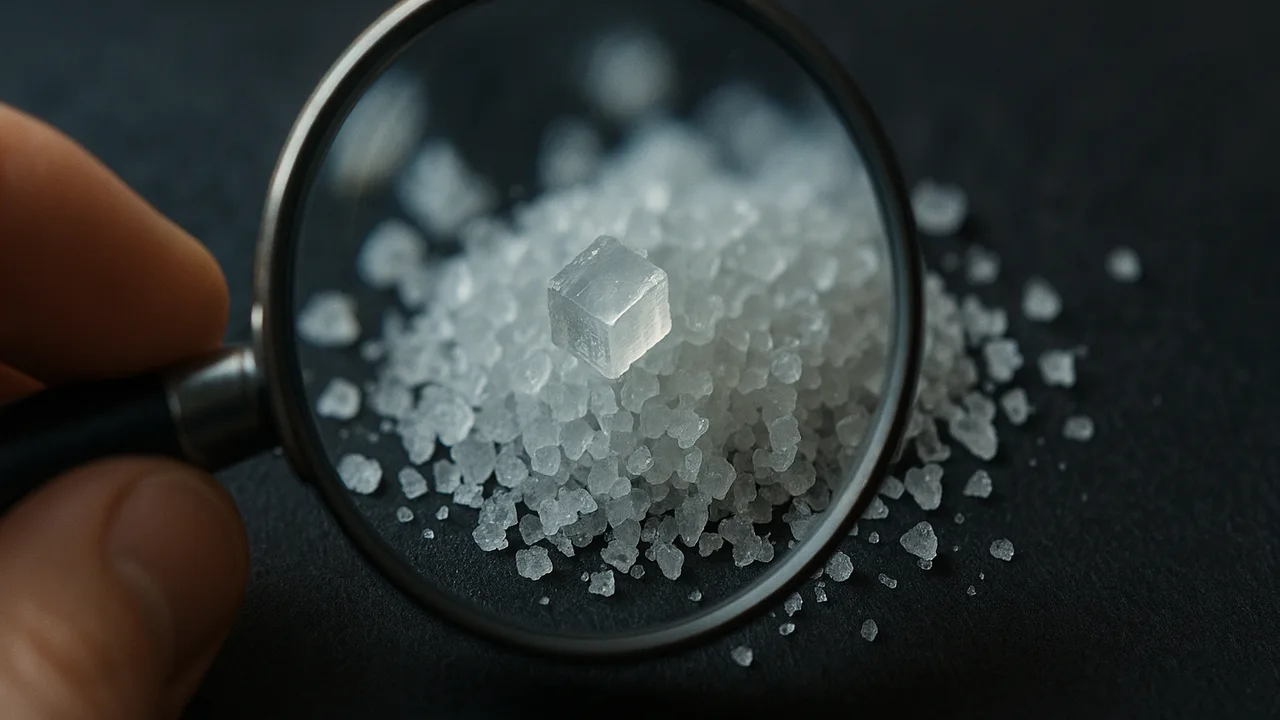
observe salt crystals and use a model to explain how an extended structure repeats the same pattern of atoms in every direction.
- I can create models that show individual atoms, molecules, and extended structures with repeating parts.
- I can identify and label substances as solids, liquids, or gases in my models.
- I can use models to describe how pure substances are made of atoms or molecules, and how these can be arranged in different ways, like repeating patterns or single atoms.
- I can explain, using my models, how the way atoms and molecules are arranged affects what a substance is like, even though we cannot see them.
Phase 2: Investigate
Warm-Up ~5 min
Do Now. Sprinkle a few grains of table salt onto a dark card. Look at them with a hand lens for one full minute. Then predict.
If you crush one salt grain into smaller bits, what shape will the tiniest bits have?
Instruction ~10 min
Explore first. At your station, look at four samples with a hand lens: table salt, coarse kosher or sea salt, granulated sugar and sand. Record what you see before you read on.
| Sample | Shape of the grains | Straight edges and flat faces? (yes / some / no) | Do grains look alike? | Sketch of one grain |
|---|---|---|---|---|
| Table salt | ||||
| Coarse salt | ||||
| Sugar | ||||
| Sand |
Naming the idea. Table salt is the substance sodium chloride. A salt grain has no separate molecules. Instead, sodium and chlorine atoms alternate in a checkerboard pattern that repeats in all three directions. Scientists call this an extended structure. A grain with flat faces like this is a crystal.
Worked example 1: a sugar-cube-sized model. Diego’s team stacked 27 beads, alternating two colors, into a 3 × 3 × 3 cube. Each color stood for one type of atom. They could keep adding layers on any side, and the pattern would not change. A real salt grain is like this cube, but with an enormous number of layers.
Worked example 2: molecule or extended structure? Priya compared her water model from 1.03 with the salt cube. A water molecule has a fixed size: always two hydrogens and one oxygen. The salt pattern has no fixed size. It simply keeps going until the crystal ends. Pure copper and diamond are also extended structures, but each uses only one type of atom.
Why the arrangement matters. The repeating pattern explains the flat faces and square corners you saw. Sugar molecules also stack into crystals, but in a different pattern, so sugar grains have a different shape. Sand grains are often worn and rounded by water and wind.
Guided Exercises ~15 min
Compare your samples and models. Discuss each card with your team before answering.
Independent Practice ~10 min
Show what you know about all three kinds of structures.
Make a three-box model sheet: single atoms, molecules and an extended structure. Draw one example in each box and label it solid, liquid or gas at room temperature.
How confident are you that you can I can model an extended structure and explain how it differs from a molecule.
Closure ~5 min
Salt showed us that atoms can also connect in a pattern that repeats without end. Next time, we watch ice turn into water and steam and track the temperature.
Exit ticket: use your model to explain why salt grains have flat faces, even though we cannot see the atoms.
Teacher notes
Materials (per team): table salt, coarse kosher or sea salt, granulated sugar, play sand, dark cards, hand lenses, 27 beads or small cubes in two colors (or sugar cubes with two marker colors).
Setup: one sample per corner of the dark card. A phone camera on zoom works well as an extra lens.
Listen for: “salt is made of salt molecules.” Sodium chloride forms an extended structure, not molecules. Stay simple: do not use the word “ion” unless a student does; no charges or electrons (MS-PS1-1 boundary). Some table salt grains are chipped or clumped; coarse salt shows cubes more clearly.
Support / stretch: give a pre-made bead layer to copy. Stretch: research what a diamond’s repeating pattern looks like and compare it to salt.