1.15 Two Cooler Concepts: Sketch, Label, Explain
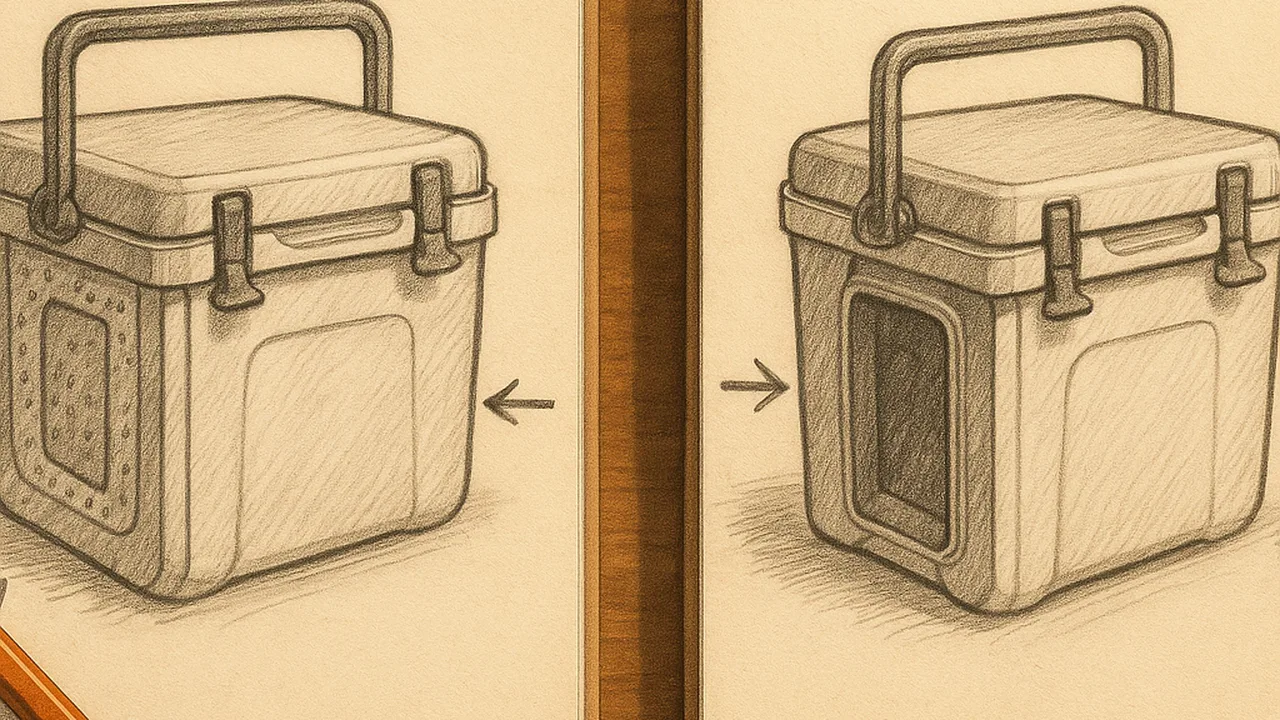
sketch at least two cooler concepts and explain, with particle ideas, how each one could keep a lunch cold.
- I can identify scientific ideas that relate to the problem and each possible solution.
- I can explain how each design solution could solve the problem.
- I can work with others to define and describe the criteria and constraints for evaluating a design solution.
Phase 4: Build
Warm-Up ~5 min
Do Now. Two lunch bags sit on a warm bus for four hours. One is a paper sack. The other is a thick, padded bag. Which lunch is colder at 12:30, and why?
What does a good cooler actually do?
Instruction ~10 min
Design engineers, welcome to the Build phase. In Make Sense you modeled what happens to particles when thermal energy moves. Now you will use that model to design a cooler for our client, the 6th-grade field trip team.
Restate the problem first. Lunches are packed around 7:30 in the morning and eaten around 12:30. Cold food should stay at 4 °C (40 °F) or colder to stay safe. The bus and the picnic area may be warm, and there is no electricity. That is the problem in one breath.
Our criteria: the lunch bottle stays at 4 °C or colder until lunch, at least half of a 200 g bag of ice is still frozen, it holds one lunch and one drink, and one student can carry it. Our constraints: a $5 budget from the price list, no electricity, two class periods to build, no dry ice, food stays in sealed bags, and it must be reusable for at least ten trips.
A concept is a first idea, not a finished product. Engineers sketch at least two concepts so they can compare them fairly. Each sketch gets labels, a materials list with costs, and a particle explanation of how it slows thermal energy.
Worked example 1: Concept A, the Foam Fortress. Mei’s team lines a cardboard box with foam sheets and covers the inside with foil. Their explanation: “Foam is full of tiny pockets of trapped air. Gas particles are far apart, so fewer collisions pass energy along. Thermal energy creeps in slowly.” Cost: box $0.50, two foam sheets $2.00, foil $0.50, tape $0.50, for a total of $3.50.
Worked example 2: Concept B, the Wool Wrap. Diego’s team wraps the lunch in two layers of wool felt inside a cloth bag. Their explanation: “Wool fibers trap air between them, which slows energy transfer. The bag is soft and light to carry.” Cost: felt $3.00, bag $1.00, for a total of $4.00. Both concepts use the same science idea, trapped air, but in different ways.
| Concept | Sketch labels | Materials and cost | How it slows thermal energy (particle idea) |
|---|---|---|---|
| A | |||
| B | |||
| C (optional) |
Guided Exercises ~15 min
Work with your team. Fill in one row of the concept table after each block.
Independent Practice ~10 min
Sketch your own concepts.
Sketch two different cooler concepts. Label every material, list its cost, and give each concept's total.
For each concept, explain in two sentences how it slows thermal energy moving into the lunch. Use the word “particles”.
Closure ~5 min
Strong start, design engineers. Next class we choose between concepts with a tool real engineers use: the decision matrix.
Exit ticket: which of your two concepts do you trust more right now? Name the criterion that makes you trust it.
How confident are you that you can I can explain how each design solution could solve the problem.
Teacher notes
Materials: notebooks, colored pencils, the class price list posted, sample materials to handle (foam sheet, felt, bubble wrap, foil, emergency blanket scrap, cardboard).
Setup: post the class criteria and constraints from the Investigate phase. If your class set different numbers, use yours everywhere this part says 4 °C, 200 g or $5. Give 12 minutes for sketching.
Listen for: “the foil keeps the cold in” (coolers slow thermal energy coming IN; cold is not a substance); concepts that are the same design twice.
Support / stretch: give a concept template with three label lines and a cost box. Stretch: add a third concept that uses only free or recycled materials.