5.08 The Innovators Expo
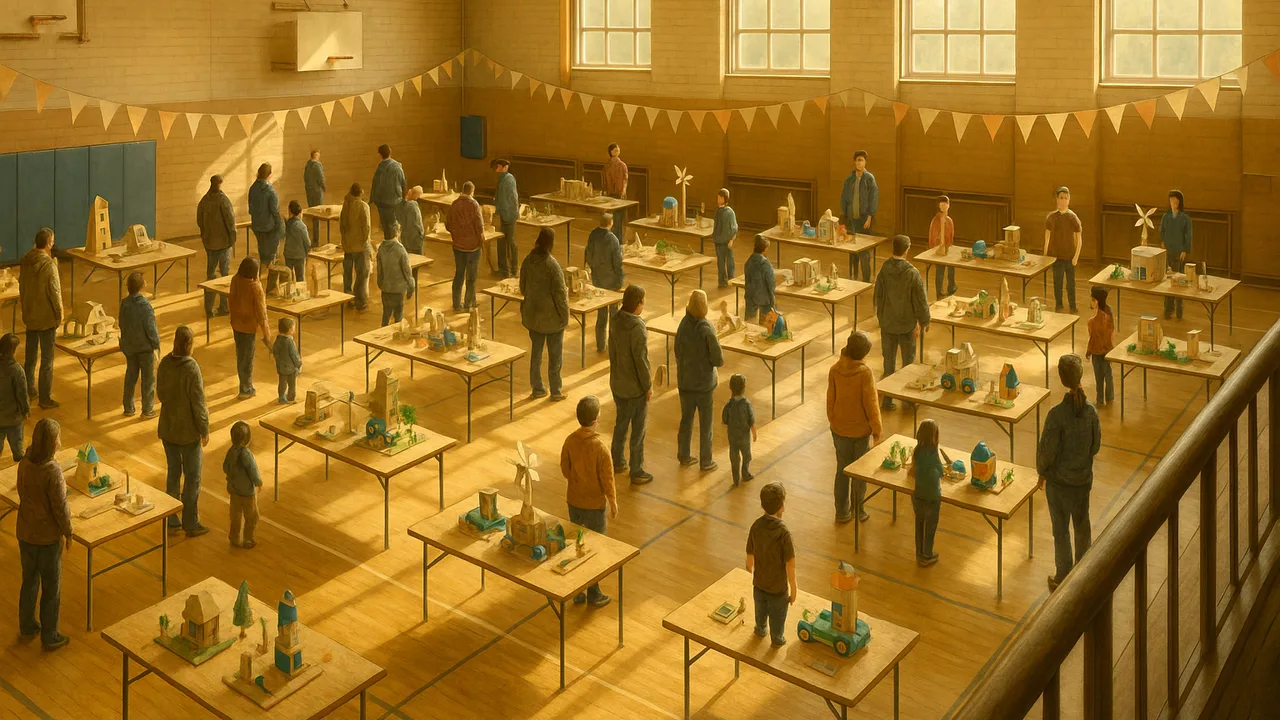
present our solution to families using evidence, and reflect on how I grew as a scientist and engineer this year.
- I can describe the required features (criteria) and limits (constraints) for a solution, including ways to increase benefits, decrease risks or costs, and meet what people need.
- I can explain how I will use the criteria and constraints to help create and test my design solutions.
- I can share my ideas and findings about design solutions with others to help create more possible solutions.
Capstone: Prove It
Warm-Up ~5 min
Do Now. Practice your 60-second pitch with your team. Each teammate says one part: the problem, the science, the design and the data. Time it!
A visitor walks up to your table. What should they hear FIRST?
Instruction ~10 min
Welcome to the Expo! Families will walk from table to table. Your table needs three things: your final prototype, a poster and your test data.
Your poster has four boxes. 1. The problem and who has it. 2. The science idea from this year that explains it. 3. Your design, with a labeled sketch. 4. Your proof: a before-and-after number or a bar graph.
Worked example 1: a strong pitch. “Lunch aides told us they shout all period. Our class rated lunch noise a 5 out of 5. Hard walls reflect sound energy, so it bounces everywhere. We built felt-and-egg-carton panels. In three trials, the rating near our panel dropped to a 3. Next, we want to test bigger panels.”
Worked example 2: answering a tough question. A visitor asks Priya, “Would your rain garden work in winter?” Priya says, “We only tested it in spring. That is a great idea for our next test.” Honest answers show real engineering. Nobody knows everything.
Reflect on your year. In the fall, you built a chain-reaction machine and a silent signal. This spring, you designed a nature-inspired invention and a hillside safety plan. Now you solved a problem you chose yourself. Think about how much you have grown.
Guided Exercises ~15 min
Get Expo-ready with your team. Move through each task.
Independent Practice ~10 min
After the Expo, reflect on your whole year in science.
Reflection: what is one science idea from this year that you used in your capstone? What is one thing you can do now as a scientist or engineer that you could not do in September?
How confident are you that you can I can share my design and my data with an audience.
Public product: the Innovators Expo
Show families your team’s solution to a real problem at school or in our community. Explain who has the problem, the science behind it, how your design works, and the data that proves it. Then listen to visitors’ ideas.
Submission workflow
- Make your final change and run one last test.
- Finish your four-box poster: problem, science, design and proof.
- Practice a 60-second pitch where every team member speaks.
- Present at the Expo and write down two visitor ideas.
- Write your year-in-science reflection.
How it is scored
| Criterion | What proficient looks like |
|---|---|
| Defining the problem | Clearly names who has the problem, what goes wrong and why it matters, using interview or survey information. |
| Science behind it | Correctly uses at least one science idea from this year to explain the cause of the problem and how the design helps. |
| Testing and revision | Tests each criterion with a fair test, records repeated trials, finds a failure point and makes a change. |
| Communicating with evidence | The poster and pitch share real data, every member speaks, and visitor questions get honest answers. |
Closure ~5 min
You did it, innovators! You found a real problem, used science to understand it, and built a solution with your own hands. Look back at our Wonder Board. Which questions can you answer now? Next: your 3DX field trip to the Innovators Expo Hall.
Exit ticket: what is one problem you want to solve someday, and which science idea might help you?
Teacher notes
Materials: poster boards, markers, tables, prototypes and data; visitor comment cards; reflection sheets.
Setup: Invite families, the principal and every client who was interviewed. Offer a second viewing time for families who work during the day. Rotate the Reporter role so every student pitches at least once.
Listen for: pitches that skip the data, and teams that describe the design without the science. Prompt with, “What makes it work?”
Support / stretch: Allow note cards and a sentence frame for the pitch. Students who are nervous can present to a small group first. Stretch: invite teams to send a short letter to the school about adopting their design.