3.18 Find the Failure Points
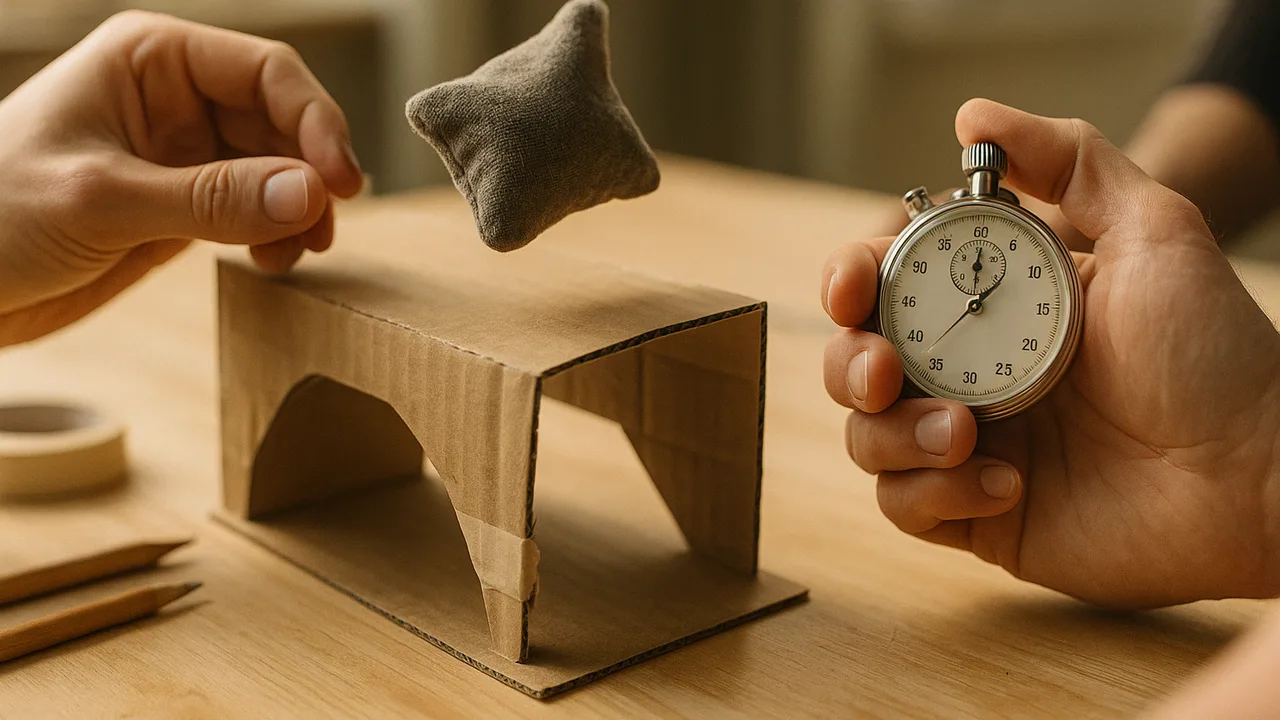
run a quick trial of our test plan, record the data, and use it to find exactly where our prototype fails.
- I can carry out my investigation and collect and record data by following my plan.
- I can explain the purpose of my investigation, including how I will find problems or failure points in my model or prototype to help make it better.
- I can explain how the evidence I collect will help me find problems or areas to improve in my model or prototype.
Phase 4: Build
Warm-Up ~5 min
Do Now. A chain is only as strong as its weakest link. Talk with your team: what do you think that saying means for a prototype?
Malik's clip has 6 hooks. If it pops open, where will it most likely start?
Instruction ~10 min
A trial run. Before the big test day, engineers try a quick trial. It is like a practice game. The goal is to find failure points. A failure point is the exact spot where a design does not work yet.
Follow your plan. The Tester runs each test the same way every time. The Recorder writes what happens right away, not later. Write what you see, like “opened at the left corner on shake 3.” Do not write “it was bad.”
Worked example 1: the Gecko Grip trial. Diego’s team tilted a book under the desk to make a slope. They set a phone case on the grip three times. Data: stayed, stayed, slid. On the third try, the liner strip was peeling at one end. Failure point: the peeling end. The evidence tells them to fix how the strip is attached, not the whole design.
Worked example 2: the Owl Quiet Fan trial. Ava’s team asked three listeners to close their eyes. Two said the fringed blade was softer. One could not tell. Then they looked closer. The fringe was bent flat on one side. Failure point: a flat fringe does not break up the air. Their data led them right to it.
Trial data table.
| Test | Try 1 | Try 2 | Try 3 | Failure point we found |
|---|---|---|---|---|
| Criterion 1 | ||||
| Criterion 2 | ||||
| Criterion 3 |
Guided Exercises ~15 min
Run your trial with your team. Use the arrows to move through each step.
Independent Practice ~10 min
On your own, read the evidence.
Ava's fringe was bent flat on one side, and one listener could not hear a difference. What should her team improve?
Explain how today's data helped your team find something to improve. Name the data and the part.
Closure ~5 min
Your team found its failure points with real data. Next time, you will make your fix and get ready for test day.
Exit ticket: why do engineers WANT to find failure points before they show a design to a client?
Teacher notes
Materials: prototypes, test plans, trial tables; books for slopes; snack bags and dry crackers; timers; extra copies of the plan.
Setup: About 20 minutes to run trials, 10 to find and explain failure points. Rotate roles so a new Tester and Recorder run today. This is a practice trial; the formal test is 3.20.
Listen for: teams that skip recording until the end, and “it worked” with no data. Ask: “Show me where you wrote that.” Praise teams that find a failure point.
Support / stretch: Give Recorders a table with check boxes (held / slid / opened). Stretch: ask teams whether their test itself had a problem, like an unfair slope, and how to fix the test.