5.04 Big Ideas, Many Solutions
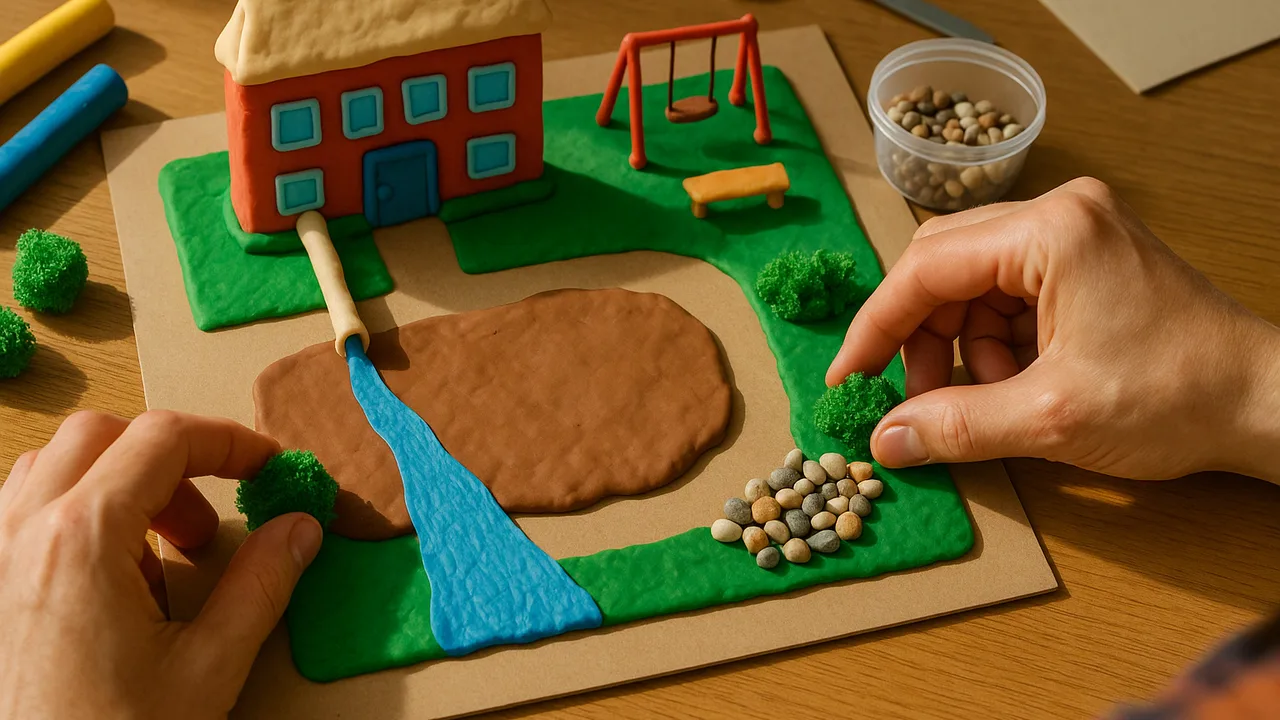
model what causes our problem, write a CER about it, and brainstorm at least two solutions based on science.
- I can use information from research to explain what causes a problem and what effects it has.
- I can use scientific facts I have learned to help me understand the problem.
- I can come up with at least two possible solutions to a problem using what I know about science.
- I can explain how each of my design solutions could solve the problem.
Capstone: Make Sense
Warm-Up ~5 min
Do Now. Look at your measurements from last time. Talk with your team: what is the cause of your problem, and what is the effect? Draw an arrow from the cause to the effect.
Jamal's team has one great idea for the soggy corner. Should they stop brainstorming?
Instruction ~10 min
Step 1: model the problem. A model is a drawing or object that shows how something works. Draw your problem place. Add arrows to show what moves: sound, light, water or soil. Label the cause and the effect.
Worked example 1: a lunchroom model. Mei’s team draws the lunchroom from the side. Arrows show sound leaving kids’ mouths. The arrows bounce off the hard ceiling, walls and tables. They come back to other kids’ ears. So the cause is hard surfaces reflecting sound energy. The effect is a loud room.
Step 2: write a CER. A claim answers the question. Evidence is your data. Reasoning uses science to connect the evidence to the claim.
Worked example 2: Jamal’s CER. Claim: Rain runoff from the blacktop causes the muddy corner. Evidence: In our tray test, water flowed downhill and carried soil to the low end. On the playground, the corner is the lowest spot. Reasoning: Water flows downhill and moves soil, which is erosion. Blacktop does not soak up water, so all of it runs to the low corner.
Step 3: Ideate. Now brainstorm. Rules: go for lots of ideas, build on others’ ideas, and no put-downs. Use the toolbox. Jamal’s team lists: a rain garden with deep-rooted plants that soak up water; a row of stones to slow the water; a small ditch that guides water to a drain. Each idea connects to science about water and plants.
Step 4: explain each idea. For every idea, finish this: “This could work because ____.” Then share with another team. Their ideas may spark new ones for you.
Guided Exercises ~15 min
Work with your team. Use the arrows to move through each task.
Independent Practice ~10 min
On your own. Write a CER using these sentence starters: “I claim that…”, “My evidence is…”, “This shows… because…”
CER: What causes your team's problem? Use at least one piece of data and one science idea from this year.
Pick two of your team's solution ideas. For each one, explain how it could solve the problem.
Closure ~5 min
Gallery walk: tape your idea lists on the wall. Add a sticky note to another team’s list with one idea to build on. Next time, your team chooses one idea and starts building.
Exit ticket: which idea from another team's list gave you a new idea for your own project? What was it?
Teacher notes
Materials: chart paper, markers, sticky notes; teams’ data tables from 5.02 and 5.03.
Setup: Post the brainstorm rules. Time the brainstorm (about 6 minutes) to keep energy high. The gallery walk shares ideas across teams, which is what 3-5-ETS1-2 asks students to do.
Listen for: reasoning that only repeats the evidence. Ask, “What science idea explains it?” Also listen for “soundproof”; soft materials lower echo but do not stop all sound.
Support / stretch: Give a partly filled CER frame. Stretch: ask teams for one idea per unit (energy, waves, living things, Earth).