5.05 Choose, Sketch and Build Prototype 1
choose our best idea using the criteria and constraints, and build a first prototype.
- I can describe what is needed to design a solution, including doing research and talking with others to make the design better.
- I can explain the purpose of my investigation, including how I will find problems or failure points in my model or prototype to help make it better.
Capstone: Build
Warm-Up ~5 min
Do Now. Read the case study below about Louis Braille. Then answer: what did Louis keep changing, and why?
Louis Braille started with a raised-dot code that used up to 12 dots. What do you think he changed?
Instruction ~10 min
Choose with a decision matrix. A decision matrix is a table that scores each idea against your criteria and constraints. Give each idea 1, 2 or 3 points for each rule. The idea with the most points is a strong choice. You still use your judgment, too.
Worked example 1: the bus signal. Diego’s team scores three ideas. A flag board with colors and shapes: seen from 20 steps (3), cheap (3), easy for little kids (3) = 9. A buzzer: heard (2), needs batteries (1), confusing with many buses (1) = 4. A big printed list: hard to see far away (1), cheap (3), easy (2) = 6. The flag board wins.
Sketch before you build. Draw your prototype. Label each part and its job. Write the materials next to each label.
Build Prototype 1. A prototype is a first model to test. It does not need to be pretty. It needs to be good enough to test. Engineers expect it to have problems. Finding them is the point.
Worked example 2: the quiet lunchroom panel. Ava’s team cannot change the whole lunchroom. So they build a small test panel: cardboard covered with egg cartons and old felt. They will hold it near a speaker and compare it to bare cardboard. The purpose of the test is to find where the panel fails, so they can make it better.
Ask for help. Good design needs research and talking with others. Check a library book, ask the art teacher about materials, or show your client your sketch.
Guided Exercises ~15 min
Fill in your team’s decision matrix.
| Idea | Criterion 1 | Criterion 2 | Constraint 1 | Constraint 2 | Total |
|---|---|---|---|---|---|
Independent Practice ~10 min
Build time! Follow your sketch. The Recorder takes a photo or makes a drawing at the end of class.
Write the purpose of your first test. What part of your prototype do you think might fail, and how will testing show it?
🔎 Mini case study: Louis Braille, the teenage inventor ~5 min
Louis Braille was born in France in 1809. When he was a small child, he hurt his eye in an accident in his father’s workshop. An infection spread, and he became blind in both eyes.
Louis went to a school for blind students in Paris. Their books had big raised letters. They were heavy, and reading them was very slow. Then an army captain visited with a code of raised dots. It was clever, but each sound used a tall pattern of up to 12 dots. It was hard to feel with one fingertip.
Louis was a teenager, but he kept working on the idea. He made each letter fit in a small cell of six dots. By about age 15, he had a system that worked. He kept improving it for years, adding numbers and music. Many adults were slow to accept it at first. Today, braille is used by blind readers all over the world.
Think about it: Louis started with someone else’s idea and made it better for the people who would use it. How could your team improve an idea that already exists?
Closure ~5 min
Prototype 1 is built! Next time, other teams will give you feedback, and you will make your first improvement.
Exit ticket: describe your prototype in two sentences. Which science idea from this year makes it work?
Teacher notes
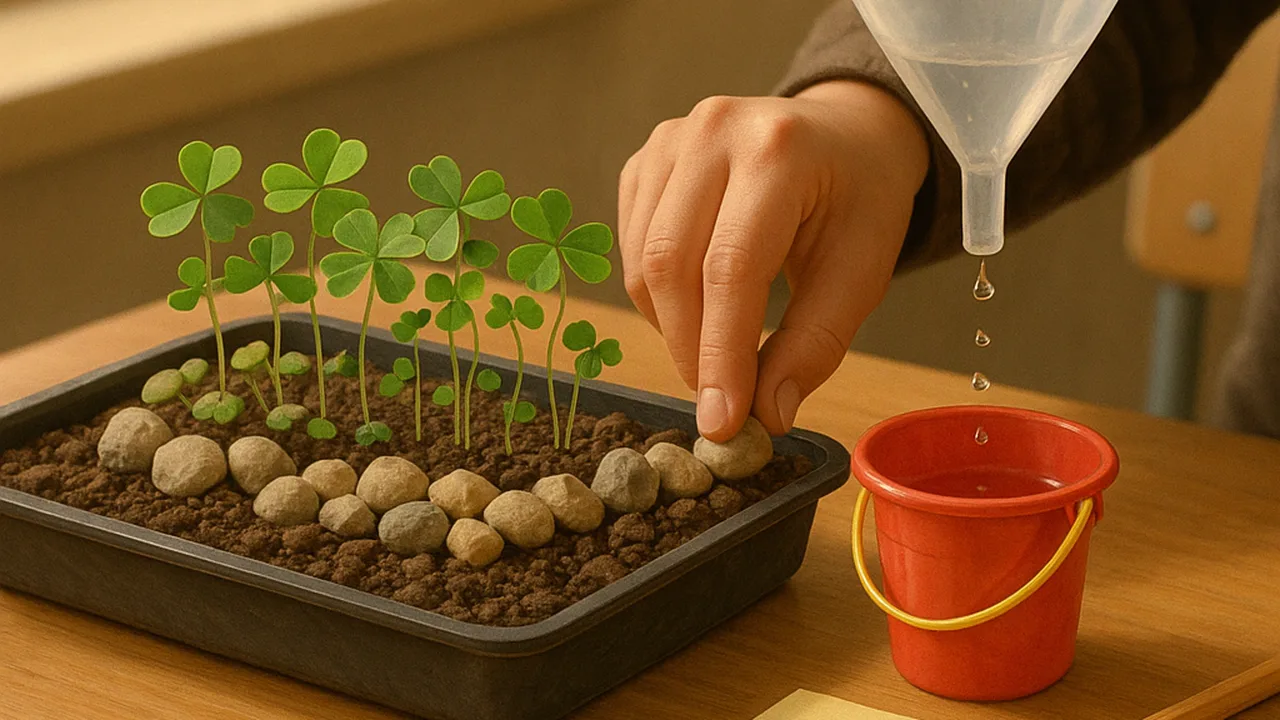
Materials: recycled cardboard, egg cartons, felt and fabric scraps, colored paper, tape, craft sticks, string, small cups and trays, soil and seed packets or plant photos for rain-garden models, window-cling paper or washable markers for bird-window samples; safety scissors; goggles.
Setup: Ask families early for recycled materials. Bird-window teams should prototype on a plastic sheet or a small practice pane, not the real window, until the principal approves.
Listen for: teams that skip the matrix and pick the “coolest” idea. Ask them to show the scores.
Support / stretch: Pre-cut materials for students who need it. Stretch: ask a team to add a second criterion to its matrix that they had missed.