4.02 Clue Hunt: Is Our Land Changing?
Hillside Heroes: A Safety Plan for a River-Valley Town
How does Earth’s surface change, and how can our community stay safe when it does?
The mystery: After heavy rain, soil slides down steep hillsides in hilly cities and river-valley towns, and the rivers run brown with mud.
find clues that the land near me has changed, sort our Wonder Board into things to investigate, and get ready to work in a team.
- I can point out which parts of my explanation about landscape changes I need to support with evidence.
- I can identify what we are investigating, including how weathering or erosion changes Earth materials.
Phase 1: Spark
Warm-Up ~5 min
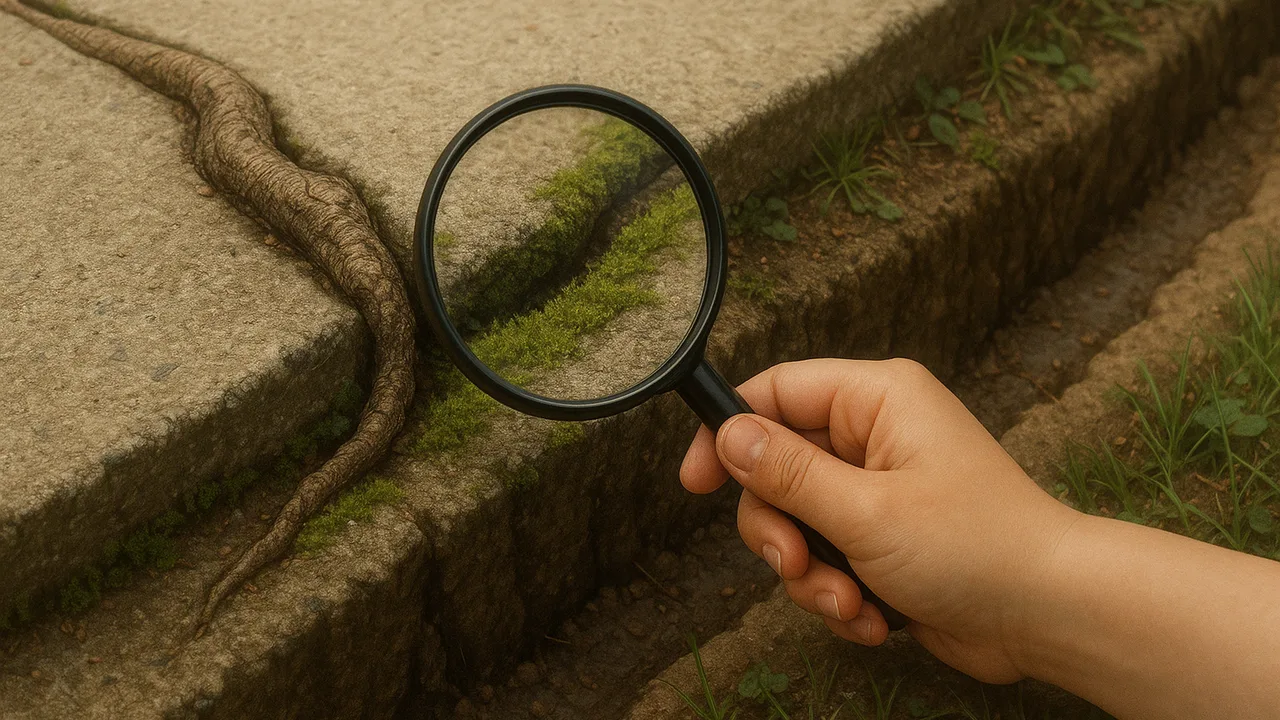
Do Now. Look at this short list of things you might see near school: a pothole, a crack in a rock with a weed growing in it, a pile of sand at the bottom of a hill, a smooth round pebble in a creek. Which one is the best clue that the land changed?
A rock has a crack, and a small plant is growing in it. What will probably happen to the crack over many years?
Instruction ~10 min
Junior engineers, scientists start with clues. A clue is something we can see that hints at what happened. A pile of sand at the bottom of a hill is a clue. It hints that water carried the sand down. But a clue is not proof yet. We need to test our ideas and collect evidence.
Which parts need evidence? Suppose Diego says, “Water carried this sand down the hill during a storm.” His idea has parts. “Water moved it” needs evidence. “During a storm” needs evidence too. Good scientists point to each part and ask, “How do we know?”
Worked example 1: the pothole. Ava sees a pothole in late winter. Her idea: “Ice broke the road.” What does she need to show? First, that water got into a crack. Second, that the water froze. Third, that freezing made the crack bigger. Each part is a thing we can investigate.
Worked example 2: the round pebble. Malik finds a smooth, round pebble in a creek. His idea: “Rocks get rounder when they tumble in water.” The part that needs evidence is the tumbling. We could shake rocks in a jar to test it.
Sorting our Wonder Board. We will sort our questions into four groups: Water and slopes, Ice and shaking, Rocks and fossils and Maps and patterns. Each group becomes an investigation in the next phase.
How we will work. Each team has four rotating roles. The Materials Manager gets and returns supplies. The Recorder writes data. The Tester runs the tests. The Reporter shares with the class. You will switch roles each lesson, so everyone tries every job.
Guided Exercises ~15 min
Take a short clue walk around the school grounds, or use the photo cards. The Recorder fills in this table.
| Clue we saw | Where | What we think happened | Part that needs evidence |
|---|---|---|---|
Then work through the questions with your team.
Independent Practice ~10 min
Get ready for the Investigate phase.
Write the question your team most wants to investigate. Then write what you think is changing the land, and how you could watch it happen in a model.
Closure ~5 min
We found clues and turned our questions into investigations. Next, we build a model hillside and make it rain.
Exit ticket: name one clue that the land changed. Which part of your idea about it still needs evidence?
Teacher notes
Materials: clipboards, the clue table, the Wonder Board sticky notes from 4.01, four chart-paper headings, role cards. Backup: 6–8 photo cards (pothole, cracked rock with plant, sand fan, creek pebbles, gully, exposed roots) if weather keeps you inside.
Setup: Walk the route first and note 3–4 safe clues. Form teams of four and assign the first round of roles.
Listen for: students treating a clue as proof. Ask, “How could we check that?” Give only the short meaning of weathering today; save the full ideas of weathering and erosion until students have explored.
Support / stretch: Give a sentence frame: “I think ___ happened because I see ___.” Stretch: ask students to sort clues into fast and slow changes.