3.13 Borrow It, Build It
pick my team’s best nature-inspired idea, sketch it with labels, and explain which structure it borrows and why we will test it.
- I can use evidence to explain how inside and outside parts of plants and animals have special jobs.
- I can explain how these parts help plants and animals survive, grow, act, or make more of their kind.
- I can show how different parts work together as a system to help plants and animals live and grow.
- I can describe the limits on my design, such as how much it costs, what materials I can use, or how much time I have.
- I can explain the purpose of my investigation, including how I will find problems or failure points in my model or prototype to help make it better.
Phase 4: Build
Warm-Up ~5 min
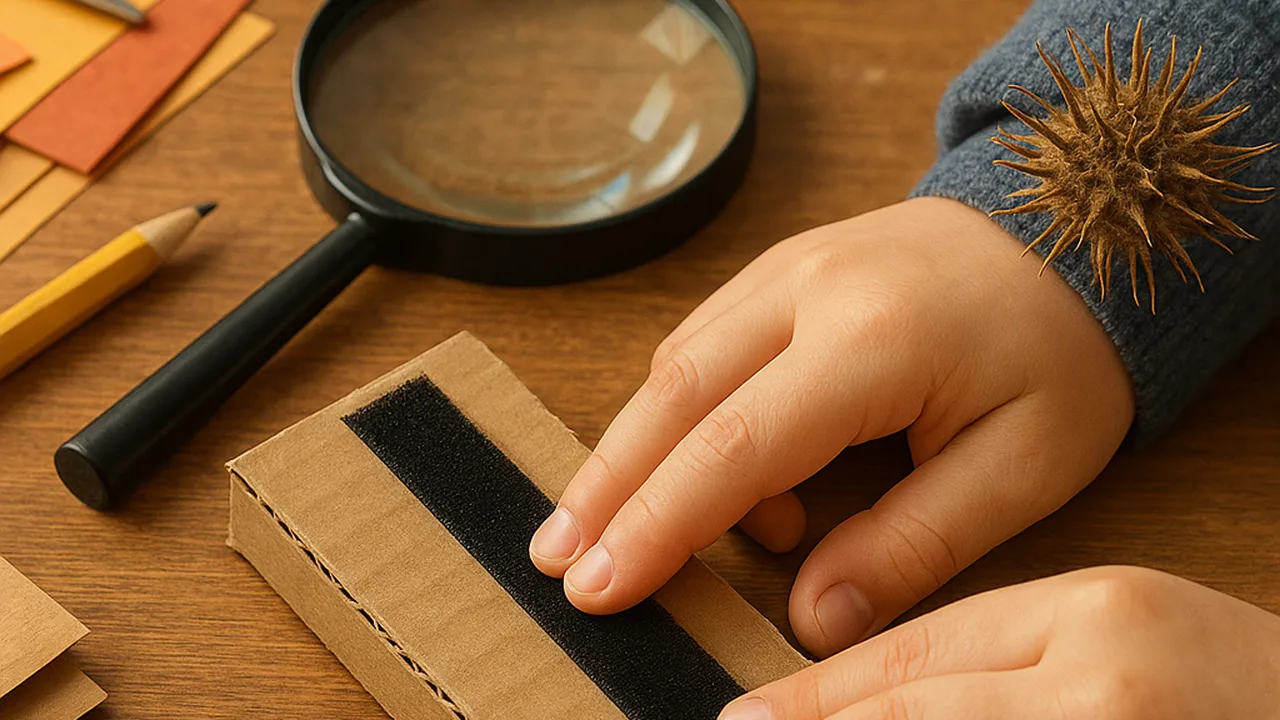
Do Now. Have you ever used shoes, a jacket, or a backpack with a strap that rips open and sticks shut? Rub your finger on both sides of a hook-and-loop strip. What does each side feel like?
Where do you think the idea for hook-and-loop straps came from?
Instruction ~10 min
Junior engineers, welcome to the Build phase. A prototype is an early model of an invention. It does not have to be perfect. It has to show your idea and let you test it. Over the next lessons, your team will plan, build, test, and improve one prototype for the nature center.
Step 1: pick one idea. Look at your three brainstorm ideas from Make Sense. Pick the one that best meets our criteria. Does it borrow a real structure? Does it solve a human problem? Can a visitor get it in one minute?
Step 2: sketch and label. Draw your invention. Label the part that copies nature. Write the plant or animal it came from. Then write the job that part does for the living thing.
Worked example 1: the Burr Bag Clip. Malik’s team borrowed the burr’s tiny hooks. Their problem: snack bags spill open in backpacks. They plan to bend short pieces of pipe cleaner into hooks and tape them to one strip of cardboard. On the other strip they will glue yarn loops. Pressed together, the strips should hold the bag shut. Their label says: “Borrowed from burdock burrs. Hooks grab loops, like burrs grab fur.”
Worked example 2: the Owl Quiet Fan. Ava’s team borrowed the owl’s soft feather edges. Their problem: a noisy fan blade. They plan two paper blades. One has a straight edge. One has a soft, fringed edge cut like a comb, with felt on top. They will wave both and listen.
Step 3: why we test. Engineers do not test to prove they are right. They test to find failure points. A failure point is a spot where the design does not work yet. Finding it early tells you what to fix. So every team will ask: “Where might our design break, slip, or confuse someone?”
Remember our limits.
- Criterion: it borrows one real structure from a plant or animal.
- Criterion: it solves a real human problem.
- Criterion: a visitor can understand it in one minute.
- Constraint: it fits on a desk.
- Constraint: it uses free or cheap classroom materials.
- Constraint: we have two class periods to build: Prototype Day and Revise Day.
Guided Exercises ~15 min
Plan with your team. Use the arrows to move through each step. The Recorder writes, and everyone helps think.
Independent Practice ~10 min
On your own, connect your idea back to nature.
The structure you borrowed works with other parts of the plant or animal. Name one other part it works with, and explain how they work together to help the living thing survive or reproduce.
🔎 Mini case study: How a Dog Walk Led to Velcro ~5 min
George de Mestral was an engineer from Switzerland. One day he came home from a walk in the woods with his dog. Burrs were stuck all over his clothes and his dog’s fur. Instead of just pulling them off, he got curious. He looked at a burr under a microscope.
He saw that the burr was covered in tiny hooks. The hooks caught on anything with loops, like fur or the threads in cloth. He had an idea. What if people could make a fastener with hooks on one side and loops on the other?
Making it was not easy. He spent years testing materials and ways to make tiny hooks. He finally found that nylon worked well. He named his invention Velcro. Today hook-and-loop fasteners are on shoes, jackets, bags, and much more. The burr’s job is to spread seeds. De Mestral borrowed that same structure to hold things together.
Think about it: Which burr structure did de Mestral copy, and how is its job in the invention like its job for the plant?
Closure ~5 min
Your team picked an idea and drew a plan. Like de Mestral, you looked closely at nature and borrowed a structure. Next time, you will plan a fair test for every criterion.
Exit ticket: finish this sentence. “Our invention borrows the ____ from the ____, which helps the ____ ____. In our invention, it helps people ____.”
Teacher notes
Materials: teams’ brainstorm lists from Make Sense; a strip of hook-and-loop tape for the warm-up; sketch paper; a sample materials bin (cardboard, pipe cleaners, yarn, felt, paper, craft sticks, tape, glue sticks).
Setup: About 15 minutes to choose and sketch, 10 minutes for the materials list, 5 for the case study. Post the criteria and constraints. Teams keep their sketch in a project folder for the rest of the unit.
Listen for: inventions that only look like an animal (an “owl-shaped lamp”) instead of borrowing a structure’s function. Ask: “Which part does a job, and what job?” Also listen for “we test to show it works.” Reframe: we test to find what does not work yet.
Support / stretch: Offer the two worked examples as starter kits for stuck teams. Stretch: ask teams to name a second structure that could make their invention better.