4.10 Break It, Move It, Drop It
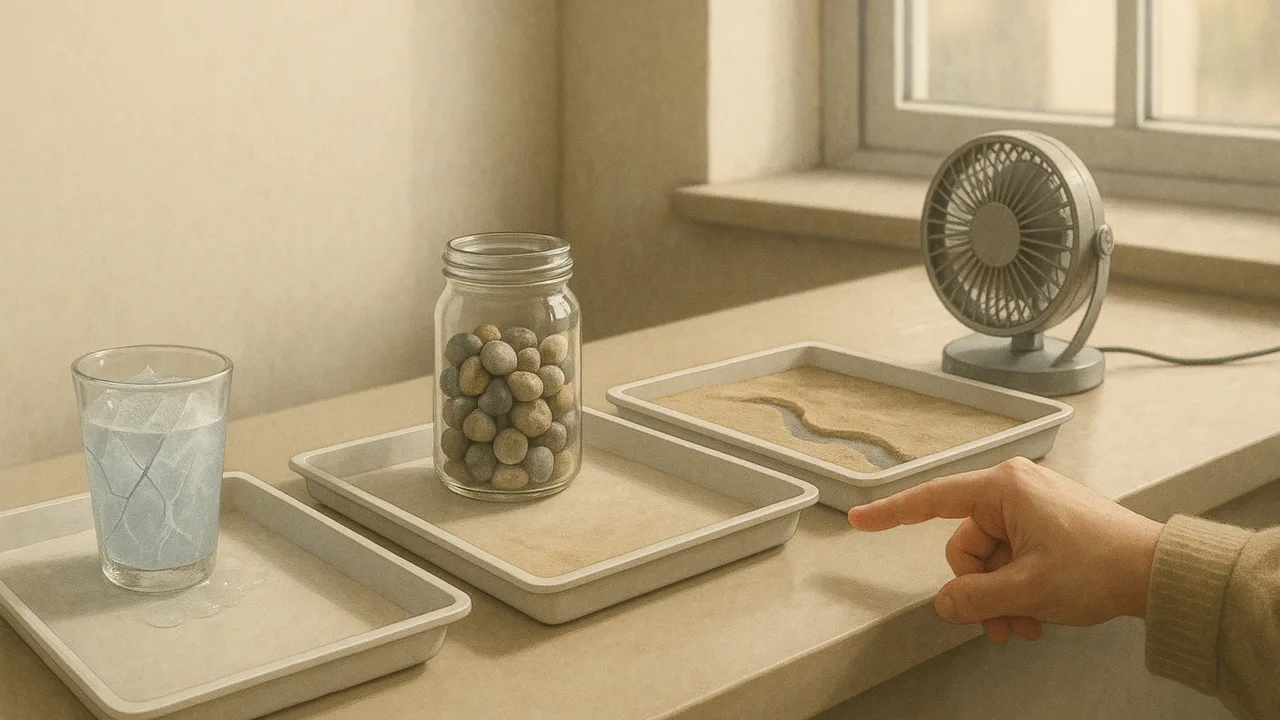
use my data from ice, shaking, water and wind to explain weathering and erosion, and show them in a model.
- I can make and record observations to show how weathering or erosion changes rocks, soil, or sediment.
- I can explain how the data we collect will help us find cause and effect relationships between weathering or erosion and changes to Earth materials.
Phase 3: Make Sense
Warm-Up ~5 min
Do Now. Open your notebook to your freeze-and-thaw log. Compare the wet bag with the dry bag after the last cycle.
What changed more, the wet chips or the dry chips? Give one number or observation from your log.
Instruction ~10 min
Now we name what we saw. You ran five investigations. In each one, Earth materials changed. Scientists sort these changes into two big ideas.
Weathering breaks rock. Weathering is when rock breaks into smaller pieces. The pieces stay in about the same place. Ice is one cause. Water gets into a crack and freezes. Ice takes up more space, so it pushes the crack wider. After many cycles, pieces break off. Plant roots do this too as they grow. Bumping and rubbing also weather rock. That is what happened to our sugar cubes.
Erosion moves the pieces. Erosion is when water, wind, ice or gravity carry rock and soil to a new place. Our pan hills lost soil to running water. Our wind box lost sand to moving air. Faster water and faster wind moved more material and bigger pieces. Steep slopes made water run faster. Plant roots held soil in place.
Deposition drops them. Moving water and wind slow down sooner or later. When they slow, they drop what they carry. That is deposition. The mud fan at the bottom of our pans was deposition. So was the sand piled against the craft sticks.
Worked example 1: a model. Mei draws a flow chart. Box 1: “Ice cracks a rock on a hilltop (weathering).” Arrow. Box 2: “Rain carries the pieces downhill (erosion).” Arrow. Box 3: “The pieces settle in the river (deposition).” Her model shows the whole path.
Worked example 2: a CER. Jamal writes: Claim: “Freezing and thawing weathers rock.” Evidence: “After four cycles, our wet chips had more crumbs and new cracks. The dry chips did not.” Reasoning: “Water in the cracks froze and grew, so it pushed the rock apart. The dry chips had no water to freeze.”
Guided Exercises ~15 min
Sort each result from our investigations. Then build your team’s model.
| Investigation | What changed | Weathering, erosion or deposition? | Cause |
|---|---|---|---|
| Pan hill (4.03–4.04) | |||
| Freeze and thaw (4.05) | |||
| Shake jar (4.06) | |||
| Stream table and wind box (4.07) |
CER starters: Claim: “___ changes Earth materials by ___.” Evidence: “In our test, we saw ___.” Reasoning: “This happens because ___.”
Independent Practice ~10 min
Make your own model.
Draw a three-box flow chart for a rock on a hill above our client's town. Show weathering, erosion and deposition. Label the cause in each box.
weathering
Tap to revealbreaking rock into smaller pieces
erosion
Tap to revealcarrying rock and soil to a new place
deposition
Tap to revealdropping the pieces when water or wind slows
freeze and thaw
Tap to revealice grows in cracks and pushes rock apart
plant roots
Tap to revealhold soil in place, but can also crack rock
Closure ~5 min
Break it, move it, drop it: that is how water, ice and wind reshape the land. Next, we explain what rock layers tell us about long ago.
Exit ticket: explain the difference between weathering and erosion. Give one example of each from our investigations.
Teacher notes
Materials: students’ notebooks with all data tables, the freeze-and-thaw bags, chart paper for the class flow chart, CER organizers.
Setup: Post the class data from each investigation so teams with missing data can borrow it.
Listen for: mixing up weathering and erosion. A quick test: “Did it break, or did it move?” Also listen for “roots only help.” Roots hold soil, but they can also widen cracks in rock.
Support / stretch: Give a partly filled CER. Stretch: ask students to explain how one process can lead to the next.