3.04 The Celery Challenge: How Do Plants Move Water?
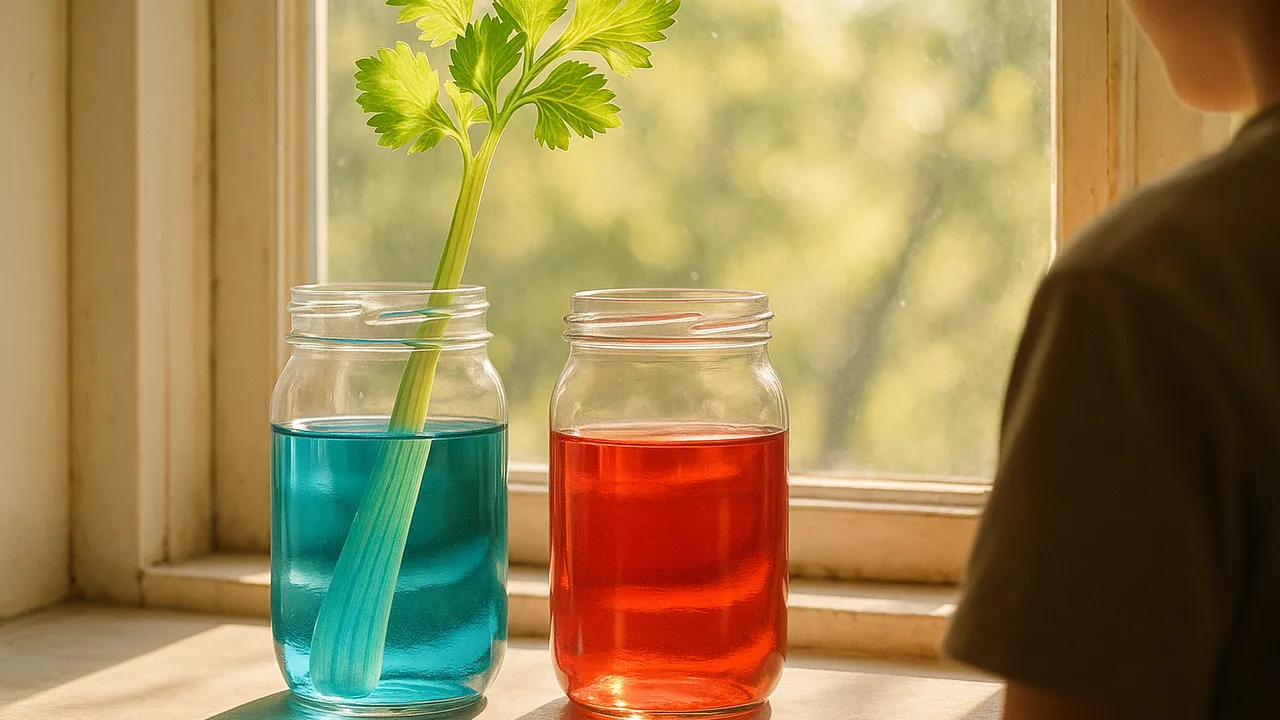
set up and observe a celery stalk in colored water to find out how roots and stems move water to a plant’s leaves.
- I can describe the inside and outside parts of certain plants and animals.
- I can explain what those parts do for the plant or animal.
- I can use evidence to explain how inside and outside parts of plants and animals have special jobs.
- I can explain how these parts help plants and animals survive, grow, act, or make more of their kind.
- I can show how different parts work together as a system to help plants and animals live and grow.
Phase 2: Investigate
Warm-Up ~5 min
Do Now. A plant on the windowsill is drooping. Someone waters the soil, not the leaves. A few hours later the leaves stand up again. How did the water get from the soil all the way up to the leaves?
We will stand a fresh celery stalk in water with blue food coloring. What will we see in a few hours?
Instruction ~10 min
Explore first. Today your team sets up the Celery Challenge. You will check it at the end of class and again next lesson. Watch closely and record what you see before we talk about why.
Setup steps.
- Fill a clear cup halfway with water.
- Add about 10 drops of blue or red food coloring and stir.
- Your teacher trims the bottom of a celery stalk with leaves still on.
- Stand the stalk in the cup right away.
- Set up a second cup with plain water and a second stalk. This one is for comparing.
Worked example 1: a careful observation. After 30 minutes, Malik looked closely. He wrote: “Colored cup: tiny streaks of blue near the bottom of the stalk. Leaves look the same. Plain cup: no change.” He wrote only what he saw, with no guesses yet. That makes his data useful later.
Now let’s name it. Plants have parts that work together like a delivery system. Roots grow in the soil and take in water. The stem holds the plant up. Inside the stem are tiny tubes that carry water up. Leaves use water, air, and sunlight to make the plant’s food. A celery stalk is really a leaf stalk, but it has the same kind of water tubes as a stem.
Worked example 2: a plant as a system. Ava drew a plant with arrows. Water goes into the roots, up the tubes in the stem, and out to the leaves. She wrote: “If the roots stop working, the leaves cannot get water. The parts need each other.” That is the big idea of a system.
| Time | Colored cup: stalk | Colored cup: leaves | Plain cup |
|---|---|---|---|
| Start | |||
| After 30 minutes | |||
| Next lesson (about a day) |
Guided Exercises ~15 min
Set up both cups, then work through these questions while you wait. Use the arrows to move through them.
Independent Practice ~10 min
On your own, draw the system.
Draw a plant with roots, a stem, and leaves. Add arrows to show how water moves. Then describe your drawing in two sentences.
Closure ~5 min
Your celery keeps working overnight. Next lesson we will cut it open and see the tubes. Then we will look at bird feathers and bones.
Exit ticket: name two plant parts that work together to get water to the leaves. What does each one do?
Teacher notes
Materials: fresh celery stalks with leaves (2 per team); clear plastic cups; blue or red food coloring; paper towels; smocks or old shirts; a knife for teacher use only.
Setup: Trim the celery bottoms just before placing them in water. Darker colors show best. Change becomes clearer after a few hours and is strong by the next day; keep the cups somewhere safe overnight for 3.05.
Listen for: “The celery drinks with a mouth” or “the water soaks up like a sponge.” Keep the language at tubes carrying water up. The words xylem and transpiration are not needed at grade 4.
Support / stretch: Give a picture word bank (roots, stem, leaves, tubes, water). Stretch: split the bottom of one stalk partway, put each half in a different color, and predict what the leaves will show.