4.14 Ideate: Our Evidence, Our Ideas
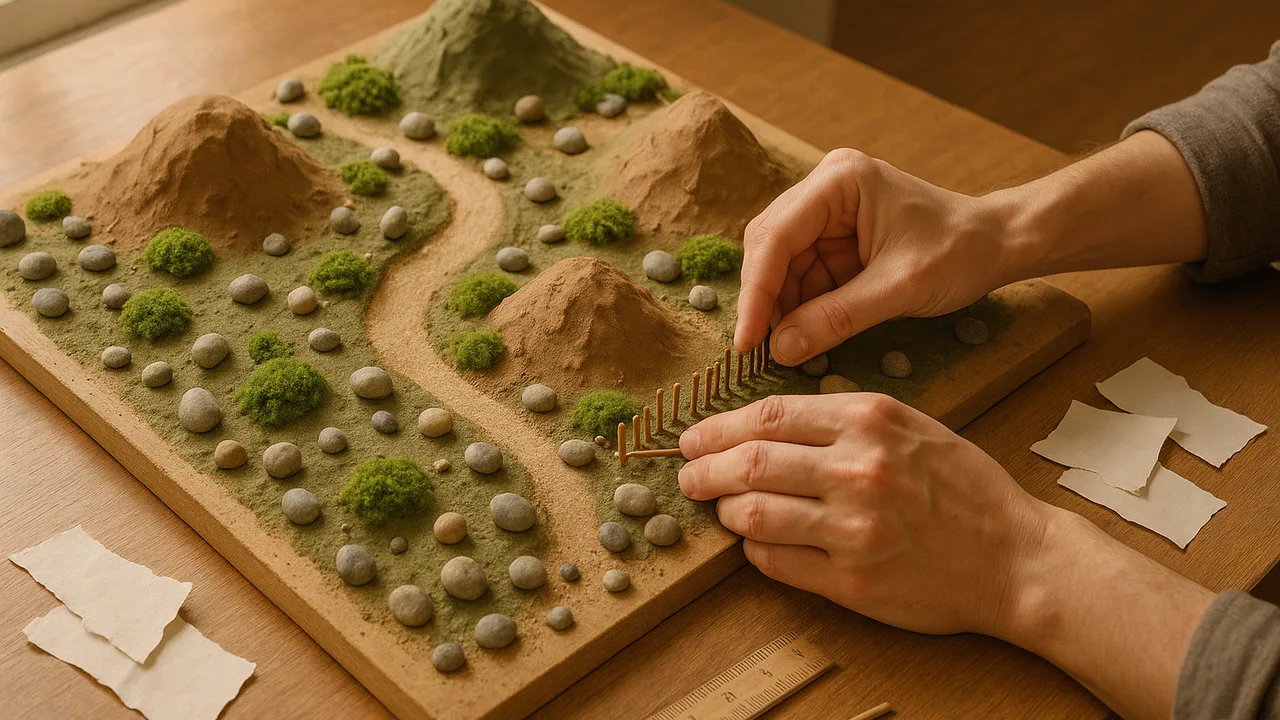
build a model that pulls together our evidence about how the land changes, and brainstorm ideas to keep the town safe.
- I can point out which parts of my explanation about landscape changes I need to support with evidence.
- I can explain how the data we collect will help us find cause and effect relationships between weathering or erosion and changes to Earth materials.
- I can use organized data to explain that Earth’s features, like mountains and volcanoes, happen in patterns that tell us how they formed or where they usually occur.
Phase 3: Make Sense
Warm-Up ~5 min
Do Now. Reread the Wonder Board. Which questions can we answer now? Put a check next to them.
Pick one Wonder Board question we can now answer. Write the answer in one or two sentences.
Instruction ~10 min
Junior engineers, time to put it all together. Our driving question has two parts. First: how does Earth’s surface change? Second: how can our community stay safe? Today we finish part one with a model. Then we start part two by brainstorming.
Our big model. Each team draws the client’s town in cross section, like a slice. Show the hill, the homes, the road and the river. Add arrows for each process: ice cracking rock at the top, rain eroding the slope, roots holding soil, sediment dropping into the river. Add rock layers under the hill, with fossils, to show the land’s long history.
Worked example 1: one arrow, one piece of evidence. Mei draws an arrow of soil sliding down the bare slope. Next to it she writes, “Evidence: the steep bare pan lost the most soil.” Every arrow on the model gets a piece of evidence. If an arrow has none, the team marks it with a question mark.
Worked example 2: from science to ideas. Jamal’s team asks, “What did the science show?” Plants held soil in our pans. So one idea is planting the bare slopes. Slower water carried less soil. So another idea is slowing the water with steps. The steep spots on the map need help most. So the plan should start there.
Brainstorm rules. Go for lots of ideas. No idea is silly yet. Build on each other’s ideas. But every idea must connect to a science fact we found. In the Build phase, you will choose, test and improve the best ones.
Guided Exercises ~15 min
Build your team’s cross-section model on chart paper. Then fill in this evidence check.
| Part of our model | Process shown | Our evidence | Still need evidence? (yes/no) |
|---|---|---|---|
| Top of the hill | |||
| Hillside slope | |||
| River at the bottom | |||
| Rock layers underground |
Independent Practice ~10 min
Answer part one of the driving question on your own.
How does Earth's surface change? Write a short explanation that uses evidence from at least two investigations: one about weathering or erosion, and one about rock layers, fossils or maps.
Closure ~5 min
Our model shows how the land changes, and our ideas are ready to test. Next: your 3DX field trip. Visit the Map Room and see Earth’s patterns up close. Then the Build phase begins.
How confident are you that you can I can explain how Earth's surface changes using evidence.
Exit ticket: which of your brainstorm ideas do you most want to build? Which science fact makes you think it will work?
Teacher notes
Materials: chart paper, markers, sticky notes for evidence labels, all notebook data tables, the Wonder Board.
Setup: Post a sample cross-section frame (hill, homes, road, river, ground below) for teams that need a start.
Listen for: brainstorm ideas with no science link (“build a giant roof over the hill”). Ask, “What did our data show that makes this work?” Save choosing and testing ideas for the Build phase in part 2 of the unit.
Support / stretch: Give a word bank (weathering, erosion, deposition, roots, slope, layers). Stretch: ask teams to rank their ideas by how well they match the evidence.