3.14 A Test for Every Criterion
plan a fair test for each criterion and constraint, naming what we change, what we measure, the tools we use, and what we keep the same.
- I can create a plan that includes different tests for each criterion or constraint of my model or prototype.
- I can describe what I will change in each test, what I will measure, what tools and methods I will use to collect data, and what I will keep the same to make the test fair.
- I can explain how the evidence I collect will help me find problems or areas to improve in my model or prototype.
- I can list the features that a solution must have to solve the problem.
Phase 4: Build
Warm-Up ~5 min
Do Now. Jamal and Mei want to know which paper airplane flies farther. Jamal throws his hard. Mei throws hers softly. Jamal’s goes farther. Is that a fair test? Talk with your team for one minute.
Can Jamal and Mei say which airplane DESIGN is better?
Instruction ~10 min
Every criterion needs a test. A criterion is something your design must do. A test is how you find out if it does it. If you skip a test, you will not know if your design meets that criterion. So we will write a test plan with one row for each criterion and constraint.
Four questions for every test.
- What do we change? Only one thing, like the edge shape or the number of hooks.
- What do we measure or observe? For example, how many shakes before the bag opens.
- What tools do we use? A ruler, a timer, a scale, or a classmate’s ears.
- What do we keep the same? Everything else, so the test is fair.
Worked example 1: the Burr Bag Clip. Malik’s criterion is “it holds the bag shut.” His test: put three crackers in a snack bag, close it with the clip, and shake it five times. He counts the shakes before it opens. He keeps the same bag, the same crackers, and the same shaker. Later, if he adds hooks, the number of hooks is the only thing he changes.
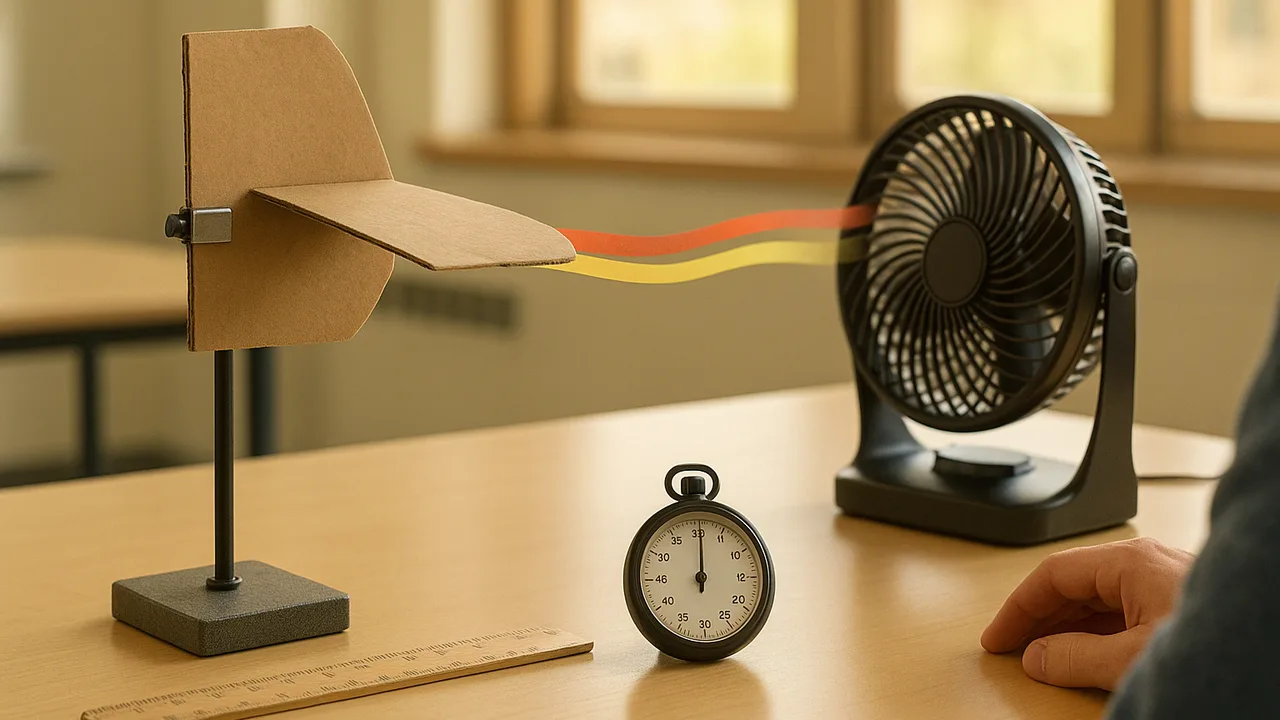
Worked example 2: the one-minute test. Ava’s criterion is “a visitor can understand it in one minute.” Her tool is a timer and a classmate from another team. She shows the fan for one minute. Then the classmate explains it back. If the classmate can name the owl structure and the problem, the test passes.
How evidence helps. Test results are evidence. If the bag opens on shake two, that evidence points to a weak spot. It tells the team where to look and what to improve. Good evidence is specific, like a number or a clear observation.
Our test plan.
| Criterion or constraint | What we change | What we measure or observe | Tools | What we keep the same |
|---|---|---|---|---|
| Borrows a real structure | ||||
| Solves a human problem | ||||
| Understood in one minute | ||||
| Fits on a desk | ||||
| Free or cheap materials |
Guided Exercises ~15 min
Write your test plan with your team. Use the arrows to move through each step.
Independent Practice ~10 min
On your own, check a plan.
Priya's plan says: “Test: see if it works.” Rewrite her plan so it says what she changes, what she measures, her tools, and what she keeps the same.
How confident are you that you can I can plan a fair test for each criterion of my design.
Closure ~5 min
Your team now has a plan with a test for every criterion. Next time, it is time to build!
Exit ticket: list our three criteria. Next to each one, write one word for what you will measure or observe.
Teacher notes
Materials: test-plan copies (one per team); paper airplanes for the warm-up demo (optional); snack bag, crackers, and a timer to model the Burr Bag Clip test.
Setup: Model one row together, then let teams finish. Keep measures simple and countable: shakes, seconds, yes/no, or listener votes. No units or calculations are needed.
Listen for: tests that change several things at once; “measure” entries that are opinions (“it looks good”); and teams that forget the constraints. Ask: “How will you KNOW?”
Support / stretch: Give a partly filled plan with the “keep the same” column started. Stretch: plan a second trial for each test and explain why repeating a test makes the evidence stronger.