3.07 The Mystery Box: Touch, Smell, and Memory
use touch and smell to identify mystery objects and explain how the brain uses memory to decide what something is and what to do.
- I can explain how different sense receptors pick up certain types of information from the environment and send it to the brain.
- I can describe how the brain uses information from sense receptors to help animals notice things right away or remember them for later.
- I can show how what animals sense and remember affects how they act or respond to things around them.
- I can use a model to explain how information from the environment goes through the brain and affects what animals do.
- I can describe how different senses send information to the brain, and how animals use what they sense and remember to make choices, like picking which fruit to eat.
- I can show that sensory input, the brain, and actions are all parts of a system that helps animals behave in ways that fit their surroundings.
Phase 2: Investigate
Warm-Up ~5 min
Do Now. Think of a smell that reminds you of something, like popcorn at the movies or cut grass in summer. Why do you think a smell can bring back a memory so fast?
Quick check from last time: in the ruler drop, which part decided when to pinch?
Instruction ~10 min
Explore first. Today there are two stations. At each one, guess first, then explain how you knew.
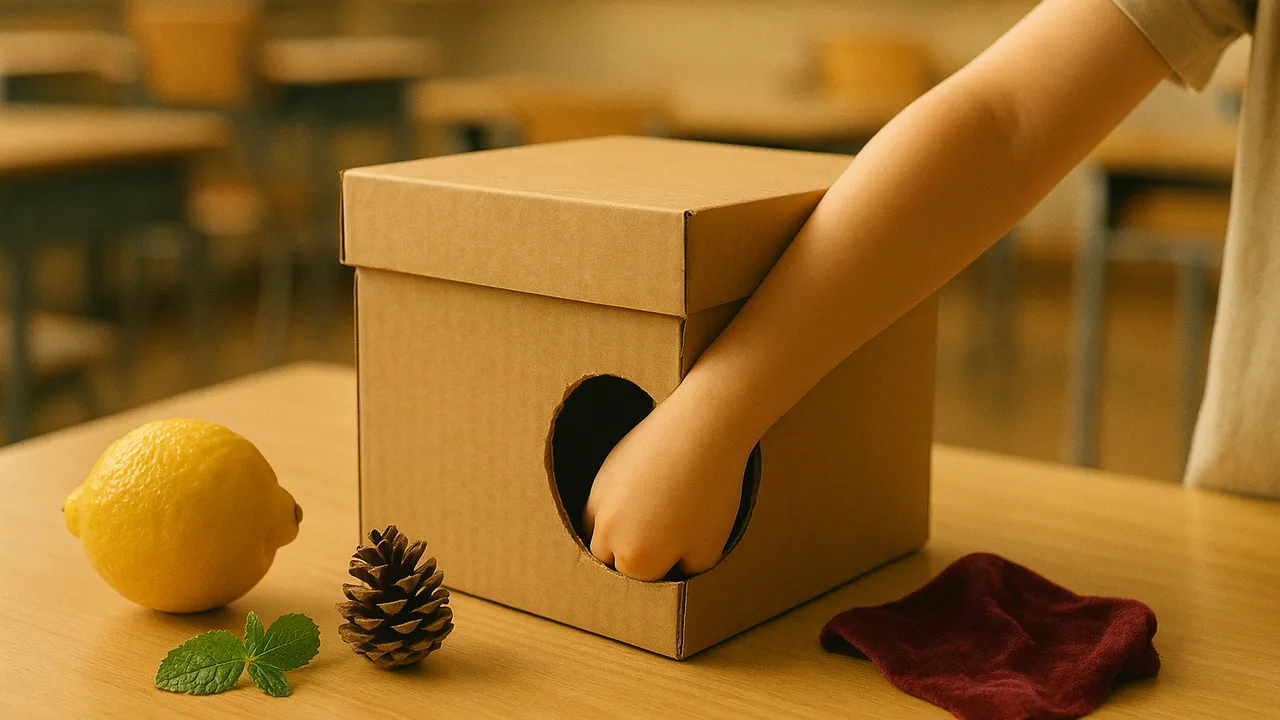
Station 1: Mystery box. Reach into the box through the hole. Do not peek! Feel each object. Is it smooth, bumpy, soft, hard, heavy, or light? Say your guess. Your Recorder writes your guess and the clues you used.
Station 2: Smell jars. Each jar has a cotton ball with a kitchen smell, like lemon, cinnamon, or vanilla. Hold the jar a little away. Use your hand to wave the air toward your nose. Do not stick your nose in the jar. Guess the smell and write what it reminds you of.
Worked example 1: the walnut. Jamal reaches into the box and feels an object. He says, “Round, hard, and bumpy. I think it is a walnut.” He was right. His fingertips picked up the shape. His brain compared it to things he remembered. Then he answered out loud. The steps were: sense → brain and memory → act.
Now let’s name it. The brain does two jobs with sense messages. Sometimes it acts right away, like pulling your hand off a hot pan. Sometimes it stores the information as a memory to use later. Next time you meet the same thing, the brain compares the new message to the memory. That helps you know what it is and how to act.
Worked example 2: an animal uses memory. A black bear smells food from far away. Its nose has a great many smell receptors. Its brain may remember that this smell came from a bird feeder or a trash can before. So the bear walks toward it. That is why people in bear country are asked to take down bird feeders and lock up trash. When bears cannot find food there, they are less likely to come back.
| Station | Object or smell # | My guess | Clues my senses gave | What it reminded me of | Was I right? |
|---|---|---|---|---|---|
| Mystery box | |||||
| Mystery box | |||||
| Mystery box | |||||
| Smell jar | |||||
| Smell jar | |||||
| Smell jar |
Guided Exercises ~15 min
Finish both stations. Then use these questions to talk with your team. Use the arrows to move through them.
Independent Practice ~10 min
On your own, apply it to an animal.
A dog hears the sound of its food bag and runs to the kitchen. Explain how the dog's senses, brain, and memory work together to cause this response.
Closure ~5 min
Your brain is a memory bank. It uses what you sensed before to help you act now. Next time we will meet forest animals in our region and see how their bodies and senses help them survive.
Exit ticket: name one sense you used today. Explain how your brain used a memory to help you identify something.
Teacher notes
Materials: a shoebox with a hand-sized hole and a cloth flap; safe objects (walnut in shell or a pinecone, sponge, rubber ball, wooden block, spoon); small lidded jars with cotton balls and kitchen extracts or spices (lemon, vanilla, cinnamon, peppermint).
Setup: Check allergy plans; swap the walnut for a pinecone if there is a nut allergy. Number the objects and jars. Two stations of about 10 minutes, then name the ideas together.
Listen for: “My nose knew it was lemon.” Push for the brain’s role: the nose sends the message and the brain recognizes it. Also listen for the idea that memory only matters for people. Animals learn and remember too.
Support / stretch: Offer a texture word bank (rough, smooth, bumpy, soft, hard). Students sensitive to smells can do the box only. Stretch: ask students to design a fair test to find whether people guess objects better by touch or by smell.