3.17 Critique Circle: I Like, I Wonder, What If
give and use kind, specific feedback to find the parts of a prototype that do not yet meet our criteria or constraints.
- I can describe how I will collect evidence about how well my model or prototype meets the criteria and constraints.
- I can identify and describe specific parts of my model or prototype that do not meet the criteria or constraints.
- I can explain which parts of my model or prototype could be improved to better meet the criteria and constraints.
- I can explain how the evidence I collect will help me find problems or areas to improve in my model or prototype.
Phase 4: Build
Warm-Up ~5 min
Do Now. Read these two comments about a drawing. Comment A: “It’s good.” Comment B: “I like how you labeled the hooks. I wonder if the tape will hold when it gets wet.” Which comment helps the artist more?
Why does Comment B help more?
Instruction ~10 min
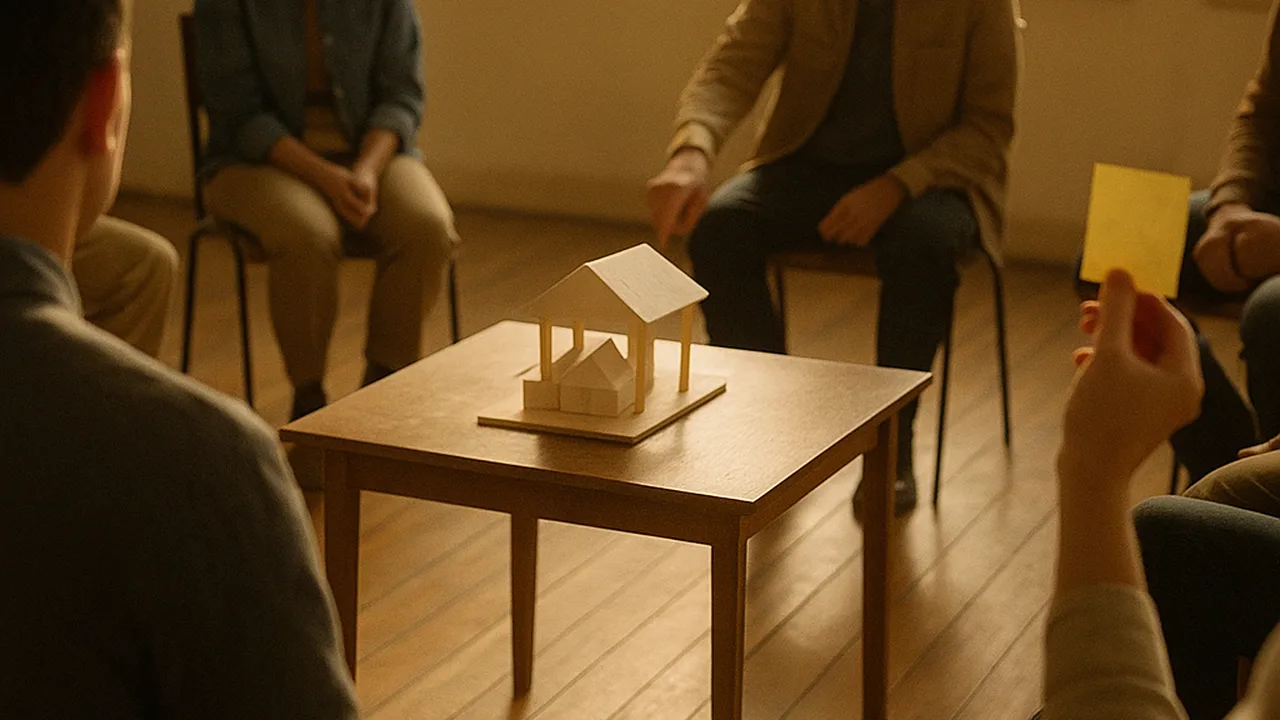
Engineers share early. Other eyes catch problems you miss. Today, two teams pair up. Each team shows its prototype and test plan for two minutes. Then the other team gives feedback. Then you switch.
The three starters.
- I like… names something that works well.
- I wonder… asks about a part that might not meet a criterion or constraint.
- What if… offers one idea to make it better.
Be kind, be specific, and be helpful. Talk about the design, not the people.
Worked example 1: feedback for the Owl Quiet Fan. Jamal’s team said: “I like how the fringe looks like a real owl feather. I wonder if visitors will know it is about owls. What if you add a picture of the feather?” The “I wonder” points to one criterion: a visitor can understand it in one minute.
Worked example 2: feedback for the Burr Bag Clip. Priya’s team said: “I like that it really holds. I wonder if the long strip is too big for a small bag. What if you cut it in half?” That points to a constraint and a specific part: the strip length.
Sort the feedback. After critique, your team sorts every comment into the table. Which criterion or constraint does it connect to? Which part of the prototype? Then circle the one change that matters most.
| Feedback we got | Criterion or constraint it connects to | Part of our prototype | Change it might lead to |
|---|---|---|---|
| I like… | |||
| I wonder… | |||
| What if… |
Guided Exercises ~15 min
Run the critique circle with your partner team. Use the arrows to move through each step.
Independent Practice ~10 min
On your own, decide what matters most.
Your team got three ideas. Which ONE change should you make first? Explain which criterion it will help your prototype meet.
Closure ~5 min
Your team now knows which part to fix first. Next time, you will run a quick trial to find the failure points for sure.
Exit ticket: write the most helpful comment your team got today. Why was it helpful?
Teacher notes
Materials: prototypes and test plans; feedback tables; sticky notes; a timer.
Setup: Reteach the weakest 3.16 item first (5 minutes). Pair teams with different structures. Run two 2-minute shares, 3 minutes of feedback each, then 10 minutes to sort feedback. Post the starters.
Listen for: feedback that is only “I like it,” and teams that get defensive. Model accepting feedback: “Thanks, we will test that.” Push every “I wonder” to name a part and a criterion.
Support / stretch: Give sentence-stem cards. Let quieter students write feedback on sticky notes. Stretch: ask teams to rank all feedback by which change would help the most criteria.