4.07 Wind and Water Shape the Land
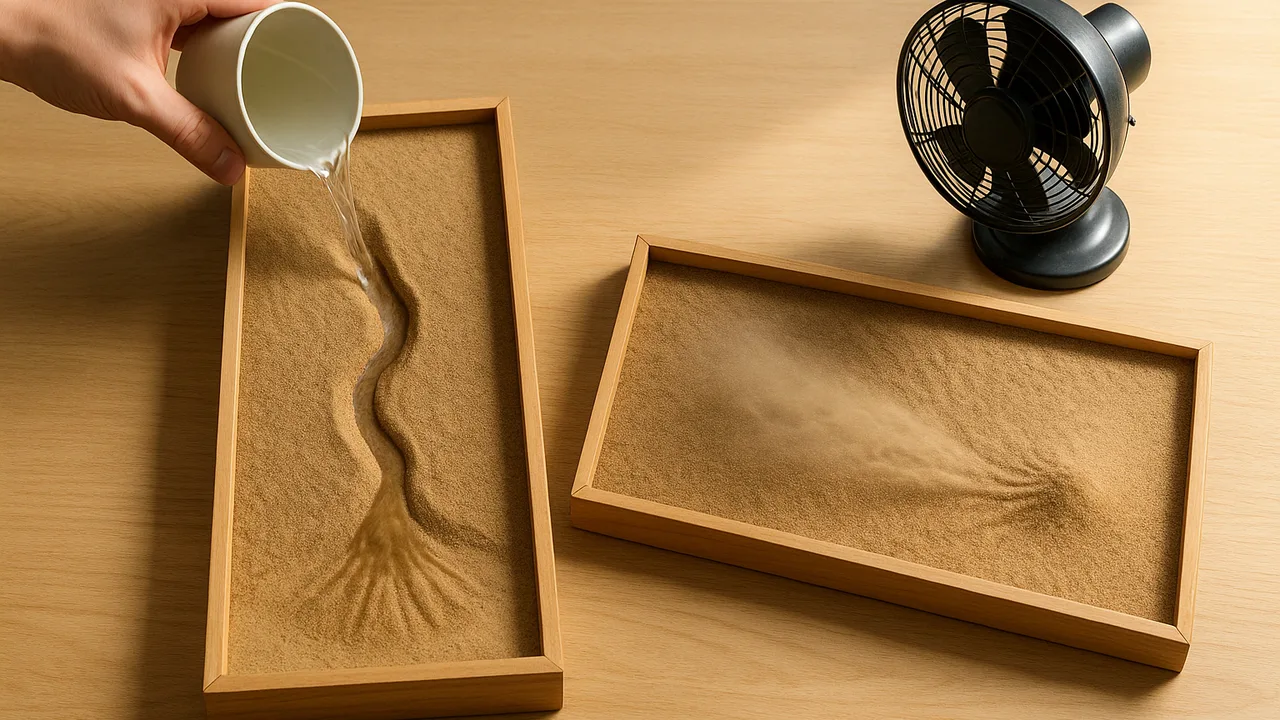
test how the speed of moving water and moving air changes how far and how much sand and soil travel.
- I can describe how we will collect data about the speed of air or water flow.
- I can describe how we will count cycles of freezing and thawing, and the number and types of plants in the Earth material.
- I can describe how we will measure the amount or size of soil, sediment, or rocks moved or broken down by weathering or erosion.
- I can explain how the data we collect will help us find cause and effect relationships between weathering or erosion and changes to Earth materials.
- I can make and record observations to show how weathering or erosion changes rocks, soil, or sediment.
Phase 2: Investigate
Warm-Up ~5 min
Do Now. Think about a windy day at a sandy playground or a beach. What moves? What stays put?
Fast water and slow water flow over the same sand and pebbles. What will fast water do?
Instruction ~10 min
Junior engineers, two stations today. Teams rotate. Explore first, record what you see, and we will talk at the end.
Station 1: the stream table. A long tray holds a mix of sand and small pebbles. One end is raised on a book. Pour water from a cup with holes in the bottom. A cup with 1 hole makes slow flow. A cup with 4 holes makes fast flow. To measure water speed, time how many seconds the water takes to reach the end of the tray. Fewer seconds means faster water. Then look at what moved.
Station 2: the wind box. A shallow box holds dry sand in a smooth layer. A small fan sits 20 centimeters away. Run it on low for 10 seconds, then reset the sand and run it on high for 10 seconds. Measure, with a ruler, how far the sand moved. Then stand a row of craft-stick “plants” in the sand and try high again.
Worked example 1: water data. Diego’s team times slow flow at 12 seconds and fast flow at 5 seconds. The slow water made a thin channel and moved sand. The fast water cut a wide channel and rolled pebbles. Faster water caused more erosion.
Worked example 2: wind data. Mei’s team measures sand that moved 3 cm on low and 11 cm on high. With the craft-stick row, sand piled up against the sticks. Faster wind moved sand farther. A barrier slowed it down.
Look for shapes. At the low end of the stream table, sand may spread out in a fan. In the wind box, sand may pile into small hills like dunes.
Guided Exercises ~15 min
Record both stations. Keep everything the same except the speed.
| Station | Setting | Speed measure | How far or how much moved | Biggest piece moved |
|---|---|---|---|---|
| Water | 1-hole cup (slow) | ___ seconds | ||
| Water | 4-hole cup (fast) | ___ seconds | ||
| Wind | Fan on low | low | ___ cm | |
| Wind | Fan on high | high | ___ cm | |
| Wind | High + stick barrier | high | ___ cm |
Independent Practice ~10 min
Use the stations to think about our town.
After a big storm, the river by our client's town runs fast and muddy. Use today's data to explain why it carries so much sediment.
The craft-stick row slowed the wind. What could play the same role on a real hill or field?
Closure ~5 min
Moving water and moving air both carry Earth materials. Faster flow carries more. Next, we dig into rock layers to see what moving water left behind long ago. Log your freeze-and-thaw cycle!
Exit ticket: finish the sentence with your data. “When the water or wind got faster, ____.”
Teacher notes
Materials: Station 1: a long plastic tray or under-bed box, sand mixed with small pebbles, a book, two paper or plastic cups (one with 1 hole, one with 4 holes, made with a pencil), a bucket of water, a timer, a catch tub. Station 2: a shallow box, dry play sand, a small battery or desk fan with low and high settings, a ruler, craft sticks, goggles for every student at the station.
Setup: Set the fan behind a line taped 20 cm from the sand. Keep the stream table far from the fan. Rotate stations halfway through.
Listen for: “wind only matters in deserts.” Wind moves soil from bare fields and construction sites, too. The worked-example numbers are for practice only.
Support / stretch: Give a timer job to a student who needs a clear role. Stretch: test a third water speed and make a bar graph.