4.23 The Habitat Plan: Tracing Energy and Matter
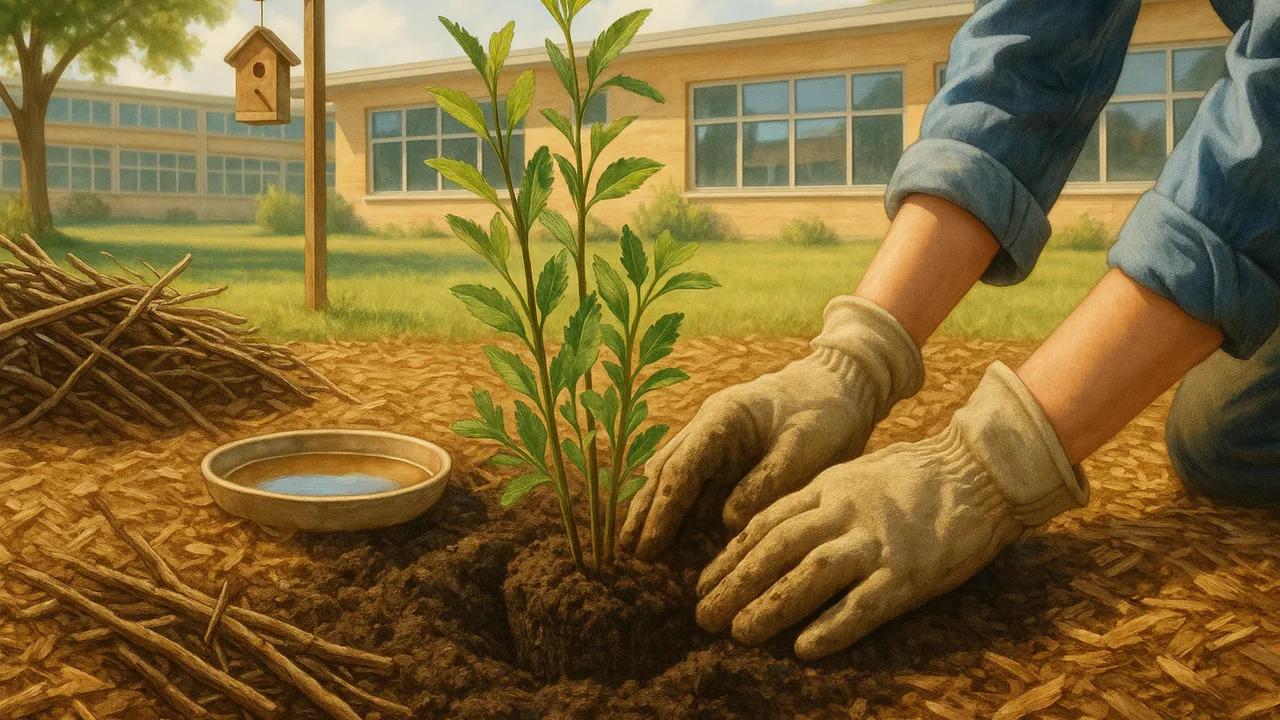
design a habitat improvement plan and model how energy flows and matter cycles through the schoolyard ecosystem it creates.
- I can develop a model that shows producers, consumers, and decomposers in an ecosystem.
- I can include nonliving parts like water, minerals, and air in my model to show how they provide or receive matter.
- I can identify where energy is present in my ecosystem model.
- I can describe how energy enters and leaves the ecosystem in my model.
- I can show how matter and energy move among producers, consumers, and decomposers in my model.
- I can explain how organisms use matter from nonliving parts of the ecosystem and how matter moves between living and nonliving parts.
- I can use my model to track how atoms cycle repeatedly between living and nonliving parts of the ecosystem.
- I can use my model to show that matter and energy are conserved as they move within and outside the ecosystem.
Phase 4: Build
Warm-Up ~5 min
Do Now. A fallen log in the woods slowly disappears over a few years. Where does all of that wood go?
Where does the matter in a rotting log end up?
Instruction ~10 min
Station engineers, now you design the habitat plan. The green team has four options: bird feeders, a bed of native plants, a brush pile and a shallow water dish. A strong plan meets the needs of at least three species and keeps the ecosystem running on its own as much as possible.
Energy flows; matter cycles. Energy enters as sunlight. Producers such as native plants capture it and store it in food. Consumers such as caterpillars, birds and hawks get energy by eating. At each step most energy leaves as heat, so energy flows through and out. Matter is different. The atoms in leaves, seeds and bodies are passed along, then decomposers return them to soil, water and air. Plants reuse them. Matter cycles and is conserved.
Worked example 1: one food chain in the plan. Native flowers → caterpillars → chickadees → a hawk. Sunlight powers the flowers. When the chickadee eats a caterpillar, some atoms build the bird’s body and some energy keeps it warm, lost as heat. Droppings, fallen leaves and dead animals go to decomposers in the brush pile, and the soil gets those atoms back.
Worked example 2: predicting interactions. Priya’s team adds a seed feeder. They predict more competition at the feeder, and a hawk may start hunting there. So they place the feeder near the brush pile, which gives small birds shelter to escape to. They also note a limitation: their model cannot predict exactly which species will show up.
Defining the boundary. The model’s boundary is the schoolyard habitat zone. Birds fly in and out, and sunlight and rain cross the boundary, so the model shows those as inputs and outputs.
Guided Exercises ~15 min
Design your team’s habitat plan, then draw its energy-and-matter model.
| Plan feature | Species it helps | Resource it provides | Interaction it may cause |
|---|---|---|---|
| Feeder | |||
| Native plants | |||
| Brush pile | |||
| Water dish |
Independent Practice ~10 min
Explain your plan with evidence.
Write a CER. Claim: our habitat plan will support at least three species. Evidence: use your count data and resource needs. Reasoning: explain using resources, interactions and energy and matter. Starters: “Our plan provides…” “The data show…” “This matters because…”
Closure ~5 min
Instruments built, habitat planned. Next we test the whole station for two weeks.
Exit ticket: trace one carbon atom from the air, into a native plant, through a caterpillar and a bird, and back to the soil. Name each step.
Teacher notes
Materials: schoolyard map, plan template, colored pencils, a list of native plants from your local extension office or native plant society, gloves for any site visit.
Setup: Confirm with the green team and facilities what can actually be installed. Native plant choices should come from a reliable local list; avoid invasive species.
Boundary note: trace matter and energy only; no chemical equations for photosynthesis or respiration.
Listen for: “plants get their food from the soil”; “energy is recycled”; “matter turns into energy.”
Support / stretch: Give pre-cut organism cards to arrange. Stretch: explain why there are fewer hawks than chickadees, using energy loss at each step.