3.21 Mid-Build Checkpoint: Rocks, Plates, Water and Design
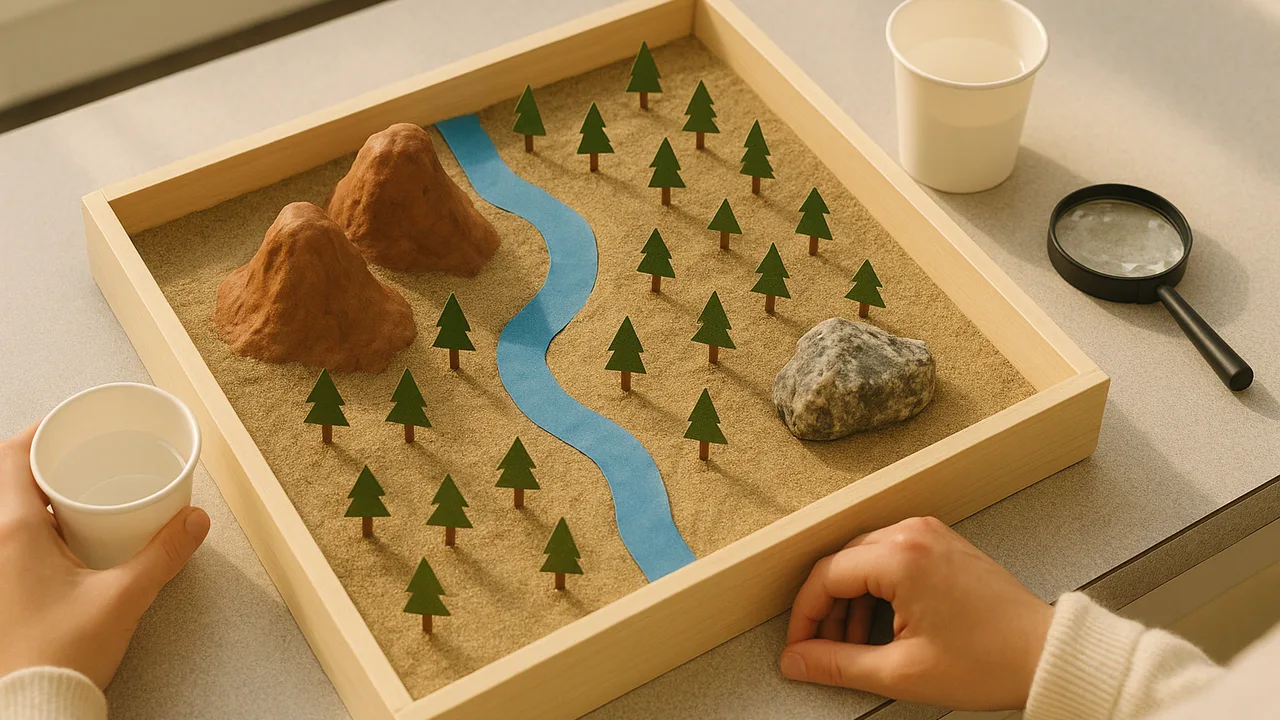
show what I know about the rock cycle, plate evidence, the water cycle, time scales and evaluating designs before we critique our prototypes.
- I can use my model to explain, with evidence, that energy from inside the Earth and from the sun drives Earth processes that cycle materials into different forms over time and in different places.
- I can analyze the data to find patterns and relationships, such as how the age of seafloor changes from the center to the edges of oceans or how similar fossils and rocks are found on different continents.
- I can use a systematic method, like a decision matrix, to find the strengths and weaknesses of each solution.
- I can evaluate each solution using the criteria and constraints we defined.
- I can compare the solutions based on how well they meet the criteria and constraints.
Phase 4: Build
Warm-Up ~5 min
Do Now. Look at your three drafted stops. Which one would you be most nervous to explain to a park ranger? Write why in one sentence.
How confident are you that you can I can explain the science behind each of my trail stops.
Instruction ~10 min
Trail designers, a quick check before critique. Engineers test their own understanding before they ask others to judge a prototype. This checkpoint is short, about 25 minutes. It shows you and your teacher what to fix before the gallery walk.
Quick review 1: two energy sources. The sun’s energy drives weathering, erosion, deposition and the water cycle. Earth’s interior energy drives melting, crystallization, deformation and uplift. Gravity pulls water and sediment downhill.
Quick review 2: patterns as evidence. Matching fossils, matching rocks, fitting coastlines and mirror-image seafloor ages all show that continents have moved.
Worked example 1: a strong data answer. Question: “What does the seafloor-age map show?” Priya wrote: “The youngest rock is at the ridge and ages increase on both sides. So new seafloor forms at the ridge and spreads apart.” She named the pattern, then what it means.
Worked example 2: a strong design answer. Question: “Why did the QR tour score lower after new evidence?” Diego wrote: “Weak signal at two stops means visitors there cannot hear it, so it scored lower on accessibility.” He linked evidence to a criterion.
Guided Exercises ~15 min
Part A: answer on your own. Your teacher will review answers with the class after everyone finishes.
Independent Practice ~10 min
Part B: write in full sentences.
Draw a rock-cycle model with sandstone, granite and a metamorphic rock. Label at least four processes and the energy source for each.
Pick one of the four guide formats. Explain how it would solve the park's problem, and name one criterion it meets well.
Explain, using two kinds of evidence, why ocean fossils can be found on a mountain ridge far from any sea.
Closure ~5 min
Checkpoint done. Use your results to fix one weak spot in your stops before next lesson’s gallery walk.
Exit ticket: which stop will you strengthen first, and what will you change?
Teacher notes
Materials: notebooks, pencils, the stop drafts.
Setup: about 25 minutes for Parts A and B, 10 minutes to review, and the rest for teams to fix one weak spot. Note students who miss the energy-source items or the seafloor pattern; pair them with a confident partner for the gallery walk.
Listen for: “the sun melts rock underground”; “the ridge is the oldest part”; matrix totals that add scores without weights.
Support / stretch: read items aloud; accept labeled drawings for Part B. Stretch: write one new checkpoint question for a classmate, with an answer key.