3.23 Revise the Stops: Lessons from a Park Interpreter
revise my team’s trail guide using critique and evidence, and defend our final design choice with reasons.
- I can use evidence and reasoning to make a claim about which solution works best, based on their strengths and weaknesses.
- I can describe what I need to know about how similar problems have been solved before.
- I can identify what evidence I need about how each solution might affect people and the environment.
- I can use reasoning and scientific ideas to connect evidence and explain how geoscience processes have changed Earth’s surface at different times and scales.
- I can describe how plate motion creates large features like mountains and continents over millions of years, and how surface processes like erosion and deposition shape features over shorter or longer times.
- I can explain how catastrophic events quickly change Earth’s surface, and how those changes are later affected by slower processes, showing that surface features result from many processes acting over different times and sizes, and will keep changing in the future.
Phase 4: Build
Warm-Up ~5 min
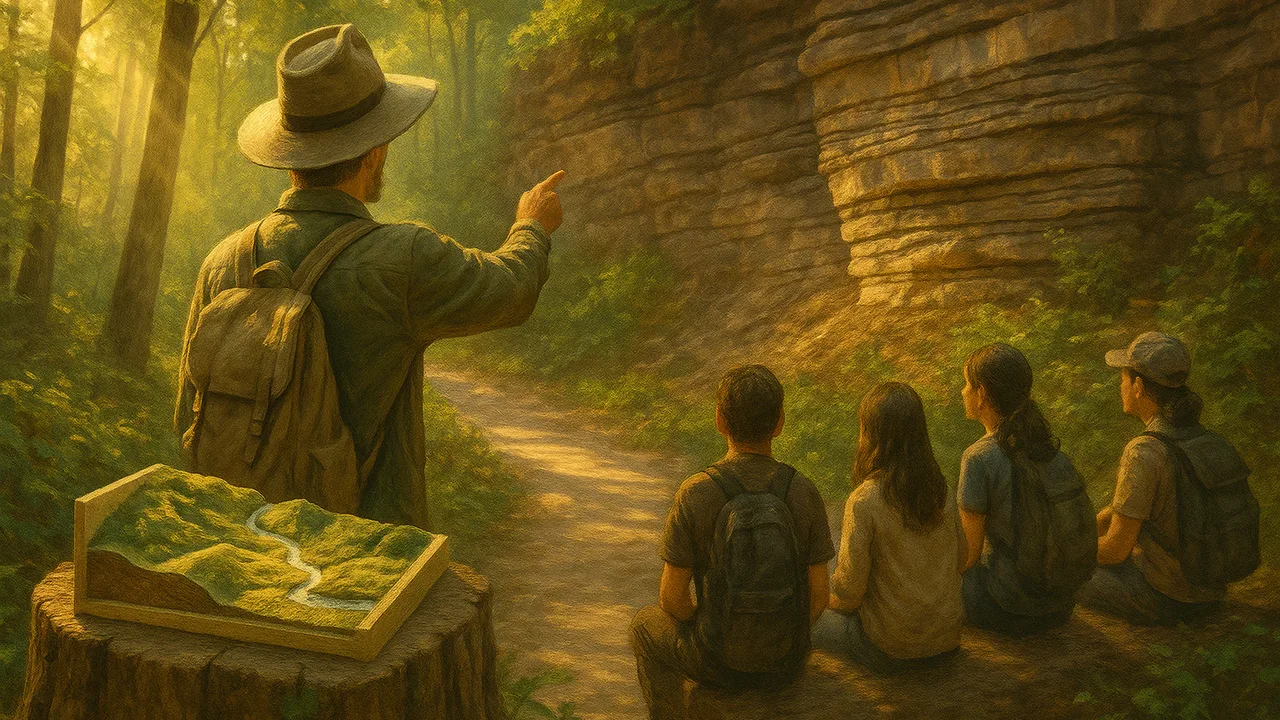
Do Now. Have you ever been on a walk led by a park ranger or nature guide? What did they do that a sign cannot do?
Your team got the feedback “too many words.” What is the best revision?
Instruction ~10 min
Trail designers, revision is where good designs become great. Use your sorted feedback. Fix the science first, then clarity, then looks. Keep a revision log so you can show the park staff what changed and why.
Worked example 1: a revision log entry. Diego’s team logged: “Feedback: visitors could not find the youngest seafloor. Change: added a color key and the word ‘newest’ at the ridge. Criterion improved: understood in about 3 minutes.” Feedback, change and criterion, every time.
Worked example 2: defending the final choice. Mei’s team rescored their matrix after critique. Their hybrid of small signs plus audio still led. Their claim: “We chose the hybrid because it scored highest on accurate science and accessibility. Its weakness is cost, so we use one large panel at the trailhead and small posts at each stop.” Claim, evidence and a plan for the weakness.
Tell the whole story. Your final guide should leave visitors with one big idea: the trail was shaped by slow plate motion, by the rock cycle, by water, and by sudden events, all at different scales. And it is still changing.
Guided Exercises ~15 min
Revise, then log every change.
| Feedback | Change we made | Criterion it improves | Evidence it worked |
|---|---|---|---|
Independent Practice ~10 min
Write your team’s final design claim on your own.
Claim: which final design will you deliver? Evidence: cite your rescored matrix and two pieces of critique. Reasoning: explain why its strengths outweigh its weaknesses for this park.
Closure ~5 min
Your guide is revised and ready to test. Next: the visitor test, where real users show us what works.
Exit ticket: which part of a park naturalist's or geologist's job did you do this unit? Give one example.
How confident are you that you can I can use evidence and reasoning to make a claim about which solution works best.
Teacher notes
Materials: sorted sticky-note feedback, prototype materials, revision log sheets, rescoring matrices.
Setup: if possible, invite a park naturalist or geologist by video for 10 minutes to answer questions; otherwise use the career spotlight. Give 25 minutes of build time.
Listen for: revisions with no logged reason; teams fixing looks but not science; a final claim with no evidence.
Support / stretch: provide one pre-filled log entry as a model. Stretch: write a 30-second accessibility feature, such as a large-print card or a simpler-language audio track.