3.06 Slow Trickle, Sudden Flood: A Stream Table Test
compare how slow and fast processes change a landscape model and estimate the time scale of each.
- I can use evidence and reasoning to explain how Earth’s surface changes because of geoscience processes.
- I can identify and describe evidence that shows how slow plate movement changes Earth’s surface over large areas and long times.
- I can identify and describe evidence of surface weathering, erosion, movement, and deposition of sediment at both large and microscopic scales.
- I can identify and describe evidence of rapid catastrophic events, like earthquakes, volcanoes, or meteor impacts, that change Earth’s surface quickly.
- I can identify the timescales for different geoscience processes, such as millions of years for plate movement or seconds to days for catastrophic events.
Phase 2: Investigate
Warm-Up ~5 min
Do Now. A canyon took millions of years to carve. A landslide can bury a road in under a minute. List one other change to land that is slow and one that is fast.
We pour the same total amount of water on two identical sand slopes: one as a slow trickle, one all at once. Which slope will change more?
Instruction ~10 min
Trail geologists, the land is changing right now, but at many speeds. Today you test two rates of water on matching slopes.
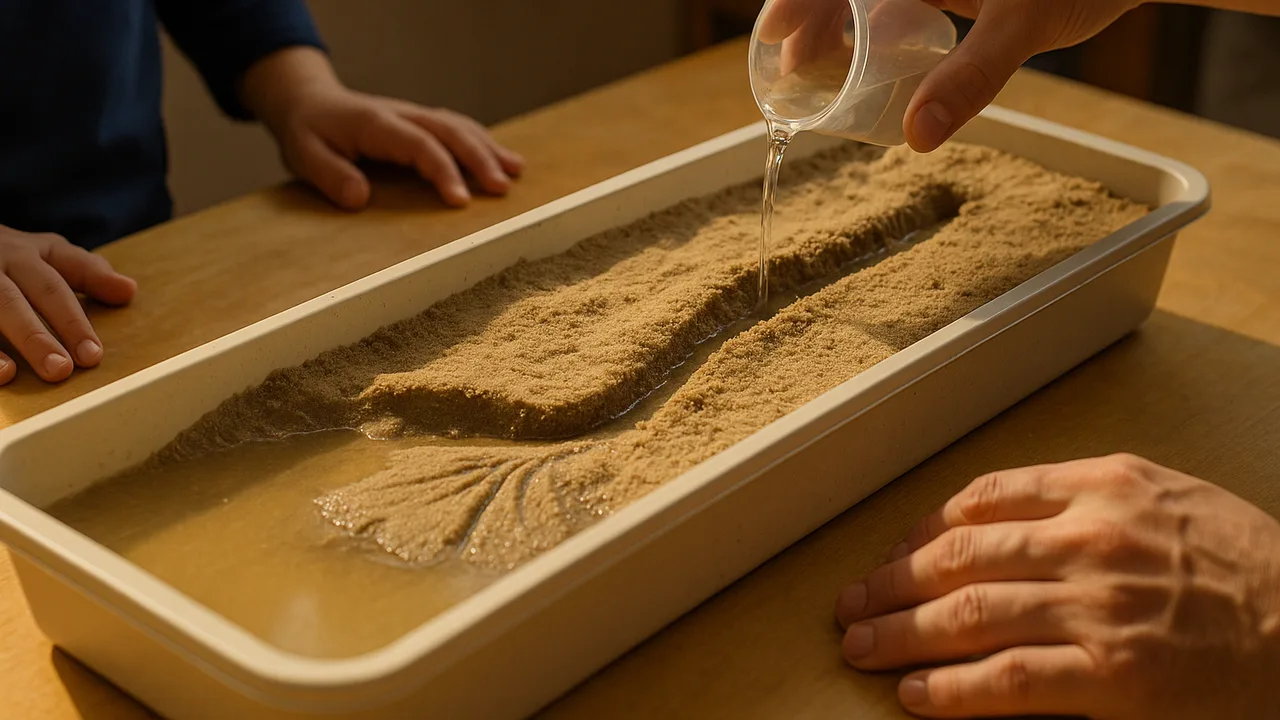
Setup. Pack damp sand into the high end of a tray to make a slope. Prop that end on a book. Mark three toothpick “trees” at the top. Trial 1: pour 500 mL slowly through a cup with a pinhole, over about two minutes. Trial 2: rebuild the slope, then pour 500 mL at once.
Worked example 1: measuring change. Mei measures the deepest channel with a ruler: 1.2 cm after the trickle. After the flood, part of the slope slumped and the deepest gully is 3.0 cm. She also counts trees still standing: 3 of 3 after the trickle, 1 of 3 after the flood. Numbers make her claim strong.
Worked example 2: scaling up. Malik connects the model to Earth. Rivers cutting valleys and wind wearing ridges act over thousands to millions of years. A flood or landslide acts in minutes to days. Both happen in hilly regions: slow erosion shapes the ridges, and heavy storms sometimes cause sudden landslides on steep slopes.
Big and small scales. Erosion acts at a tiny scale, grain by grain, and at a huge scale, carving whole valleys. Look at the sand grains with a hand lens after the trials. Rounded grains have been tumbled.
Guided Exercises ~15 min
The Recorder fills in this table for both trials.
| Trial | Water (mL) | Time to pour (s) | Deepest gully (cm) | Trees still standing (of 3) | Where sediment ended up |
|---|---|---|---|---|---|
| 1 Slow trickle | 500 | ||||
| 2 Sudden flood | 500 |
Independent Practice ~10 min
Build a time-scale ladder.
Place these on a ladder from fastest to slowest and give a likely time span for each: landslide, flood, a creek widening its valley, a ridge wearing down, a sidewalk crack growing.
Closure ~5 min
Land changes fast and slow, big and small. Next lesson, we find out how flat rock layers become long, folded mountain ridges.
How confident are you that you can I can compare slow and fast processes that change Earth's surface.
Exit ticket: describe one slow and one fast process from today's model. How would each look on a real hillside?
Teacher notes
Materials (per team): a paint tray or shallow bin, about 2 L of damp sand, a book to prop it, toothpicks, a paper cup with a pinhole, a 500 mL measuring cup, rulers, a stopwatch, a catch bin, hand lenses, towels.
Timing (50 min): Do Now 4, mini-lecture 8, two trials 20, guided questions 10, ladder and exit 8.
Listen for: “Mountains never change.” Return to it in 3.07 and 3.13. Also listen for students thinking fast events matter more than slow ones; both shape the land.
Support / stretch: Pre-mark ruler points on the tray. Stretch: add a third trial with a grass mat to see how plants change the rate.