3.04 The Crayon Rock Cycle Workshop
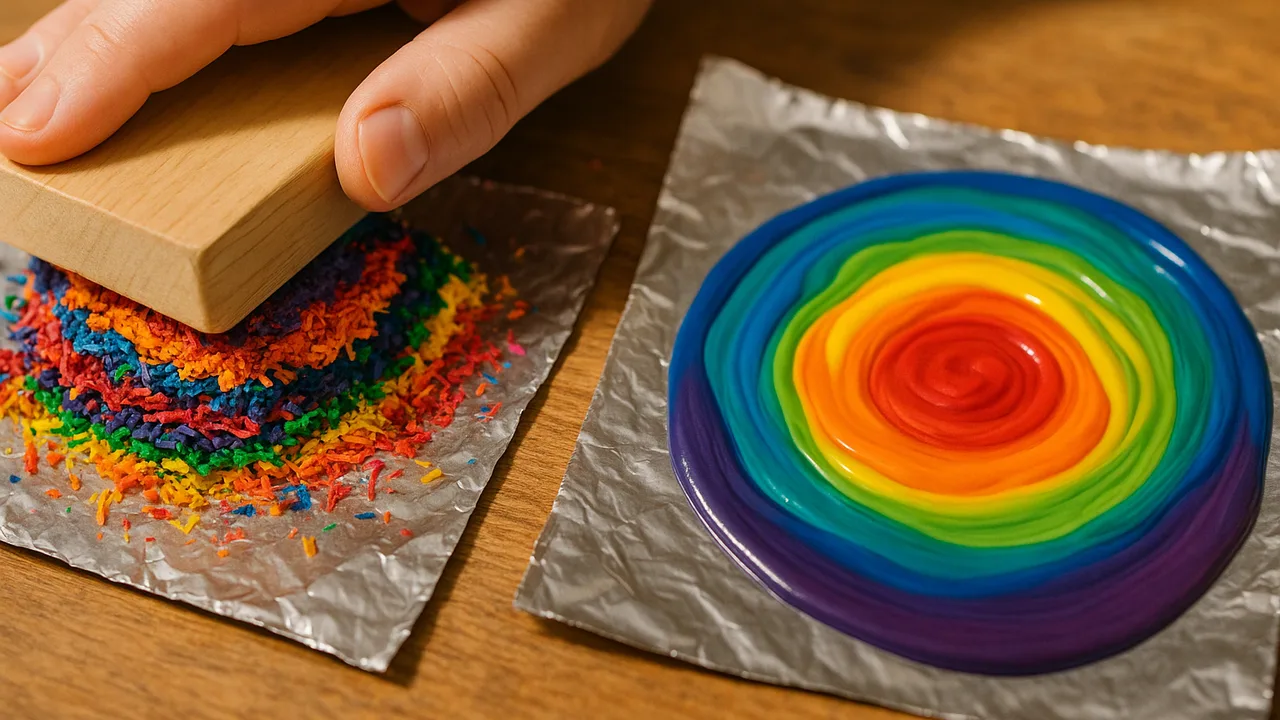
use a crayon model to show how Earth materials change through weathering, sedimentation, pressure, heating, melting and cooling.
- I can develop a model that shows different types of Earth materials found at the surface and inside the Earth, and how these materials change during processes like melting, weathering, and sedimentation.
- I can include energy from the sun and the Earth’s hot interior in my model to show how they drive changes in Earth materials.
- I can identify the Earth processes and describe when and where they happen in my model.
- I can use my model to explain how Earth processes like melting, sedimentation, and crystallization cause materials to change through chemical and physical changes.
- I can show how energy from the Earth’s interior drives processes such as melting, crystallization, and deformation, leading to changes in Earth materials.
- I can describe how energy from the sun causes weathering, erosion, and sedimentation, and explain the time and place these processes occur.
- I can use my model to show how the Earth’s internal heat drives processes like melting, crystallization, and deformation, which change rocks and move them to the surface for weathering and erosion.
- I can explain how energy from the sun moves wind and water, causing erosion and sedimentation of weathered materials.
- I can describe how any rock can become a new type of rock if the right conditions and energy sources are present.
Phase 2: Investigate
Warm-Up ~5 min
Do Now. Yesterday you sorted rocks into groups. Could a rock from one group ever become a rock from another group? Write yes or no, and one reason.
We will shave crayons, press the shavings, warm them and then melt them. Which step will change the crayon the most?
Instruction ~10 min
Trail geologists, welcome to the workshop. Crayons stand in for rock. Each step models a real Earth process. Record what the material looks like after each step before we name anything.
Step A: weathering. Scrape three colors of crayon into small shavings with a plastic knife. Step B: sedimentation. Sprinkle the colors in three thin layers onto a square of foil. Step C: compaction. Fold the foil and press hard with your palm or a book. Step D: heat and pressure. Your teacher sets the foil packet in a pan of hot tap water for one minute, then you press it again. Step E: melting and cooling. Your teacher melts shavings in a foil cup floating in hot water; it then cools on the table.
Worked example 1: matching a step to Earth. Priya’s pressed packet has three layers that crumble at the edges. She writes, “Like sand and mud on a sea floor, pressed by more sediment on top.” Geologists call rock formed this way sedimentary rock.
Worked example 2: tracing energy. Diego asks where the energy came from in each step. His muscles did the scraping and pressing in the model. On Earth, Step A is driven by sun-powered wind, water and ice, and Steps D and E by heat from deep inside Earth. Hot water stands in for that interior heat.
Now the names. Rock formed from pressed and cemented sediment is sedimentary. Rock changed by heat and pressure without melting is metamorphic. Rock formed when melted rock cools is igneous. The rock cycle is the set of paths that change rock from one type to another. Any rock can take any path if conditions change.
Guided Exercises ~15 min
The Recorder fills in the table after each step. Sketch the material and describe its texture.
| Step | What we did | What the crayon looks like | Earth process it models | Energy source on Earth |
|---|---|---|---|---|
| A | Shaved | |||
| B | Layered | |||
| C | Pressed | |||
| D | Warmed and pressed | |||
| E | Melted and cooled |
Independent Practice ~10 min
Draw your first rock cycle model.
Draw a diagram with the three rock types and sediment and magma. Add at least four arrows. Label each arrow with a process (weathering, compaction, heat and pressure, melting, cooling).
Closure ~5 min
Rock can change from one form to another along many paths. Next lesson, we test what powers those changes: the Sun or Earth’s hot interior.
How confident are you that you can I can use a model to show how one type of rock changes into another.
Exit ticket: describe one full path a rock could take from igneous to sedimentary to metamorphic. Name the process at each step.
Teacher notes
Materials (per team): 3 old crayons in different colors (paper removed), plastic knives, foil squares, paper plates, goggles. Teacher station: a pan of very hot tap water and small foil cups. Candy option: chewy fruit candies can model the same steps (no eating at lab tables).
Timing (50 min): Do Now 4, steps A–C 12, steps D–E at teacher station 10, naming the rock types 8, guided questions 8, exit 8.
Listen for: “The rock cycle is one fixed loop in one order.” Show that arrows go many ways. Also listen for “metamorphic means melted.”
Support / stretch: Provide a cycle diagram with blank arrow labels. Stretch: describe where on Earth each step happens (surface, deep underground, sea floor).