4.09 Rot Jars and Food Webs: Where Does It All Go?
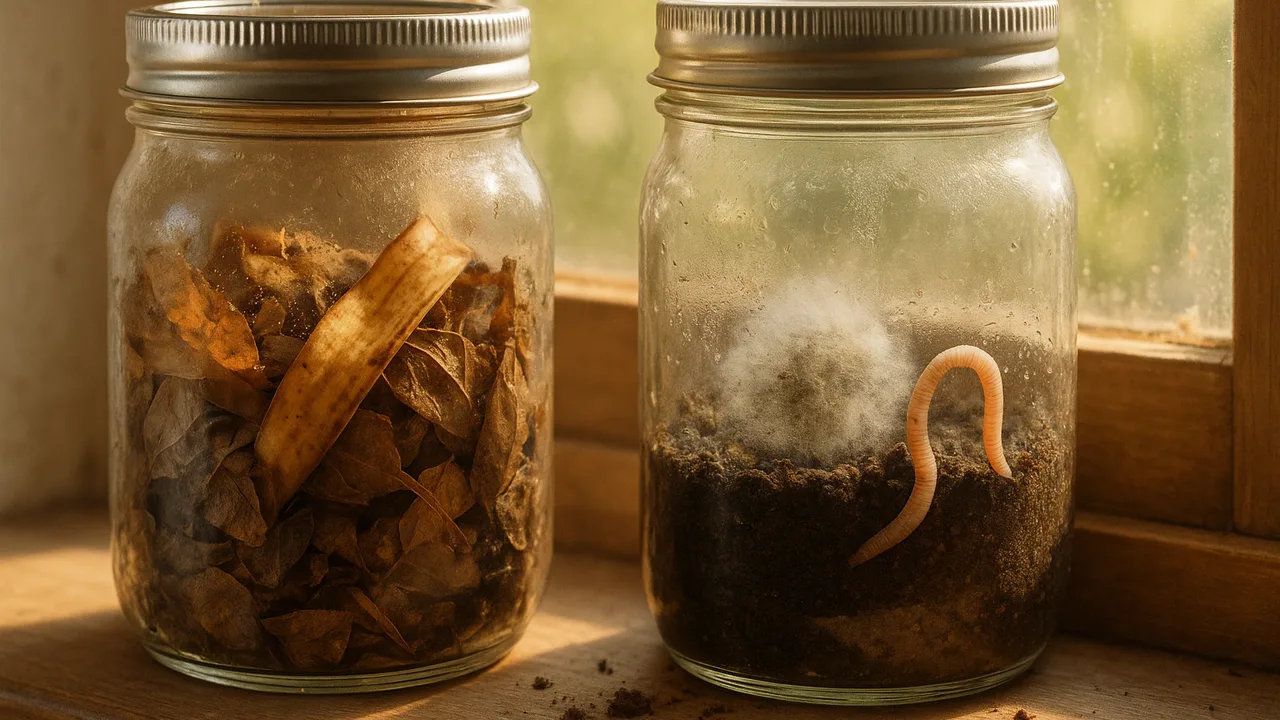
set up and observe decomposition chambers and build a food web of our schoolyard that includes producers, consumers, decomposers and nonliving parts.
- I can develop a model that shows producers, consumers, and decomposers in an ecosystem.
- I can include nonliving parts like water, minerals, and air in my model to show how they provide or receive matter.
- I can identify where energy is present in my ecosystem model.
- I can describe how energy enters and leaves the ecosystem in my model.
- I can show how matter and energy move among producers, consumers, and decomposers in my model.
- I can explain how organisms use matter from nonliving parts of the ecosystem and how matter moves between living and nonliving parts.
Phase 2: Investigate
Warm-Up ~5 min
Do Now. Every fall, our schoolyard trees drop thousands of leaves. Yet the ground is not buried under years of old leaves. Where do they go? Write your best idea.
What happens to fallen leaves over many months?
Instruction ~10 min
Explore first: rot jars. Each team builds two sealed decomposition chambers in clear zipper bags. Bag A holds a scoop of moist garden soil, a leaf, an apple slice and a piece of bread. Bag B holds the same items with no soil and is kept dry. Seal each bag, tape it shut and label it. Observe both bags through the plastic every two or three days for three weeks.
| Day | Bag A (moist, with soil): what changed? | Bag B (dry, no soil): what changed? | Signs of decomposers (fuzz, color, slime) |
|---|---|---|---|
| 0 | |||
| 3 | |||
| 7 | |||
| 14 | |||
| 21 |
Now we name it. Every ecosystem has three roles. Producers, such as grass, clover and trees, use energy from sunlight to make their own food. They build their bodies from matter they take in: water and minerals from the soil and carbon dioxide from the air. Consumers get matter and energy by eating other organisms. Decomposers, such as fungi and bacteria, break down dead organisms and wastes. They return matter to the soil and air.
Worked example 1: a schoolyard food web. Ava’s team drew this web. Sunlight reaches grass and clover. Rabbits and grasshoppers eat the grass and clover. Robins eat grasshoppers and earthworms. A red-tailed hawk eats rabbits. Earthworms, fungi and bacteria break down dead leaves, droppings and dead animals. Arrows point from the food to the eater, showing the direction matter and energy move.
Worked example 2: adding the nonliving parts. Then Ava’s team added boxes for soil and minerals, water and air. They drew arrows from the decomposers into the soil and air, and from the soil and air back into the grass. Now the model shows matter moving in a loop, not just a line. They also drew a sun symbol where energy enters, and wavy arrows for thermal energy leaving every organism.
Guided Exercises ~15 min
Use your food web and the rot jar setup.
Independent Practice ~10 min
Predict your rot jar results.
Predict which bag will change more in three weeks, A or B. Explain your prediction using the words decomposer, moisture and matter.
Closure ~5 min
Our investigations are complete, and the rot jars keep working. Next phase, we use all our data to explain storms, climate and ecosystems.
Exit ticket: name a producer, a consumer and a decomposer in our schoolyard, and one nonliving part each of them uses.
Teacher notes
Materials: per team, two quart zipper bags, packing tape, moist garden soil (not potting mix with fertilizer), fallen leaves, apple slices, bread, a marker; chart paper and sticky notes for the food web.
Setup: store bags in a warm spot away from direct sun, on a tray in a labeled bin. Schedule quick 3-minute observation checks at the start of later lessons; 4.14 uses the results.
Listen for: “plants get their food from the soil” (plants make food using sunlight; soil supplies water and minerals). “Energy is recycled like matter” (energy flows through and leaves as thermal energy; matter cycles). MS-LS2-3 excludes chemical reactions, so do not introduce the photosynthesis equation.
Support / stretch: give organism cards to arrange before drawing. Stretch: add the wet corner’s organisms and connect the two webs.