4.02 Wonder Board Workshop: Weather, Climate or Wildlife?
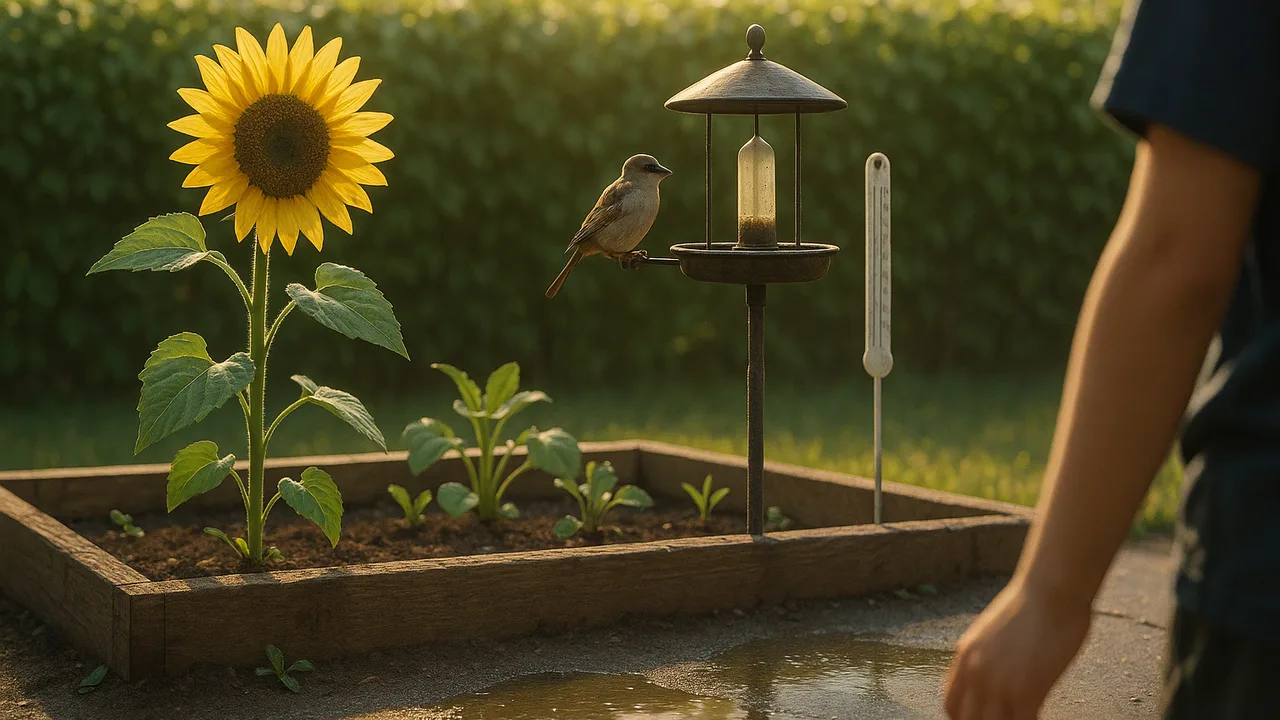
The Schoolyard Weather and Wildlife Station
What makes the weather change, and how can we help the living things in our schoolyard get what they need?
The mystery: A sunny morning turns into a thunderstorm by afternoon. Some years a pond is crowded with frogs, and other years it is nearly empty.
sort our questions into weather, climate and ecosystem questions, set the boundary of our schoolyard ecosystem, and state the purpose of our weather investigations.
- I can identify the purpose of an investigation as finding evidence for how air masses moving and interacting lead to changes in weather.
- I can define the boundaries of the ecosystem I am modeling, such as a pond, meadow, or forest.
Phase 1: Spark
Warm-Up ~5 min
Do Now. Read the two statements. “It is raining in our town today.” “Our town gets rain or snow in every month.” Are they saying the same kind of thing? Talk with your shoulder partner.
Which statement describes climate rather than weather?
Instruction ~10 min
Three kinds of questions. Our Wonder Board holds three kinds of questions. Weather questions ask about short-term changes over hours or days. Climate questions ask about long-term patterns over decades. Ecosystem questions ask how living things interact with each other and with nonliving things like water, air and soil.
Worked example 1: sorting three notes. Priya’s team sorted three sticky notes. “Why did the wind shift before the storm?” went under Weather, since it is about one afternoon. “Why is it warmer near the equator?” went under Climate, since it is a pattern that lasts for centuries. “Do birds and squirrels compete at the feeder?” went under Ecosystem, since it is about organisms interacting.
The purpose of our weather investigations. Every good investigation starts with a clear purpose. Ours is this: find evidence for how moving and meeting air masses cause changes in our local weather. Notice that the purpose names a cause (air masses moving and meeting) and an effect (weather changes). That tells us what data to look for.
Worked example 2: drawing a boundary. An ecosystem can be as big as a forest or as small as a puddle. Scientists choose a boundary so they know what is inside the system and what is outside it. Jamal’s team drew a line around the garden, the wet corner and the tree line by the fence. Inside are plants, insects, birds, worms, soil, water and air. Sunlight and rain cross the boundary from outside. Birds fly in and out, so the team noted them as visitors.
Team contract. Before investigations begin, your team writes a short contract. Say how you will share jobs, handle tools safely and settle disagreements. Every member signs it.
Guided Exercises ~15 min
Sort and sharpen our questions. Use the arrows to move through the cards.
Independent Practice ~10 min
Sketch and write about our schoolyard system.
Sketch a map of our schoolyard ecosystem and draw its boundary. List three living parts and three nonliving parts inside it, and two things that cross the boundary.
Rewrite the purpose of our weather investigations in your own words. Underline the cause and circle the effect.
Closure ~5 min
Our Wonder Board is sorted, our boundary is drawn, and our purpose is clear. Next time we become weather watchers and start a real data log.
Exit ticket: what is the difference between weather and climate? Give one example of each from our Wonder Board.
Teacher notes
Materials: the Wonder Board, three header cards (Weather, Climate, Ecosystem), a printed or projected schoolyard map, team contract template.
Setup: move last lesson’s sticky notes to a holding area. Print one schoolyard map per team for the boundary sketch.
Listen for: “climate is just the weather in summer” (climate is a long-term pattern for all seasons). Some notes fit two headers, for example “Why are there fewer frogs in dry years?” is both ecosystem and climate; let teams defend either.
Support / stretch: give picture cues on the header cards. Stretch: ask teams how moving the boundary to include the parking lot would change what enters and leaves the system.