4.06 Convection Tank: Earth’s Heat Engine in a Box
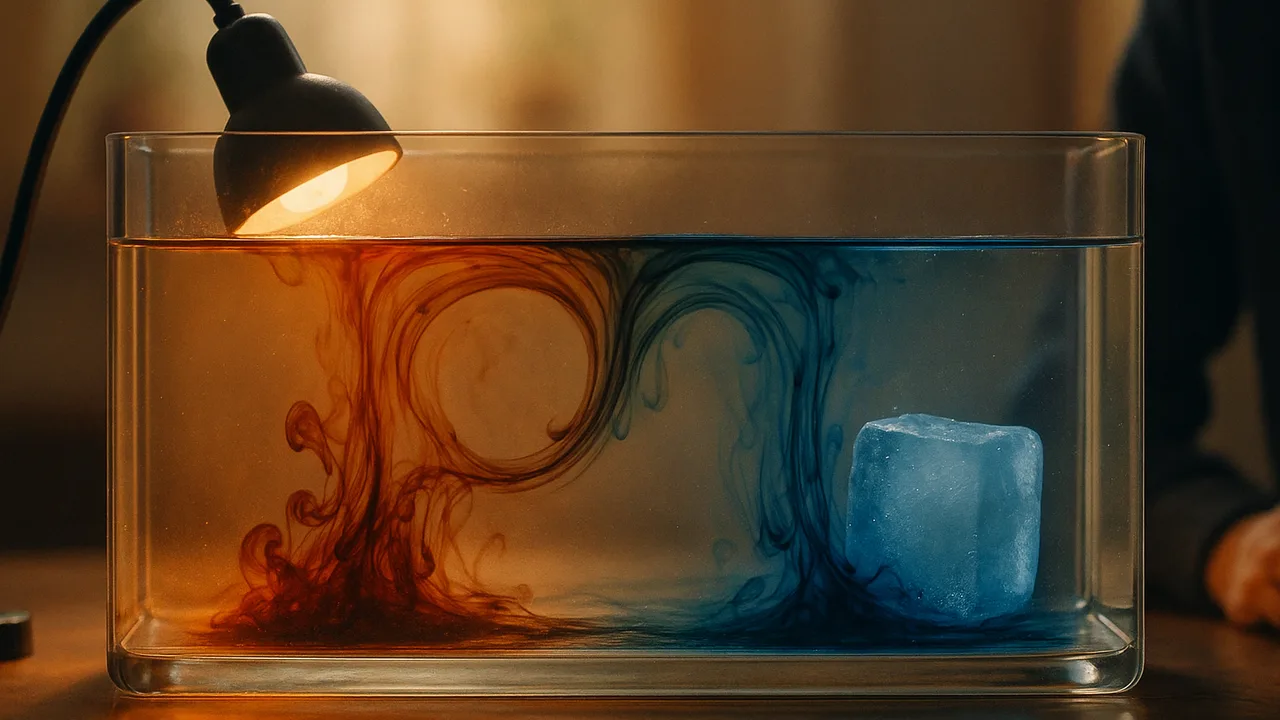
observe convection currents in a water tank and build a first model of how sunlight, air, ocean, land and ice move thermal energy around Earth.
- I can develop a model that shows the rotating Earth, the atmosphere, the ocean, continents, landforms, ice, living things, and energy from the sun.
- I can identify and label the inputs and outputs in my model, such as sunlight entering the system and thermal energy in the atmosphere, water, land, and ice.
- I can describe how differences in solar energy and temperature depend on latitude, elevation, and features like landforms and living things.
- I can explain how air and water move from areas of higher density to lower density because of changes in temperature or salinity.
- I can describe how Earth’s rotation, landforms, and the distribution of continents affect the movement of wind and ocean currents.
Phase 2: Investigate
Warm-Up ~5 min
Do Now. Last time, warm air over land rose and cooler air moved in. Water is a fluid, too. Your teacher will set a cup of hot water under one end of a clear tank and an ice pack under the other end. Predict what a drop of food coloring will do.
Where will food coloring dropped near the warm end travel?
Instruction ~10 min
Explore first: the convection tank. Each team fills a clear plastic box with room-temperature water. Set it on two supports so a cup of hot tap water fits under one end and a frozen ice pack fits under the other end. Wait one minute for the water to settle. Then add one drop of red coloring near the bottom at the warm end and one drop of blue coloring near the top at the cold end. Sketch the paths every minute for 5 minutes.
Second trial: salty water. Gently pour a little cold, very salty, blue-colored water down one inside wall of the tank. Watch where it goes. Salt, like cold, makes water denser.
| Minute | Path of red (warm end) | Path of blue (cold end) | Direction of the loop | Salty water trial: where did it go? |
|---|---|---|---|---|
| 1 | ||||
| 2 | ||||
| 3 | ||||
| 5 |
Now we name it. A convection current is a loop of moving fluid. It forms when warm, less dense fluid rises and cool, denser fluid sinks. Earth works like a giant convection tank. The equator receives the most direct sunlight, and the poles receive the least. Air and ocean water carry thermal energy from warm regions toward cold ones. Earth’s rotation bends the paths of winds and currents, and continents steer the currents along their coasts.
Worked example 1: the Gulf Stream. The Gulf Stream is a warm, fast ocean current. It flows from the Gulf of Mexico area north along the eastern coast of the United States and then across the Atlantic. It carries warm water toward colder northern seas. In the far North Atlantic, the water cools, becomes salty and dense, and sinks. Deep currents carry it back toward the equator.
Worked example 2: a system model. Priya’s team drew Earth as a system. Input: energy from the Sun, strongest at the equator. Parts: the rotating Earth, the atmosphere, the ocean, continents and mountains, ice, and living things such as forests. Flows: arrows show warm air and water moving toward the poles and cold air and water moving back. Output: thermal energy leaving Earth and radiating to space. Each part stores or moves thermal energy differently.
Guided Exercises ~15 min
Use your tank sketches and the system model to answer these.
Independent Practice ~10 min
Connect the tank to the planet.
Compare your convection tank with Earth. What part of the tank stands for the equator, the poles and the ocean? Name one way the model is NOT like the real Earth.
Closure ~5 min
Air and water circulate in giant loops, carrying thermal energy around Earth. Next time we switch to living things and test how resources limit a population.
Exit ticket: explain how a convection current forms, and name one input and one output in our Earth system model.
Teacher notes
Materials: per team, a clear plastic box, two supports (books or blocks), a mug of hot tap water, a frozen ice pack, red and blue food coloring, a cup of very salty cold water, a tray, paper towels.
Setup: fill tanks a few minutes early so the water is still. Drop coloring gently with a dropper held just under the surface or a straw to the bottom.
Listen for: “heat rises” (warm fluid rises because it is less dense; thermal energy itself moves in all directions). Students may ask why winds curve. The MS-ESS2-6 boundary excludes the dynamics of the Coriolis effect; it is enough to say Earth’s rotation bends the paths.
Support / stretch: give a model template with labeled boxes to connect. Stretch: ask students to predict what would happen to northern climates if a warm current weakened.