3.03 Rock Detectives: Reading Clues in Real Rocks
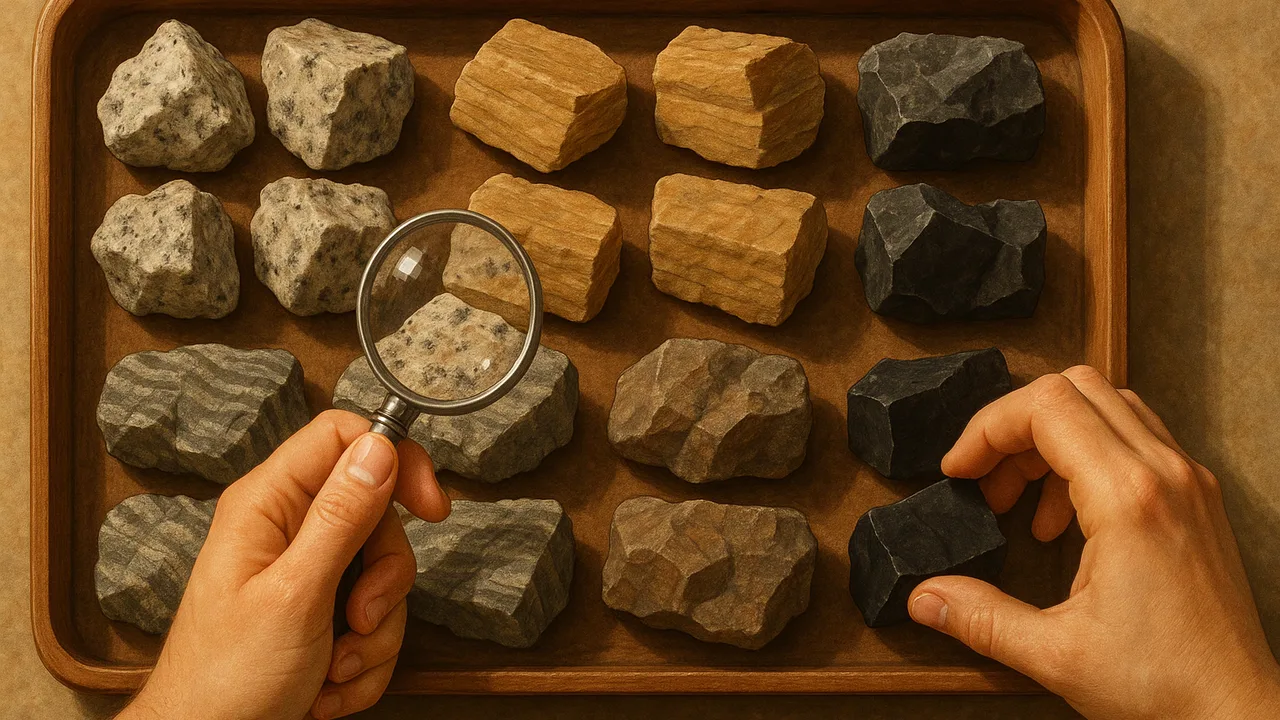
observe real rock samples, sort them by texture clues, and infer how each group may have formed.
- I can develop a model that shows different types of Earth materials found at the surface and inside the Earth, and how these materials change during processes like melting, weathering, and sedimentation.
- I can include energy from the sun and the Earth’s hot interior in my model to show how they drive changes in Earth materials.
- I can identify the Earth processes and describe when and where they happen in my model.
Phase 2: Investigate
Warm-Up ~5 min
Do Now. A chocolate chip cookie, a stack of pancakes and a flattened, squished sandwich each formed in a different way. Look at each one. What clue tells you how it was made?
If a rock has visible layers of sand-sized grains, how do you think it formed?
Instruction ~10 min
Trail geologists, today you explore before we name anything. Each team gets a tray of numbered rocks. Your job is to observe carefully, sort, and explain your sorting rule with evidence.
Tools. Use a hand lens, a penny, a nail and a bottle of water to wet the surface. Observe color, grain size, whether grains are rounded or interlocking crystals, whether you see layers or bands, holes, or fossils.
Worked example 1: one rock, many clues. Ava looks at rock 4. She writes, “Sand-sized rounded grains; feels gritty; thin layers; a little sand rubs off.” Rounded grains suggest the pieces were tumbled by water or wind. Layers suggest they settled one layer at a time.
Worked example 2: comparing two rocks. Malik compares rock 2 and rock 7. Rock 2 has large, interlocking crystals in a speckled pattern. Rock 7 has bands of light and dark minerals that look squeezed into wavy stripes. He infers that rock 2 cooled slowly from melted rock, and rock 7 was changed by squeezing and heat. Both are inferences, and he labels them that way.
Observation or inference? “It has layers” is an observation. “It formed in water” is an inference. Keep them in separate columns.
Guided Exercises ~15 min
The Recorder fills in this table for all the rocks on your tray. Sort the rocks into groups, then name your rule.
| Rock # | Color | Grain size and shape | Layers, bands, holes or fossils? | Inference: how did it form? |
|---|---|---|---|---|
| 1 | ||||
| 2 | ||||
| 3 | ||||
| 4 | ||||
| 5 | ||||
| 6 |
Independent Practice ~10 min
Connect the rocks to the park.
The ridge rocks in our park hold shell fossils and show layers. Which of today's groups do they most likely belong to? Give two pieces of evidence.
Closure ~5 min
Rocks keep records of how they formed. Next lesson, we make our own “rocks” from crayons and watch one type change into another.
Exit ticket: pick one rock from your tray. Write one observation and one inference about how it formed.
Teacher notes
Materials (per team): a tray of 6 numbered rocks from the school kit (include a sandstone, a shale or limestone with fossils, granite, basalt or pumice, gneiss, and a slate or schist), hand lenses, a penny, a steel nail, a dropper of water, goggles, paper towels.
Timing (50 min): Do Now 5, mini-lecture 8, observe and sort 22, share sorting rules 7, independent 4, exit ticket 4.
Listen for: sorting by color only. Push for texture clues. Do not introduce the words igneous, sedimentary and metamorphic yet; they are named after the crayon model in 3.04. Naming individual minerals is outside the MS-ESS2-1 boundary, so keep the focus on how rocks formed.
Support / stretch: Give an observation word bank (rounded, angular, layered, banded, glassy, holes). Stretch: rank the rocks by how much change you think each went through.