4.13 Same Patterns, Different Places
compare interactions in several ecosystems, explain why competition, predation and mutualism appear everywhere, and predict interactions in a new ecosystem.
- I can use evidence and reasoning to build an explanation for a phenomenon involving interactions among organisms.
- I can describe how patterns of interactions, like competition, mutual benefit, and predator/prey, are similar across different ecosystems and species.
- I can use evidence and reasoning to connect patterns and support my explanation about interactions among organisms.
- I can predict which organisms will have predatory, competitive, or mutually beneficial interactions in a given environment based on evidence and resource availability.
Phase 3: Make Sense
Warm-Up ~5 min
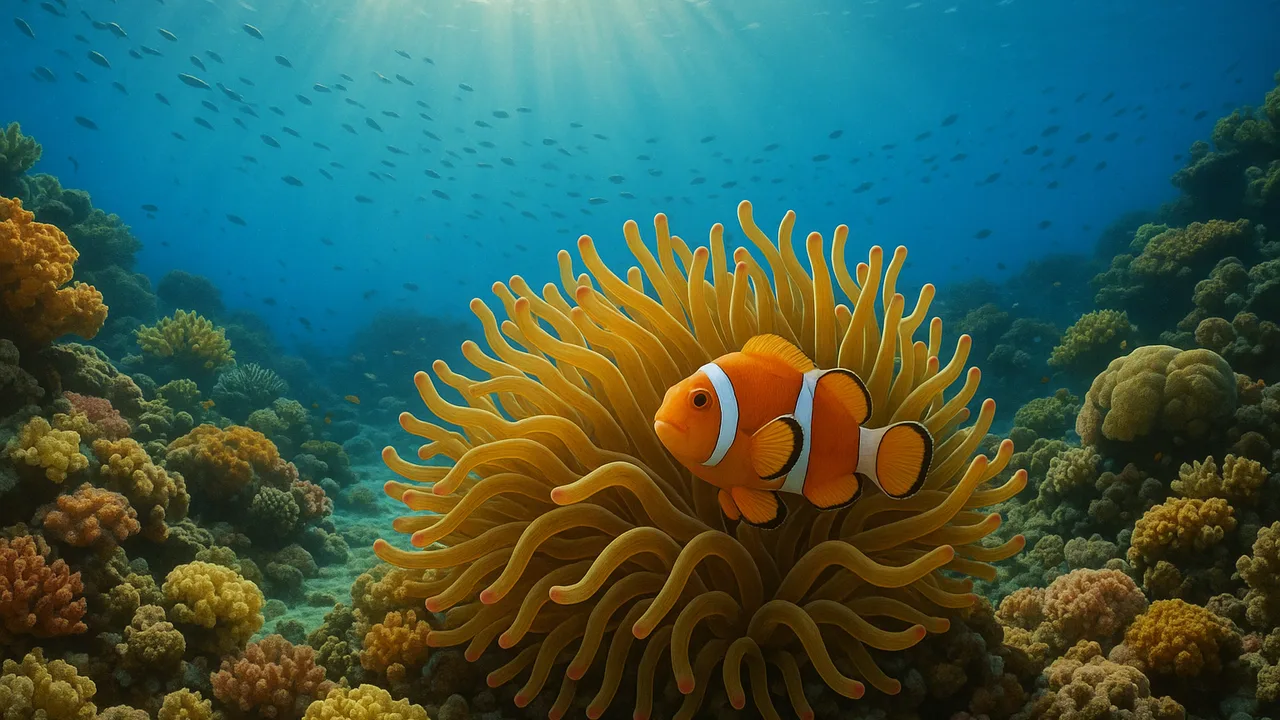
Do Now. A clownfish hides among the stinging arms of a sea anemone on a coral reef. A bee visits a flower in our garden. These organisms live in completely different worlds. What do their interactions have in common?
What do the clownfish-anemone and bee-flower pairs share?
Instruction ~10 min
Reading: patterns everywhere. Every ecosystem has limited resources. Wherever resources are limited, organisms compete for them, some organisms eat others, and some partners help each other. So the same three patterns show up in a reef, a grassland, a forest and our schoolyard, even though the species are different.
| Ecosystem | Competition | Predation | Mutualism |
|---|---|---|---|
| Coral reef | Corals compete for space and light | Sharks eat smaller fish | Clownfish and sea anemone |
| African grassland | Lions and hyenas compete for prey | Lions hunt zebras | Oxpecker birds eat ticks off large grazing animals |
| Northern forest | Trees compete for sunlight | Lynx hunt snowshoe hares | Fungi on tree roots trade nutrients for sugars |
| Our schoolyard | Birds and squirrels at the feeder | Robins eat earthworms | Bees and flowers |
Worked example 1: a predator-prey pattern. In northern forests, trapping records kept over many decades show that lynx and snowshoe hare numbers rise and fall in repeating cycles. When hares are plentiful, lynx have more food and their numbers grow. More lynx eat more hares, and hare numbers fall. Then, with less food, lynx numbers fall too. The lynx population changes a little after the hare population does.
Worked example 2: predicting in a new place. Malik is given a mountain stream ecosystem: algae on rocks, mayfly larvae that eat algae, two kinds of trout that both eat mayfly larvae, and a kingfisher that eats trout. He predicts the two trout species will compete for mayflies, and the kingfisher and trout show predation. He looks for mutualism and notes he needs more sources to find one. His prediction uses the resource each organism needs as evidence.
Guided Exercises ~15 min
Use the comparison table and your 4.08 survey.
Independent Practice ~10 min
Write an explanation. Use these sentence starters:
- Claim: The ___ pattern appears in many ecosystems.
- Evidence: In ___ and in ___, we see ___.
- Reasoning: This happens because ___ is limited, so ___.
Write a CER explaining one phenomenon from our schoolyard survey, such as fewer small birds at the feeder when food runs low. Cite at least two sources of evidence.
Predict which organisms in our wet corner will compete, which will be predator and prey, and which might be mutual partners. Give evidence for each.
Closure ~5 min
Different places, same patterns. Next time we finish our models by tracing matter and energy, and we start brainstorming the station.
Exit ticket: describe one interaction pattern that is the same in a coral reef and in our schoolyard.
Teacher notes
Materials: the comparison table, 4.08 survey tables, CER starters, photo cards of each ecosystem.
Setup: post photos of the four ecosystems around the room for a gallery walk before the reading.
Listen for: “predators will eat all the prey” (predator numbers fall when prey are scarce). The lynx-hare cycle comes from fur-trading records in Canada; keep it qualitative. The clownfish nutrient benefit is still being studied, so say “may.”
Support / stretch: give a sorting mat with the three columns. Stretch: research a parasite example and argue whether it fits any pattern.