3.22 Gallery Walk: Critique with Visitor Eyes
give and use specific peer feedback to judge how well each trail-guide prototype meets our criteria and constraints.
- I can work with others to define and describe the criteria and constraints for evaluating a design solution.
- I can use a systematic method, like a decision matrix, to find the strengths and weaknesses of each solution.
- I can evaluate each solution using the criteria and constraints we defined.
- I can compare the solutions based on how well they meet the criteria and constraints.
- I can use multiple reliable sources, including my own investigations, data, and models, to gather evidence about how Earth’s surface changes at different sizes and times.
Phase 4: Build
Warm-Up ~5 min
Do Now. Which feedback is more useful: “It’s good” or “Your seafloor map has no key, so I could not tell young rock from old”? Why?
Which comment is the most helpful critique?
Instruction ~10 min
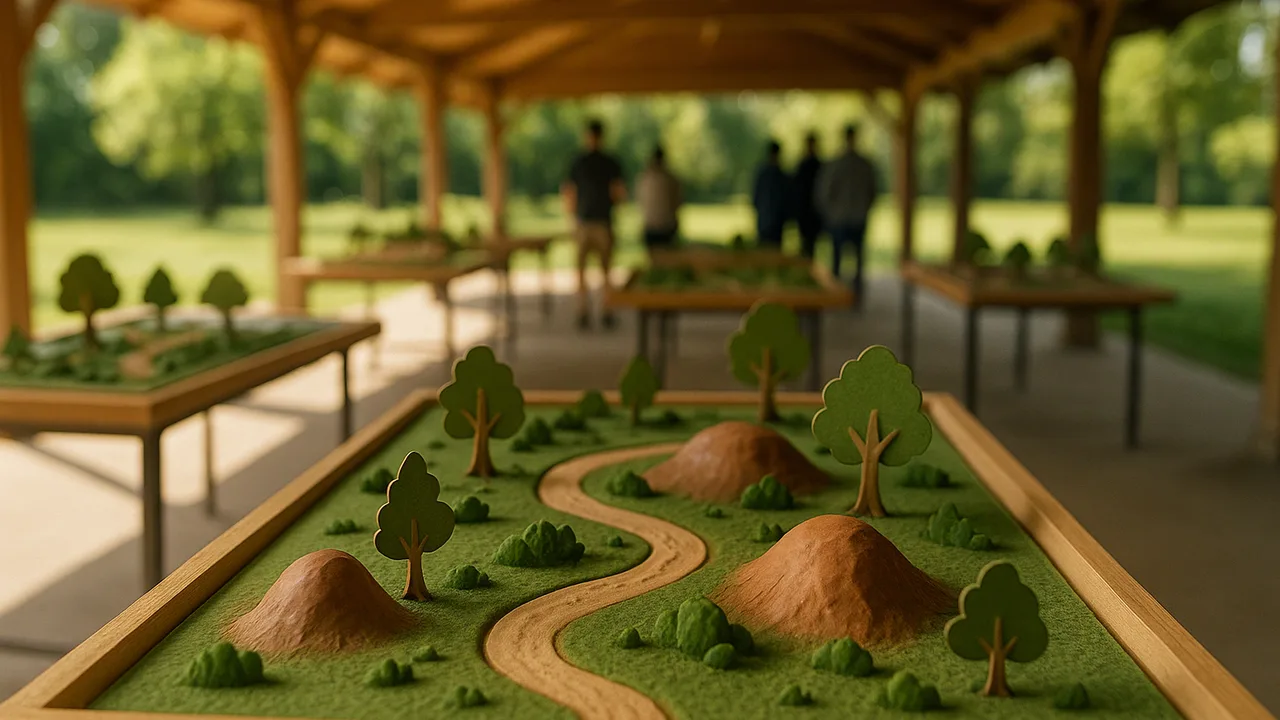
Trail designers, today you are the visitors. Every team sets up its prototype stops. Teams rotate every 6 minutes. At each station, read or listen like a real visitor first, then judge like an engineer.
The protocol. Leave three sticky notes at each station: I like… (a strength tied to a criterion), I wonder… (a question or confusion), and What if… (a specific suggestion). Then score the stop on the shared criteria card.
The shared criteria card. Before the walk, the class agrees on what each score means. For “understood in about 3 minutes,” a 3 means a first-time reader could explain the main idea back. Agreeing first keeps the scoring fair across teams.
Worked example 1: a strong critique. At Mei’s station, Malik wrote: “I like that your timeline string shows people as a tiny sliver. I wonder whether visitors know the bottom layer is oldest. What if you add an arrow that says ‘older’ pointing down?” Kind, specific and useful.
Worked example 2: checking the science sources. Ava noticed one stop said “the waterfall formed in one big flood.” She asked, “What is your evidence?” The team had only one source. Strong stops combine several: samples, the stream table, maps and expert knowledge. Weak evidence is a fair thing to critique.
Guided Exercises ~15 min
Use this card at every station you visit.
| Station | Accurate science (1–3) | Understood in ~3 min (1–3) | Accessible (1–3) | Protects the park (yes/no) | Best “What if” |
|---|---|---|---|---|---|
| Team 1 | |||||
| Team 2 | |||||
| Team 3 | |||||
| Team 4 |
Independent Practice ~10 min
Back at your own station, read your sticky notes.
Sort your feedback into three piles: fix now, fix if time, and disagree. Pick the two most important fixes and explain which criterion each one improves.
Closure ~5 min
Great critique, trail designers. Next lesson, you revise, and you meet the people who do this work for a living.
Exit ticket: write the single most useful piece of feedback you received, and what you will change because of it.
How confident are you that you can I can use agreed criteria to evaluate the strengths and weaknesses of each solution.
Teacher notes
Materials: prototype stops on desks, sticky notes in three colors, a timer, criteria cards, devices or recorders for audio prototypes.
Setup: spend 6 minutes agreeing on score meanings, then four 6-minute rotations. Audio teams can play recordings on a device with headphones.
Listen for: vague praise; critiques of style only; teams defending instead of listening. Model one critique aloud first.
Support / stretch: give sentence-stem cards. Stretch: one student per team tallies station scores and reports which criterion the class struggled with most.