2.24 Showtime: Presenting to the Garden Club
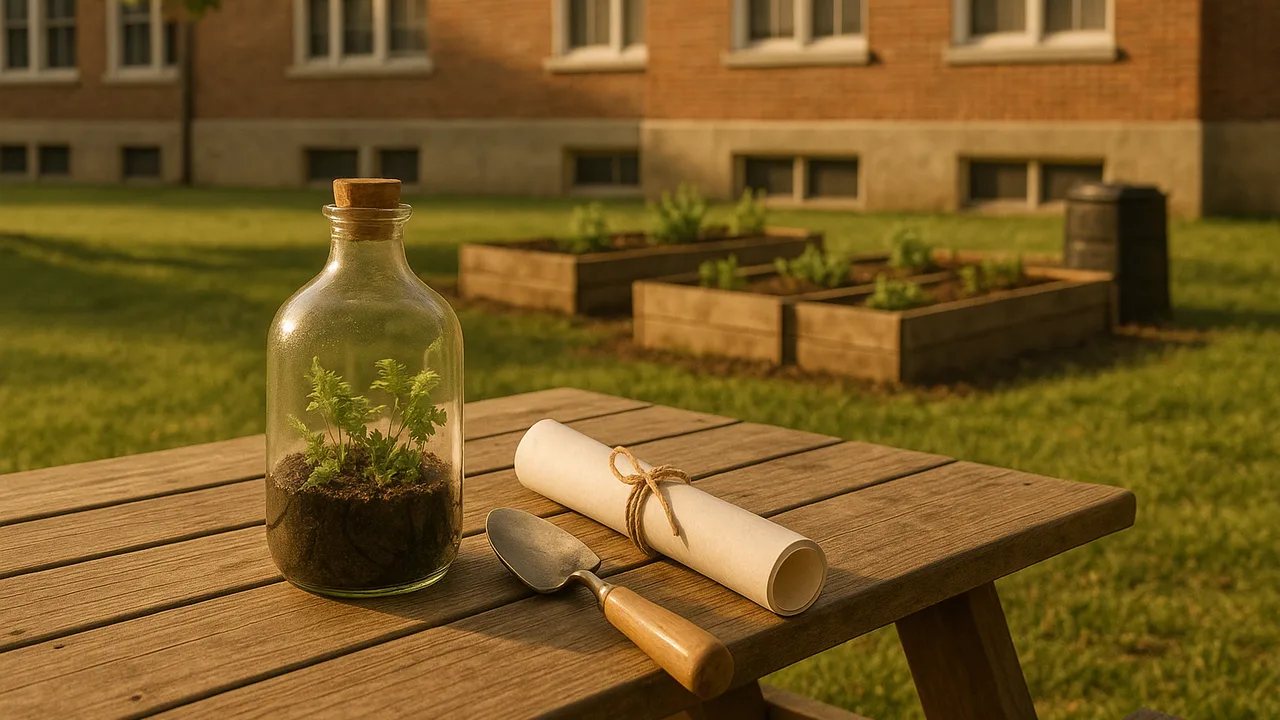
present our zero-waste garden design to the garden club and explain how matter cycles and where the garden’s food energy comes from.
- I can use my model to explain that all the energy animals use for body repair, growth, movement, and staying warm originally came from the sun through plants.
- I can describe how energy from the sun moves to animals through a chain of events, starting with plants making food and then being eaten by animals.
- I can use my model to show how matter cycles between plants, animals, decomposers, and the environment.
- I can explain how the interactions between plants, animals, decomposers, and the environment help different species meet their needs.
- I can use my model to show how adding a new species or changing something in the ecosystem can affect the balance and other parts of the system.
- I can share my ideas and findings about design solutions with others to help create more possible solutions.
Phase 5: Prove It
Warm-Up ~5 min
Do Now. The garden club members are busy. You have only three minutes to win them over. Which opening would grab them?
Which opening is strongest for the garden club?
Instruction ~10 min
Garden engineers, it is showtime! The garden club is our client. Today they choose ideas for the real garden from our designs.
Your presentation has three parts. 1. Your bottle biome as a working model. 2. Your garden-and-compost plan with matter and energy arrows. 3. A short talk where every team member speaks and the team shares test data.
Worked example 1: Priya’s talk. “Here is our sealed bottle. It weighed 612 grams on Day 1 and 612 grams today, yet the radish grew 7 centimeters. Its new matter came mostly from the air and water. In the real garden, the compost bin returns matter from old plants to the soil. Energy is different. It comes in as sunlight, and plants turn it into food. When you eat a garden carrot, that energy moves to you.”
Worked example 2: answering a question. A club member asks, “What if we add chickens?” Jamal uses the model: “Chickens could eat some scraps and insects. Their droppings could go in the compost. But fewer insects might mean less food for birds that visit.”
Share and borrow. When it is not your turn, visit another team. Write one idea the garden club could combine with yours.
Guided Exercises ~15 min
Rehearse with your team before the garden club arrives.
Independent Practice ~10 min
After the show, reflect on the club’s feedback.
What did the garden club say or ask? Name one idea from another team that could make your design better, and explain why.
Project task: The Zero-Waste School Garden Pitch
Present your team’s garden-and-compost design to the school garden club. Your pitch includes your sealed bottle biome as a working model, your garden plan with matter and energy arrows, your test data, and a short talk.
Submission workflow
- Gather your Day 1 and test-day data from the bottle biome and the test plan.
- Finish your garden-and-compost plan. Draw matter arrows in one color and energy arrows in another.
- Rehearse a three-minute talk. Every team member speaks.
- Present to the garden club. Trace one scrap through the matter cycle and trace the garden’s food energy back to the Sun.
- Answer questions using your model, and share one idea with another team.
How it is scored
| Criterion | What proficient looks like |
|---|---|
| Criteria and constraints | Test data shows the design gives every scrap a place, returns compost to the beds, fits the space, is safe, and takes about 10 minutes of care a week. |
| Matter cycle model | The model correctly shows matter moving among plants, animals, decomposers, and the soil, air and water, and explains that plant matter comes mostly from air and water. |
| Energy from the Sun | The talk correctly traces the energy animals and people get from food back through plants to sunlight. |
| Communication and collaboration | Every member speaks, the team uses data to compare its design, answers a question with the model, and shares an idea with another team. |
Closure ~5 min
You did it, garden engineers! You turned a wish for zero waste into a tested design the garden club can really use.
Exit ticket: which question on our Wonder Board can you answer now? Write the answer in two sentences.
How confident are you that you can I can use my model to explain that the energy in food came from the Sun.
Teacher notes
Materials: each team’s bottle biome, plan poster, data tables and a timer. Arrange a time with the garden club advisor so members can attend. If they cannot come, record the talks and share them.
Setup: spend 10 minutes on rehearsal, then run talks in rotations. Score the rubric during the talks.
Listen for: “plants get energy from the soil”; energy arrows drawn in a loop; one student doing all the talking.
Support / stretch: give a talk script with blanks. Stretch: prepare an answer to “Could a garden ever run without the Sun?”