1.04 Invisible but Real: Air in a Balloon and a Smell That Travels
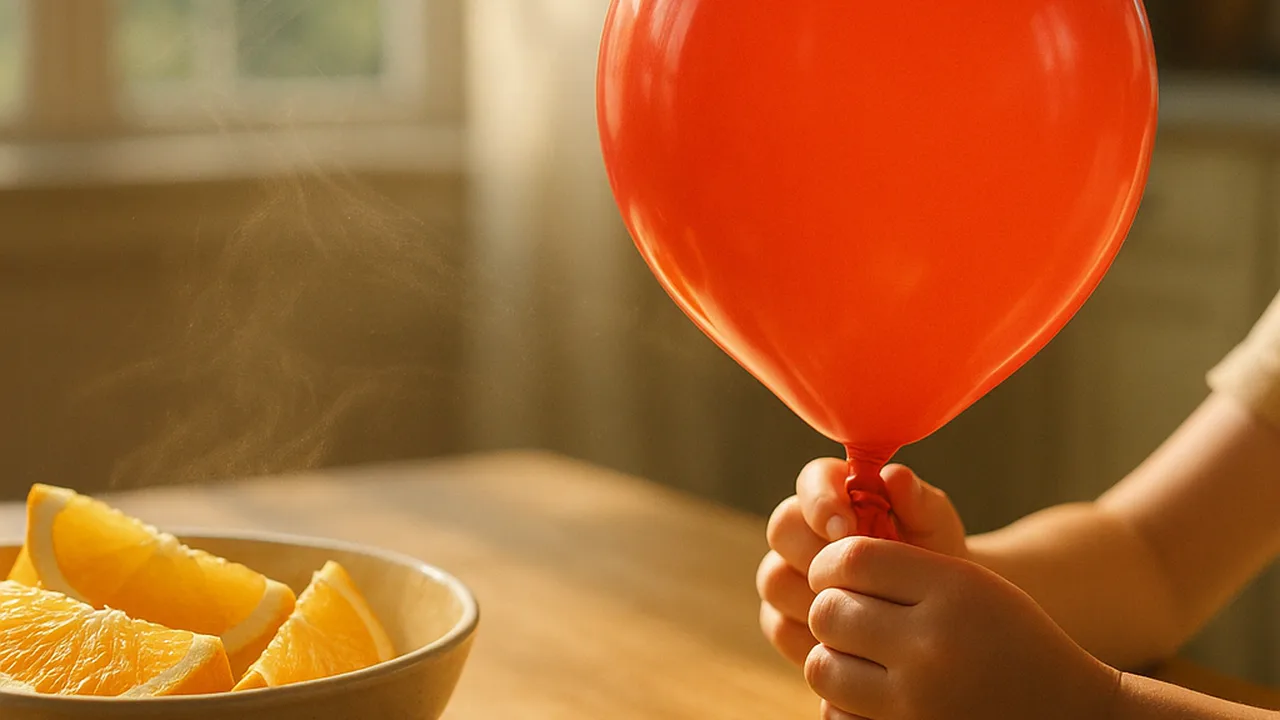
gather evidence that air and smells are matter made of particles too small to see, and use a model to explain what we observe.
- I can use my model to describe how tiny, invisible particles make up the matter we can see and touch.
- I can explain how the way many tiny particles behave together helps us understand things we observe, like a balloon expanding or sugar dissolving.
- I can use my model to explain how matter made of tiny, unseen particles can cause things we notice, like air filling a basketball or ice turning into water.
Phase 2: Investigate
Warm-Up ~5 min
Do Now. Your teacher holds up a flat ball and a pump. First the flat ball goes on a kitchen scale. Then the teacher pumps it full of air and weighs it again. Predict before you see the numbers.
After the ball is pumped full of air, what will the scale show?
Instruction ~10 min
Pantry detectives, we are hunting invisible matter. Matter is anything that has mass and takes up space. Sugar is matter. So is water. But what about air, or a smell? Today you will test three stations and record evidence.
- Balloon bottle: stretch a balloon over the mouth of an empty plastic bottle. Set the bottle in a tub of warm water for two minutes. Then move it to a tub of ice water. Watch the balloon each time.
- Squeeze test: pull a syringe (no needle) full of air. Cover the tip with your finger and push the plunger. Then let go.
- Smell spread: your teacher opens a jar of vanilla or peels an orange at the front of the room. Raise your hand the moment you smell it. The Recorder notes the time and where each hand goes up.
| Station | What I did | What I observed | Evidence that something invisible is there |
|---|---|---|---|
| Ball on the scale | |||
| Balloon bottle, warm water | |||
| Balloon bottle, ice water | |||
| Squeeze test | |||
| Smell spread (seconds to reach my seat) |
Worked example 1: the balloon bottle. Mei saw the balloon puff up in warm water and droop in ice water. Nobody added air. Mei drew the bottle full of tiny dots. In the warm picture, the dots move fast and spread apart. They push on the balloon from inside, so it fills. In the cold picture, they slow down and stay closer together.
Worked example 2: the smell. Jamal sat near the front and smelled the orange first. Priya sat at the back and smelled it later. Nothing visible floated across the room. Their model: tiny bits of the orange went into the air, spread out, and finally reached the back row.
The pattern. In every station, something we could not see still caused something we could see: a heavier ball, a fuller balloon, a smell. Models with tiny particles help us explain all of them.
Guided Exercises ~15 min
Use your team’s table to answer these together.
Independent Practice ~10 min
Model one station on your own.
Draw the balloon bottle in warm water and in ice water. Use dots for air particles. Label the matter you can see and the particles you cannot. Explain your drawing in two sentences.
Closure ~5 min
Air and smells are matter too, even though we cannot see them. Next time, we put matter on a scale: does dissolved sugar still have mass?
Exit ticket: a basketball is pumped up for a game. Use the idea of tiny particles to explain why it feels firm.
Teacher notes
Materials: a flat playground ball and a pump, a kitchen scale that reads in grams; per team: an empty plastic bottle, a balloon, two tubs (warm tap water and ice water), a plastic syringe with no needle. One orange or a small jar of vanilla.
Setup: weigh the ball yourself before class to be sure your scale shows the change; a few grams is typical. Stretch the balloons a few times first so they inflate easily.
Listen for: “hot air rises, so it went up into the balloon” (the air spread out in all directions); “the particles got bigger” (the particles spread apart; they did not grow). Keep to particles; no atoms or molecules (5-PS1-1 boundary).
Support / stretch: give a partly drawn model with dots to finish. Stretch: predict how long the smell would take to reach the back in a room twice as long, and explain why.