1.07 The Puffing Bag: Mixing in a Sealed Bag
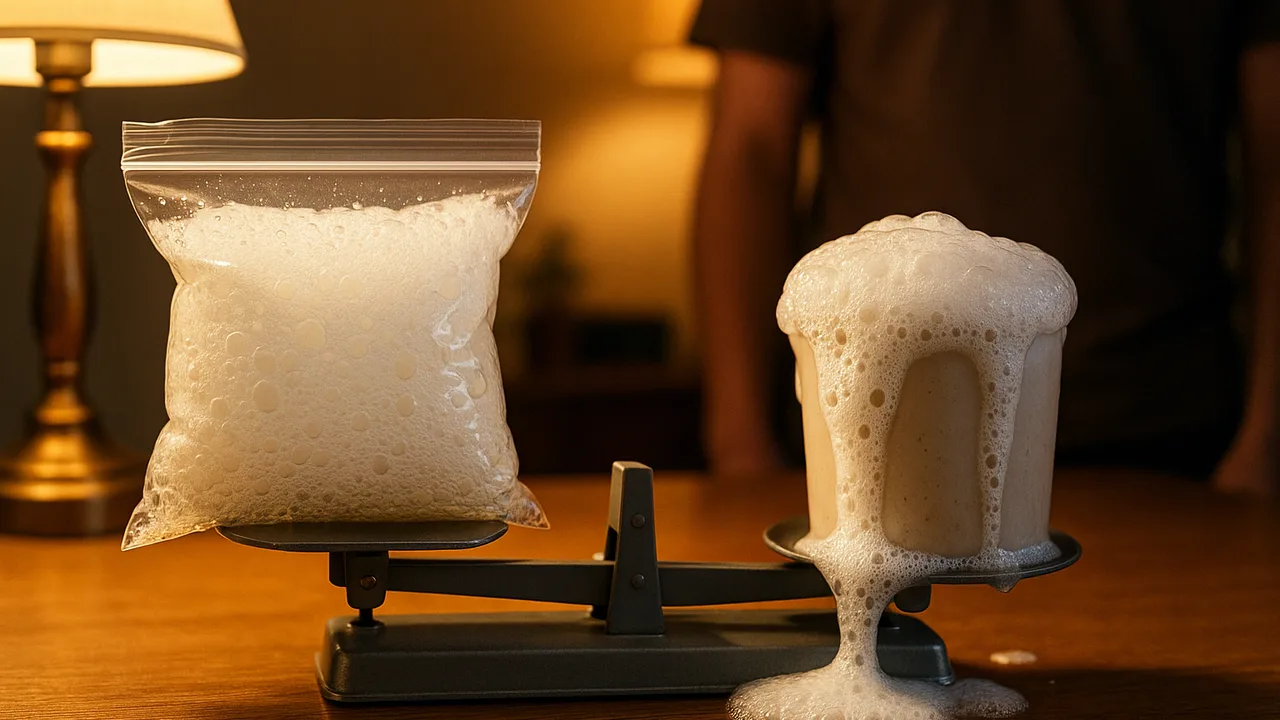
measure the mass of baking soda and vinegar before and after mixing, in a sealed bag and an open one, and use the data as evidence about mass.
- I can use my measurements and calculations to explain that the total weight of the substances stayed the same, even if their properties changed.
- I can use my measurements and what I know about patterns in nature to give evidence that the total weight of matter is conserved after heating, cooling, or mixing substances.
Phase 2: Investigate
Warm-Up ~5 min
Do Now. Your teacher drops a pinch of baking soda into a cup of vinegar. Fizz! Bubbles rise and pop. Bubbles hold gas, and gas is matter. Where do you think that gas goes?
If we mix baking soda and vinegar inside a SEALED bag, what will the scale show afterward?
Instruction ~10 min
Pantry detectives, this is our trickiest mass test. We will mix a powder and a liquid. The mixture fizzes and makes a gas. Is mass still the same afterward? A sealed bag lets us catch the gas.
Sealed-bag test. Put half a teaspoon of baking soda in one corner of a zip bag. Stand a small cup holding 2 spoonfuls of vinegar upright in the bag. Seal it. Weigh it: this is before. Now tip the cup so the vinegar reaches the powder. Do not open the bag. When the fizzing stops, weigh it again.
Open-bag test. Do the same thing, but leave the bag open while it fizzes. Weigh before and after.
| Test | Mass before (g) | What I observed (bubbles, sound, temperature, bag shape) | Mass after (g) | Difference (g) |
|---|---|---|---|---|
| Sealed bag | ||||
| Open bag |
Worked example 1: the sealed bag. Priya’s team measured 58 g before. The bag fizzed, felt cool, and puffed up. After: 58 g. The difference is 0 g. The gas stayed trapped in the bag, so its mass was still counted.
Worked example 2: the open bag. Diego’s team measured 57 g before and 56 g after. The bubbles popped, and gas floated out into the room. The scale could not count the gas anymore, so the total looked smaller. The matter was not destroyed. It just left the bag. These are sample numbers.
The pattern so far. Dissolving, melting, freezing and now mixing: when we catch all the matter, the total mass stays the same. Is the gas a brand new substance? That is a question we will investigate later in the unit.
Guided Exercises ~15 min
Use both rows of your data table to answer these.
Independent Practice ~10 min
Connect all three mass investigations.
Look at your data from dissolving, melting and freezing, and the sealed bag. What pattern do you see in the mass every time? Give two numbers as evidence.
How confident are you that you can I can use mass data to show that matter is not lost when substances are mixed.
Closure ~5 min
Even a fizzing mixture keeps its mass when we catch all the matter. Next time, we start measuring the properties that will crack the pantry mystery.
Exit ticket: a classmate says, “The open bag proves matter can disappear.” Use the sealed-bag data to answer them.
Teacher notes
Materials (per team): goggles, a kitchen scale, 2 sturdy quart zip bags, 2 small paper cups, baking soda, white vinegar, measuring spoons, paper towels.
Setup: keep amounts small (half a teaspoon of baking soda) so bags only puff a little. Do a trial run first. A strongly puffed bag can read about a gram light even when sealed, because the bigger bag is pushed up slightly by the surrounding air, the way a balloon is; the matter is all still there. Small amounts keep this effect below what a kitchen scale shows.
Listen for: “gas has no mass” and “the fizzing destroyed some matter.” Do not teach that a new substance formed yet; that question belongs to 5-PS1-4 later in the unit.
Support / stretch: give a sentence frame for the pattern. Stretch: how could a team catch the gas from the open bag to prove it has mass?