1.10 Shrinking Down: A Particle Model of Matter
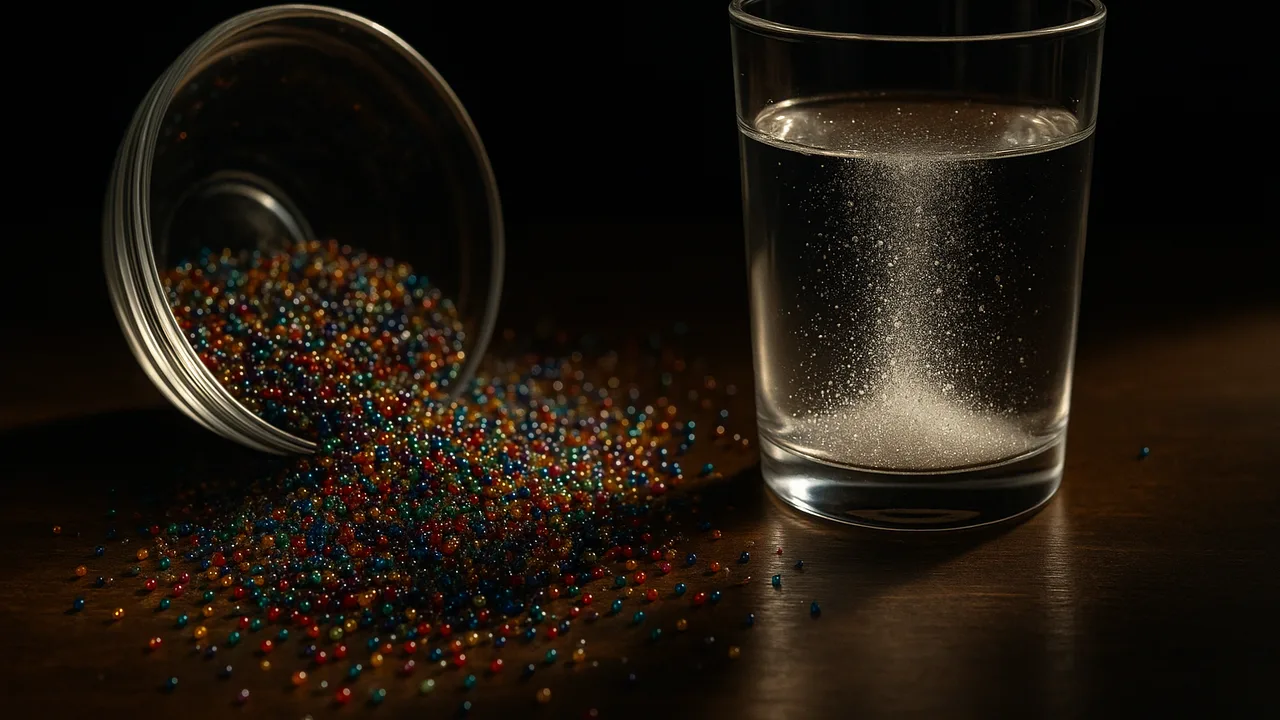
develop and use a particle model to explain dissolving sugar, a puffing balloon and a spreading smell, and write a CER about where the sugar went.
- I can develop a model to show that matter is made of tiny particles that are too small to see.
- I can identify and label both the visible matter (like sugar, air, or water) and the tiny particles in my model.
- I can use my model to describe how tiny, invisible particles make up the matter we can see and touch.
- I can explain how the way many tiny particles behave together helps us understand things we observe, like a balloon expanding or sugar dissolving.
- I can use my model to explain how matter made of tiny, unseen particles can cause things we notice, like air filling a basketball or ice turning into water.
Phase 3: Make Sense
Warm-Up ~5 min
Do Now. Look back at your sugar trail, balloon and smell notes. Each time, something we could not see caused something we could see. Talk with a partner: what do all three have in common?
Which idea explains ALL three investigations best?
Instruction ~10 min
Now we can name what you found. Scientists explain many puzzles with one big idea: all matter is made of particles that are much too small to see. A single grain of sugar is made of a huge number of them. We cannot see one particle, but we can see what billions of them do together.
Three rules of our particle model.
- All matter, including solids, liquids and gases, is made of tiny particles.
- The particles are always moving. In a gas, they move freely and spread far apart.
- Particles do not disappear. They can spread out, mix in or pack closer, but they are still there.
Worked example 1: the vanishing sugar. A sugar grain is a big crowd of particles stuck together. In water, the particles break away from the grain. They spread out between the water particles. Each one is far too small to see, so the water looks clear. The salt dish proved it: when the water left, the salt particles packed back into crystals we could see.
Worked example 2: a CER. Here is how Mei’s team explained the disappearing sugar.
- Claim: The sugar is still in the water as particles too small to see.
- Evidence: The cup and sugar had the same total mass before and after dissolving. Salt crystals reappeared when salt water evaporated.
- Reasoning: Matter is made of tiny particles that do not disappear. Dissolving spreads them out until we cannot see them, but their mass is still there.
Model it. Draw three zoom-in circles: sugar water, the warm balloon bottle, and the orange smell. Inside each circle, draw particles as dots. Label what we can see outside the circle and the particles inside it.
Guided Exercises ~15 min
Use your model and your data to answer these with your team.
Independent Practice ~10 min
Write your own CER. Use these sentence starters:
- Claim: When sugar dissolves, the sugar ___.
- Evidence: In our test, the mass before was ___ g and after was ___ g. We also observed ___.
- Reasoning: This shows ___ because matter is made of ___.
Write your CER: where did the sugar go? Include a labeled particle model drawing and data from your own table.
Closure ~5 min
One model explained three mysteries. Next time, we use the same model and our scale data to explain why mass is never lost.
Exit ticket: use the particle model to explain why you can smell cookies baking from another room.
Teacher notes
Materials: students’ notes from 1.03–1.05, the salt dish, chart paper and markers, small round stickers or dot stamps for particles.
Setup: post the three model rules and the CER sentence starters. Gallery-walk the models for the last 5 minutes.
Listen for: “particles get bigger when heated” and “there is empty air between particles” (between particles there is nothing; air is itself particles). Stay at the particle scale: do not introduce atoms or molecules, which are beyond the 5-PS1-1 boundary.
Support / stretch: give a half-drawn model to finish. Stretch: add a fourth zoom-in circle for the syringe being squeezed.