2.03 Light, Water and a Fair Plant Test
set up a fair test of how light and water affect plant growth, and record my first measurements in a data table.
- I can describe evidence that shows plants grow bigger over time.
- I can explain how changes in the weight of soil and water in a closed system show that soil does not provide most of the material for plant growth, and that plants need water to grow.
- I can describe evidence that plants need air to grow and that air is matter.
Phase 2: Investigate
Warm-Up ~5 min
Plant detectives. The garden club asks a simple question. Where should we put each garden bed? Some spots get lots of sun and some are shady. Some are close to the hose and some are not. Make a prediction.
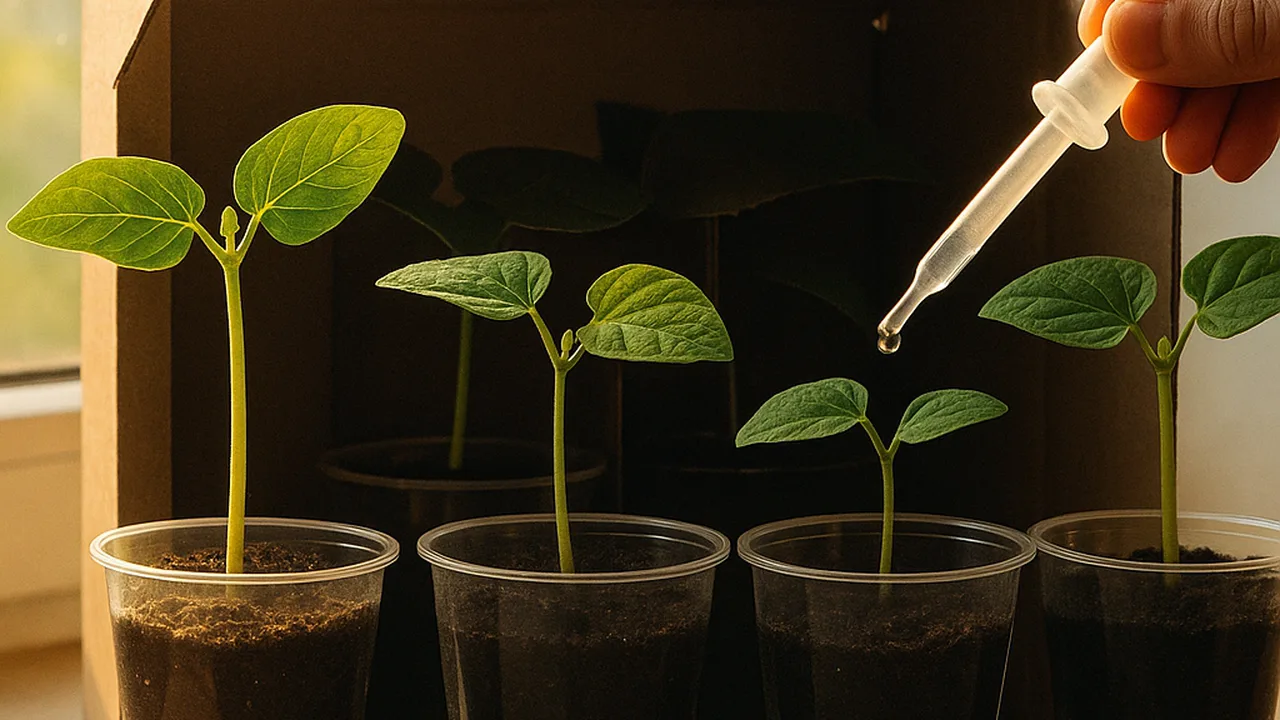
Four bean seedlings get different care for ten days. Which one will look the healthiest?
Instruction ~10 min
Explore first. Today you are scientists running a real test. You will try things, measure carefully and write down what you notice. We will name the big ideas later. For now, use your own words.
The Four Cups investigation. Each team gets four clear cups of potting soil. Each cup has a bean or radish seedling that has just come up. Label the cups A, B, C and D.
- Cup A goes in a sunny window and gets water every other day.
- Cup B goes in a dark cupboard and gets the same water.
- Cup C goes in the sunny window but gets no water.
- Cup D goes in the dark cupboard with no water.
- Measure each plant’s height in centimeters from the soil to the top. Note its color and count its leaves.
Fair test. Only change one thing at a time. All four cups get the same soil, the same kind of seed, the same cup size and the same amount of water when watered. Light and water are the only things we change.
| Cup | Light? | Water? | Day 1 height (cm) | Day 1 color and leaves | Later height (cm) | Later color and leaves |
|---|---|---|---|---|---|---|
| A | yes | yes | ||||
| B | no | yes | ||||
| C | yes | no | ||||
| D | no | no |
Worked example 1: measuring well. Priya sets the ruler’s zero mark right at the soil. She reads the height at the tip of the top leaf and writes “4.5 cm.” She measures twice to be sure. Starting at zero every time keeps the measurements fair.
Worked example 2: a fair or unfair test? Malik wants to give Cup A extra fertilizer too. His teammate says that would change two things at once. If Cup A grows best, nobody would know why. Malik agrees to keep the fertilizer out.
Back to the client. Every design has criteria (what it must do) and constraints (its limits). Start a list for the garden now and add to it all phase.
| Criteria: our garden must… | Constraints: our limits are… |
|---|---|
| give every plant what it needs to grow | only a small space behind the school |
Guided Exercises ~15 min
Use your Four Cups setup to answer these. The Recorder checks each answer against the notebook.
Independent Practice ~10 min
Plan what you will watch for.
Predict what each cup will look like in ten days. Write one sentence for each cup and a reason for each guess.
How confident are you that you can I can set up a fair test of what plants need to grow.
Closure ~5 min
Your four cups are set up and measured. Over the next days, the Recorder will check them. Next lesson, we read the results from cups that were started ten days ago.
Exit ticket: why do we change only one thing at a time in a plant test?
Teacher notes
Materials: 4 clear plastic cups per team, potting soil, bean or radish seedlings (sprout them about a week ahead), rulers in centimeters, masking tape labels, a measuring spoon or small cup for water, a dark cupboard or box. Rotate team roles today: Materials Manager, Recorder, Tester, Reporter. Each person gets a new job.
Setup: also start one teacher set of four cups ten days before this lesson so 2.04 has results to read on day one. Use the same small, measured amount of water for every watering.
Listen for: “the plant in the dark will not grow at all” (many grow taller but pale and weak at first, living off the seed’s stored food); confusing height with health.
Support / stretch: give a pre-labeled table and a ruler with the zero mark highlighted. Stretch: ask teams to add a fifth cup that tests a different variable, such as the amount of water.