1.05 The Mass Detective: Dissolving on the Scale
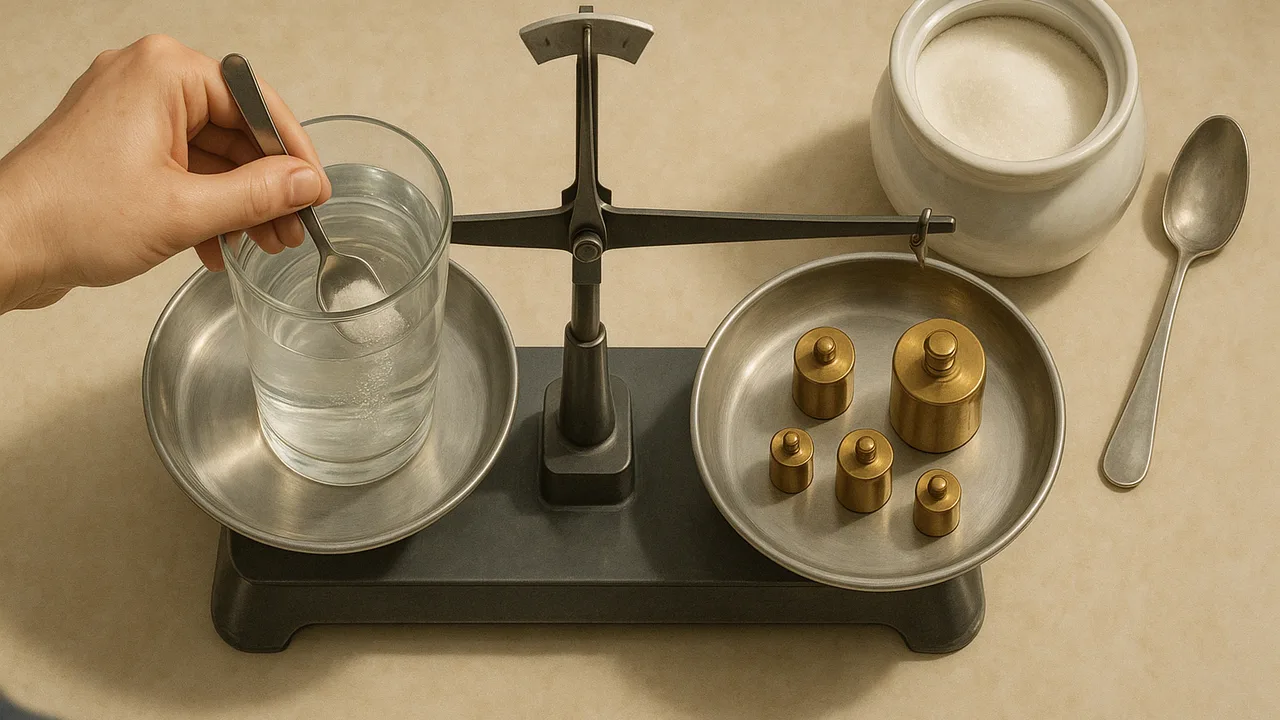
measure the mass of water and sugar before and after dissolving, find the difference, and describe the changes we observe.
- I can measure the weight of substances before they are heated, cooled, or mixed using standard units.
- I can measure the weight of substances, including any new substances made, after they are heated, cooled, or mixed.
- I can make a graph to show the weights I measured before and after heating, cooling, or mixing substances.
- I can measure or calculate the difference between the total weight of substances before and after they are heated, cooled, or mixed.
Phase 2: Investigate
Warm-Up ~5 min
Do Now. A cup of water and a small cup of sugar sit side by side on a scale. Together they show 250 grams. Next, the sugar will be stirred into the water, and both cups go back on the scale.
After the sugar dissolves, what will the scale show for both cups together?
Instruction ~10 min
Pantry detectives, today you measure. Scientists measure mass in standard units called grams. A paper clip has a mass of about 1 gram. Our kitchen scales read to the nearest gram.
How to run the dissolving test.
- Zero the scale with nothing on it.
- Put a cup of water AND a small cup holding 2 spoonfuls of sugar on the scale together. Record the total. This is before.
- Pour all the sugar into the water. Stir until you cannot see it. Tap every last grain out of the small cup.
- Put BOTH cups and the spoon back on the scale. Record the total. This is after.
- Repeat with salt. Run each test twice.
| Test | Total mass before (g) | What I observed during mixing | Total mass after (g) | Difference (after − before, g) |
|---|---|---|---|---|
| Sugar, trial 1 | ||||
| Sugar, trial 2 | ||||
| Salt, trial 1 | ||||
| Salt, trial 2 |
Worked example 1: finding the difference. Malik’s team measured 312 g before and 312 g after. The difference is 312 − 312 = 0 g. A second team measured 298 g before and 297 g after. That is a difference of 1 g. These are sample numbers.
Worked example 2: is 1 gram a real change? Our scales round to the nearest gram. A few drops spilled or one grain left behind could also explain 1 gram. So scientists repeat tests and look at the pattern across many teams. If most teams get 0 or 1 gram, the mass stayed about the same.
Check the salt dish. Look at the salt water dish from 1.03. If the water has evaporated, you should see white crystals left behind. The salt was in the water the whole time.
Guided Exercises ~15 min
Use your data table to answer these. The Recorder reads the numbers aloud.
Independent Practice ~10 min
Look at your own team’s data.
Calculate the difference for each of your trials. Did the total mass go up, go down, or stay about the same? Use your numbers.
How confident are you that you can I can measure mass before and after mixing and find the difference.
Closure ~5 min
The sugar disappeared from sight, but not from the scale. Next time, we test whether melting and freezing change mass.
Exit ticket: before dissolving, a team measured 274 g. After, they measured 274 g. What does this tell you about the sugar?
Teacher notes
Materials (per team): a kitchen scale in grams, a clear cup of water, a small paper cup, a spoon, sugar and salt, paper towels. The salt dish from 1.03.
Setup: check that every scale reads the same object to within 1 g. Post a class chart of before/after totals so 1.11 can graph them.
Listen for: “sugar has no mass once it dissolves”; forgetting to put the empty cup back on. Treat a 1 g difference as measurement error and discuss it.
Support / stretch: provide a filled-in model row. Stretch: predict the after mass if the team used 4 spoonfuls of sugar, then test it.