2.06 Air Has Mass, and Plants Without Soil
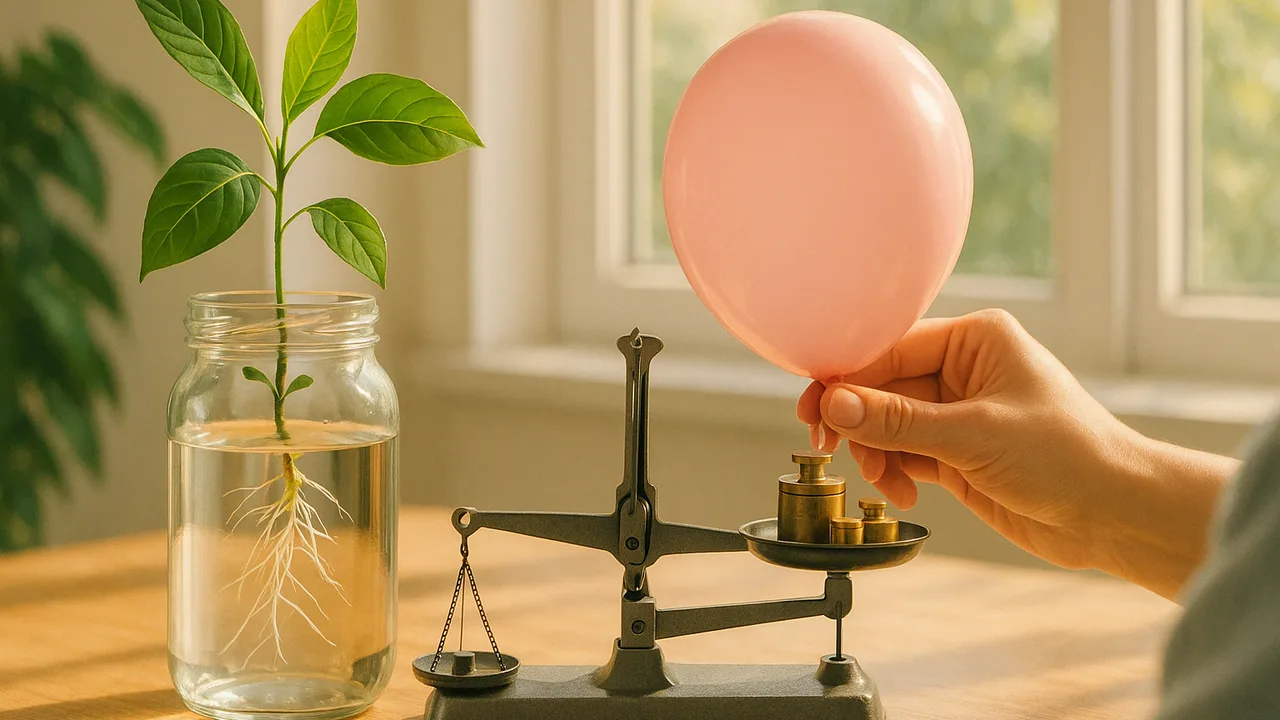
collect evidence that air is matter and that some plants can grow with no soil, and use it to decide where a plant’s materials come from.
- I can describe evidence that shows plants grow bigger over time.
- I can explain how changes in the weight of soil and water in a closed system show that soil does not provide most of the material for plant growth, and that plants need water to grow.
- I can describe evidence that plants need air to grow and that air is matter.
- I can analyze evidence to decide if plants need air, soil, or water to grow.
- I can use evidence to figure out if air, soil, or water can provide enough matter to explain how a plant’s weight increases as it grows.
- I can use reasoning to explain that soil changes very little in weight while plants grow a lot, and that some plants can grow without soil.
- I can argue that since plants can grow without soil and soil does not lose enough matter as plants grow, soil is not the main source of material for plant growth.
- I can explain that plants need water and air to grow, and since both are matter and enter the plant, they provide the materials plants need for growth.
Phase 2: Investigate
Warm-Up ~5 min
Two stations today. At Station 1 you weigh air. At Station 2 you look at plants that have never touched soil. First, a prediction.
You weigh a flat ball. Then you pump it full of air and weigh it again. What happens to its mass?
Instruction ~10 min
Explore first. Your team visits two stations. Record what you measure and see before we talk about it.
Station 1: Weighing air. Weigh a deflated playground ball on the balance. Pump it up until it is firm. Weigh it again. Then let a little air out and weigh it a third time.
Station 2: Plants with no soil. Look at green onions and pothos cuttings that have grown for two weeks in jars of plain water. Measure the longest root and the newest leaf. Compare them to the photo from day one.
| Station | What we did | Measurement or observation | What it shows |
|---|---|---|---|
| 1 | Weighed flat ball | ||
| 1 | Weighed full ball | ||
| 1 | Let some air out, weighed again | ||
| 2 | Green onion in water: new growth | ||
| 2 | Pothos cutting in water: new roots and leaves |
Worked example 1: reading Station 1. Malik’s flat ball has a mass of 410 grams. Full, it has a mass of 414 grams. He writes, “The ball gained 4 grams when we added air. Air has mass, so air is matter.” (Example numbers; your ball may differ.)
Worked example 2: reading Station 2. Mei sees that the green onion grew new green shoots with only water, light and air. There was no soil at all. She writes, “This plant made new matter without soil. So soil cannot be the main source of plant matter.”
Air goes into plants. Leaves have tiny openings, too small to see without a microscope. Air moves in and out through them. Water moves up from the roots. So both water and air enter the plant. Both are matter.
A real example. Some farms grow lettuce and herbs indoors with their roots in water instead of soil. This is called hydroponics. Farmers add a small amount of plant nutrients to the water, but no soil.
Guided Exercises ~15 min
Use your station data to answer these. The Reporter checks each answer with the team.
Independent Practice ~10 min
Use all your evidence so far.
Rank these as sources of a plant's new matter, from most to least: soil, water, air. Give one piece of evidence for each place in your ranking.
How confident are you that you can I can explain why air and water, not soil, supply most of what a plant needs to grow.
Closure ~5 min
Air is matter, and plants can grow without soil. Water and air both go into a plant. Next, we leave plants for a moment and ask who eats whom in a backyard near the woods.
Exit ticket: finish the sentence. “A plant gets most of the materials it needs to grow from ____ and ____, because…”
Teacher notes
Materials: a playground ball or basketball and a hand pump with a needle, a balance that reads to 1 gram, jars of water with green onion bottoms and pothos cuttings started two weeks earlier, day-one photos, rulers. Rotate team roles today: Materials Manager, Recorder, Tester, Reporter. Each person gets a new job.
Setup: test the ball ahead of time; a basketball usually gains a few grams, enough to see on a gram balance. Start the water jars two weeks ahead and photograph them on day one.
Listen for: “air makes things lighter, like a balloon” (a helium balloon floats because helium is lighter than air, but it still has mass); “the onion is just using its stored food” (partly true at first; over weeks it keeps adding green matter). Avoid explaining how plants turn air and water into food; that is beyond this unit.
Support / stretch: give a word bank (gained, lost, matter, mass, no soil). Stretch: ask students to design a fair test comparing a plant in soil with one in water.