1.24 Hand-off Day: Presenting the Kit to the Pantry
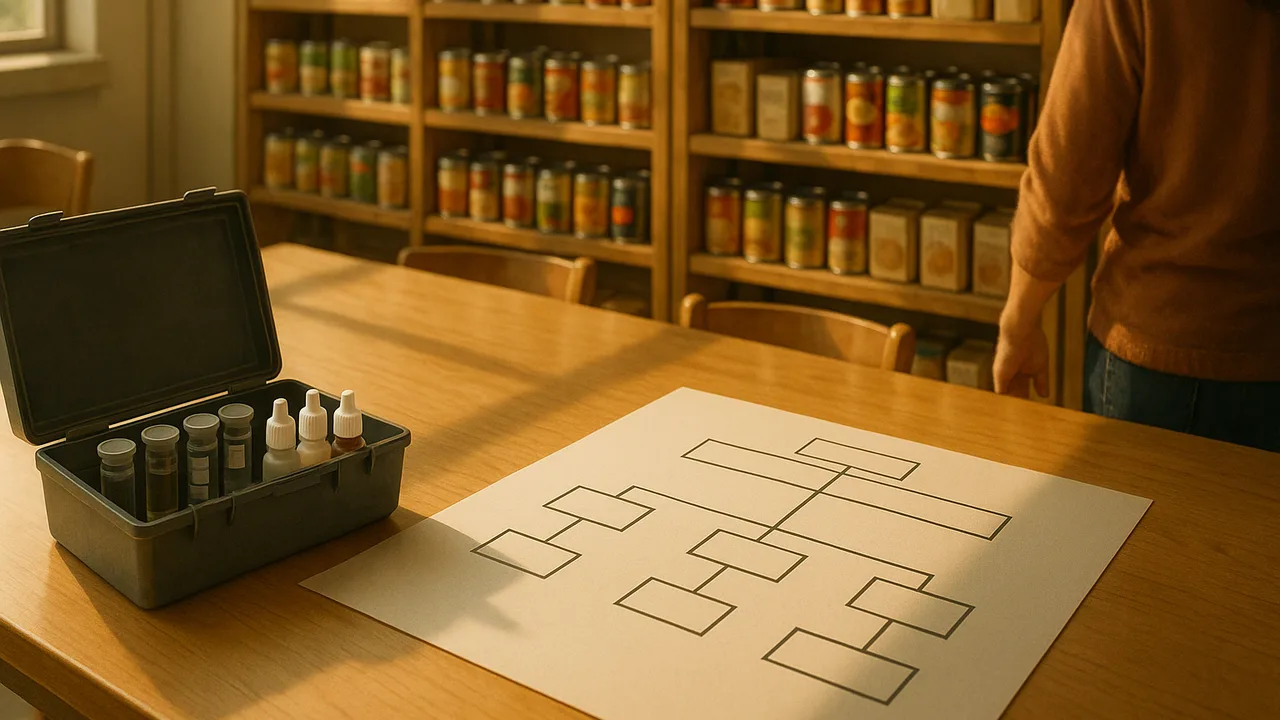
present our test kit and ID key to the food pantry and explain the science behind every step.
- I can share my ideas and findings about design solutions with others to help create more possible solutions.
- I can identify what we are investigating, including the properties of materials we can observe and measure.
- I can explain how my data will show if mixing substances made a new substance or not.
Phase 5: Prove It
Warm-Up ~5 min
Do Now. The pantry volunteers are busy adults, not scientists. Which sentence would help them most?
Which instruction is clearest for a pantry volunteer?
Instruction ~10 min
Junior chemists, today is hand-off day. The pantry manager and volunteers visit, in person or by video. Each team presents its kit and trains a volunteer to use it.
Your presentation has four parts. 1. The problem: who needs the kit and why. 2. The kit and key, step by step. 3. The science: which property each step tests. 4. The evidence: your blind test results and one improvement you made.
Explain the science simply. “Vinegar makes baking soda fizz. The bubbles are a new gas, so a new substance formed. No other powder does that.” Every step should say what it tests and why.
Worked example 1: Priya’s opening. “Your volunteers find unlabeled white powders. Tasting is never safe. Our kit names five powders in under 10 minutes, using only water, vinegar and a few tools.” She named the client’s need, a criterion and a constraint.
Worked example 2: Malik’s evidence. “In our blind test, version 1 got 4 of 6 right. Our flour step was the failure point. We added a dough test. Version 2 got 6 of 6 right.” He used data to show why the kit can be trusted. These are sample numbers.
Share and borrow. When it is not your turn, watch other teams. Write down one idea the class could combine into a single best kit.
Guided Exercises ~15 min
Rehearse with your team before the pantry visit.
Independent Practice ~10 min
After the presentations, reflect.
What did the pantry visitors ask or suggest? Name one idea from another team that could make the class kit better.
Project task: The Mystery Powder Test Kit
Deliver a safe test kit and flowchart ID key that pantry volunteers can use to identify flour, sugar, salt, baking soda and cornstarch without ever tasting them. Present the kit, train a volunteer, and explain the science and the test data behind it.
Submission workflow
- Finish version 2 of your key using your blind test results. Note the one failure point you fixed.
- Pack the kit: key card, supplies list, log sheet and the “never taste, not sure? set it aside” rule.
- Prepare a presentation: the problem, the steps, the property each step tests, and your test evidence.
- Present to the pantry and train one volunteer to run a sample with your key.
How it is scored
| Criterion | What proficient looks like |
|---|---|
| Criteria and constraints | The key identifies all five powders, has a safe “not sure” exit, uses kitchen-safe supplies, fits in a shoebox and runs in 10 minutes or less. |
| Science of properties | Every step names the property it tests (reaction with vinegar, solubility, conductivity, texture) and explains why baking soda’s fizz is evidence of a new substance. |
| Testing and improvement | The team shows blind test data, names a failure point, and shows results before and after one revision. |
| Communication | The talk and key use clear, simple words for volunteers; every team member speaks; the team shares an idea with or from another team. |
Closure ~5 min
You did it, junior chemists. Your kit is a real tool for real people. Next: the unit checkpoint, then two catch-up and stretch days.
Exit ticket: which question on our Wonder Board can you now answer? Write the question and your answer.
How confident are you that you can I can explain how my design meets the client's needs, using science and data.
Teacher notes
Materials: finished kits, key cards, log sheets, poster paper, goggles for visitors, known powder samples for the training demo.
Setup: contact the pantry ahead of time; a video call works if a visit is not possible. Be clear with the pantry that the kit is a sorting and teaching tool: the pantry’s own food safety rules decide what is given out, and many pantries discard unlabeled food. Score the rubric during the presentations.
Listen for: talks that list steps without the property behind them; one student doing all the talking.
Support / stretch: give a presentation frame with four headings. Stretch: combine the best steps from several teams into one class master key.