1.26 Catch-up and Stretch: Particles, Weight and Mixing
practice the matter ideas I found hardest and stretch my thinking with a new challenge.
- I can use my model to describe how tiny, invisible particles make up the matter we can see and touch.
- I can explain how the way many tiny particles behave together helps us understand things we observe, like a balloon expanding or sugar dissolving.
- I can use my measurements and calculations to explain that the total weight of the substances stayed the same, even if their properties changed.
- I can explain how my data will show if mixing substances made a new substance or not.
Phase 5: Prove It
Warm-Up ~5 min
Do Now. Look at your checkpoint. Find one answer you want to fix. Your teacher will help you pick a choice board square.
How confident are you that you can I can use a particle model to explain why matter seems to disappear but is still there.
Instruction ~10 min
Junior chemists, today you choose. Pick at least two squares from the choice board. Catch-up squares re-teach a big idea. Stretch squares give a new challenge. Everyone does the final check.
| Square | Type | What you do | Done? |
|---|---|---|---|
| A. Sugar model redo | Catch-up | Use beads or dots to model sugar dissolving. Show the sugar particles before and after. | |
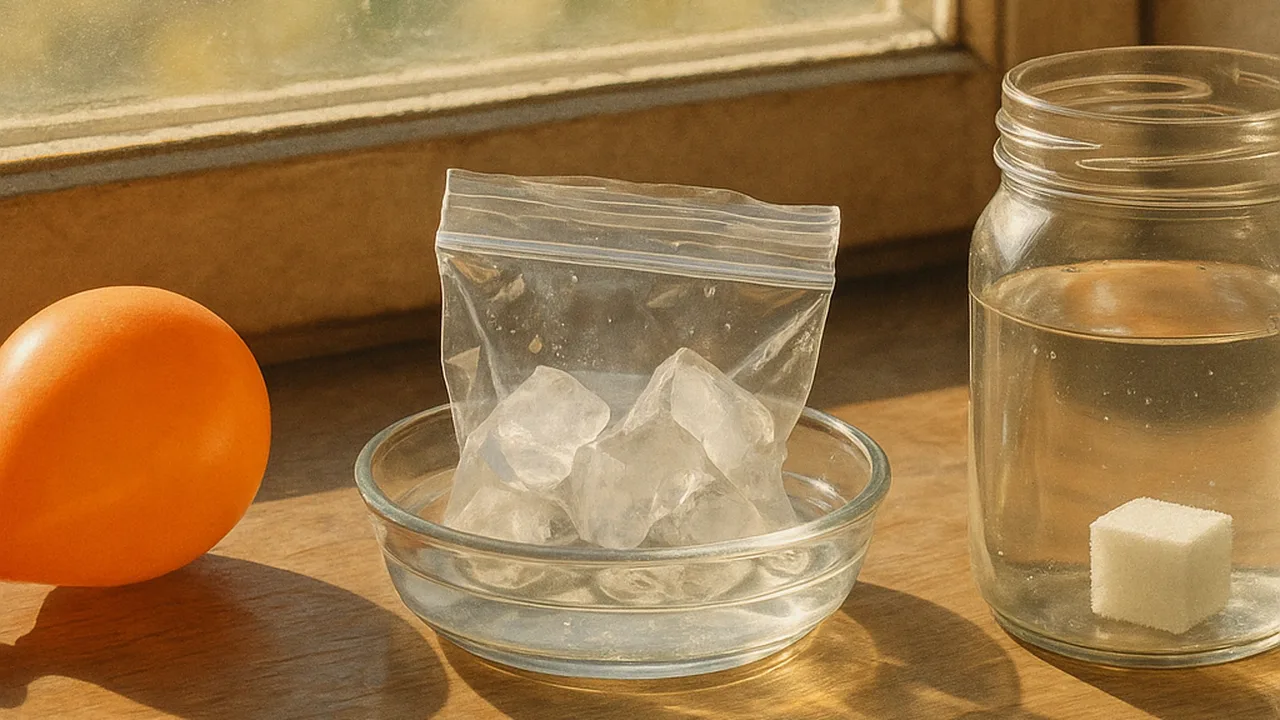
| B. Ice in a bag | Catch-up | Weigh a sealed bag with an ice cube. Weigh it again after it melts. Find the difference. | |
| C. New or mixture? | Catch-up | Sort 8 picture cards of mixes into “new substance” or “mixture”. Write one clue for each. | |
| D. Does gas weigh anything? | Stretch | Weigh a sealed bag after baking soda and vinegar react. Open it, press out the gas, reseal and weigh again. | |
| E. Baking powder puzzle | Stretch | Add plain water to baking powder. Explain why it fizzes with no vinegar. Hint: read the box’s ingredients. |
Worked example 1: square B. Ava’s sealed bag with ice weighed 52 g. After melting, it still weighed 52 g. Her claim: melting does not change the total weight. Her evidence: 52 g before and after. Her reasoning: no particles got in or out of the sealed bag. These are sample numbers.
Worked example 2: square E. Diego read the baking powder box. It contains baking soda plus a dry acid powder. Water lets them mix and react, so it fizzes. His conclusion: a key that only uses vinegar might mix up baking powder and baking soda. A good stretch question for version 3!
Guided Exercises ~15 min
Final check for everyone. Answer after your choice board squares.
Independent Practice ~10 min
Show your growth.
Explain how a balloon on top of a bottle of baking soda and vinegar shows that tiny particles we cannot see are taking up space.
Closure ~5 min
Great work. Next time: the last catch-up and stretch day, on properties and better designs.
Exit ticket: which square helped you most? What do you now understand that you did not before?
Teacher notes
Materials: beads or dot stickers, zip bags, ice, kitchen scales (0.1 g if available for square D), picture cards for square C, baking soda, vinegar, baking powder, goggles.
Setup: group students from the checkpoint results. Students who missed particle-model items start at A; conservation items, B; new substance items, C. Ice for B should be set up at the start so it melts in time.
Listen for: “gas weighs nothing”; “melting makes things lighter”; models where particles shrink or disappear. Keep models at the tiny-particle level, not atoms.
Support / stretch: pair readers for square C. Square D’s weight change may be small; a 0.1 g scale helps. Stretch: square E students present to a catch-up group.