1.16 Mixing Lab 1: Baking Soda Meets Vinegar
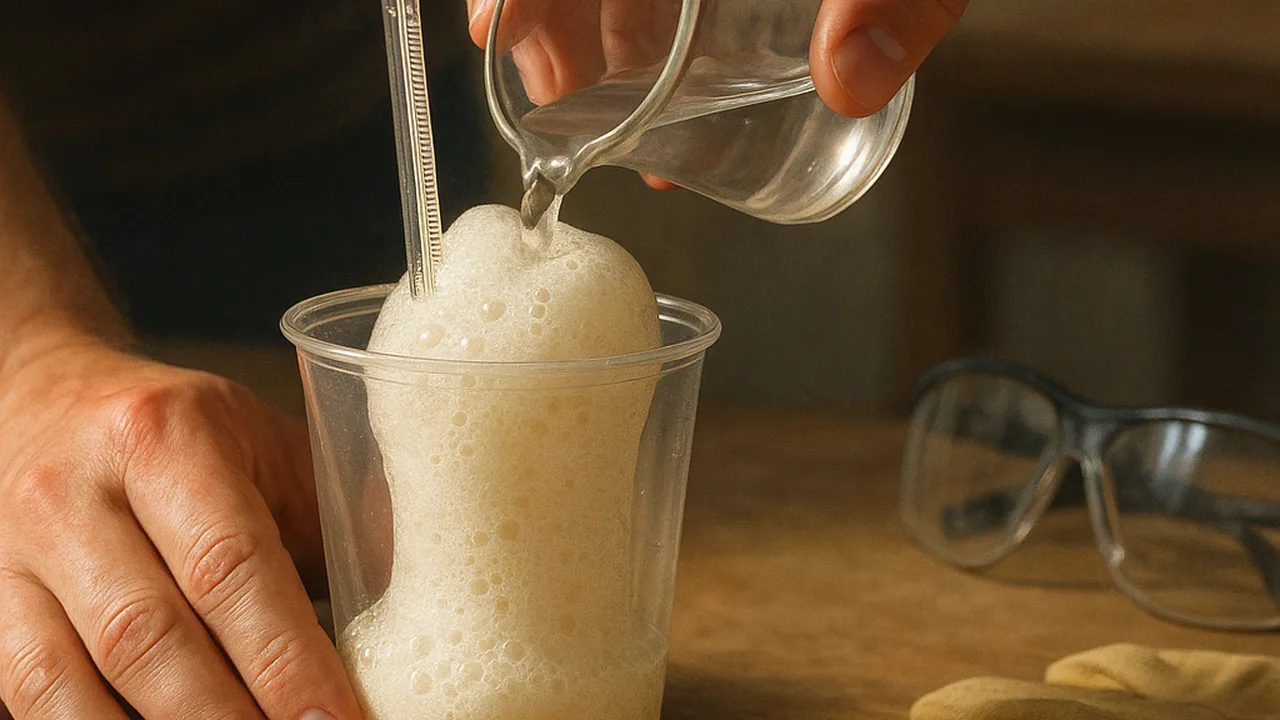
plan and carry out a fair test to find out whether mixing baking soda and vinegar makes a new substance.
- I can describe what happens when two or more substances are mixed together in an investigation.
- I can identify the purpose of the investigation as finding out if mixing substances creates new substances by looking at their properties.
- I can describe how I will measure and record the properties of the substances before mixing.
- I can describe how I will measure and record the properties of the substances after mixing.
- I can explain how I will make sure my test is fair, including how many times I will repeat it and how I will control variables like temperature and the number of substances mixed.
Phase 4: Build
Warm-Up ~5 min
Do Now. Our kit uses vinegar to find baking soda. But what actually happens when they meet? Make a prediction before we test.
When vinegar is poured onto baking soda, what will we see?
Instruction ~10 min
Junior chemists, today’s question is big. When two substances mix, do we get a new substance, or just the old ones jumbled together? The purpose of this lab is to find out using properties.
How do we know something is new? A new substance has properties the starting substances did not have. Watch for a new state, like a gas from a solid and a liquid. Watch for a color change, a new smell or a new texture. Each one is a clue.
Make it a fair test. Measure the same amounts every time: 1 spoonful of baking soda and 50 mL of vinegar. Use room-temperature vinegar. Mix only these two substances. Repeat the test 3 times so one odd result does not fool you.
Worked example 1: Priya’s before data. Baking soda: white solid powder, no smell, soft and grainy. Vinegar: clear liquid, strong sour smell. Priya also weighed each one on a scale before mixing. She wrote every property in her table.
Worked example 2: Priya’s after data. After mixing, there were bubbles of a gas. The powder was mostly gone. The liquid smelled less sour. When she mixed them inside a zip bag, the bag puffed up. The gas was made of tiny particles too small to see, and they filled the bag. A gas is a new state, so this is strong evidence of a new substance.
| Property | Baking soda (before) | Vinegar (before) | After mixing, trial 1 | Trial 2 | Trial 3 |
|---|---|---|---|---|---|
| State (solid, liquid, gas) | |||||
| Color | |||||
| Texture | |||||
| Smell (waft only) | |||||
| Weight (g) |
Guided Exercises ~15 min
Roles: Materials Manager, Measurer, Mixer and Recorder. Check your thinking between trials.
Independent Practice ~10 min
Use your data table.
Describe the changes you observed when baking soda and vinegar mixed. List at least two properties that changed.
Explain how you kept your test fair. Name two things you kept the same and how many times you repeated it.
Closure ~5 min
The fizz is more than a fun trick. It is the signal our kit will use to name baking soda. Next lab: milk and vinegar, plus a mystery mix.
Exit ticket: do you think baking soda and vinegar made a new substance? Give one piece of evidence from your table.
Teacher notes
Materials (per team): goggles, a tray, 3 clear cups, baking soda, white vinegar, a measuring spoon, a 50 mL measuring cup, a quart-size zip bag, a kitchen scale, paper towels.
Setup: pre-measure vinegar into labeled cups to save time. Run the open-cup trials first, then one bag trial per team. Keep the bags; 1.17 uses the same weighing routine.
Listen for: “the baking soda just dissolved” (dissolving does not make a gas; push for the new-state evidence); “the bubbles are air” (they are a new gas, carbon dioxide, made by the mixing). Keep explanations at the level of observable properties, not atoms.
Support / stretch: give a sentence frame: “Before, it was ___. After, it was ___.” Stretch: ask what would happen to the bag’s puffiness with half as much baking soda.