2.07 Who Eats Whom in a Backyard Near the Woods?
build food chains and a food web from common backyard and forest organisms, and show how matter moves when one living thing eats another.
- I can make a model that shows how matter moves between plants, animals, decomposers, and the environment in an ecosystem.
- I can explain how animals eat plants or other animals, and how matter moves between them when they eat.
- I can describe how decomposers, like fungi and bacteria, break down dead plants and animals and return matter to the environment.
- I can show how organisms take in matter from the environment for life and release waste back into the environment.
Phase 2: Investigate
Warm-Up ~5 min
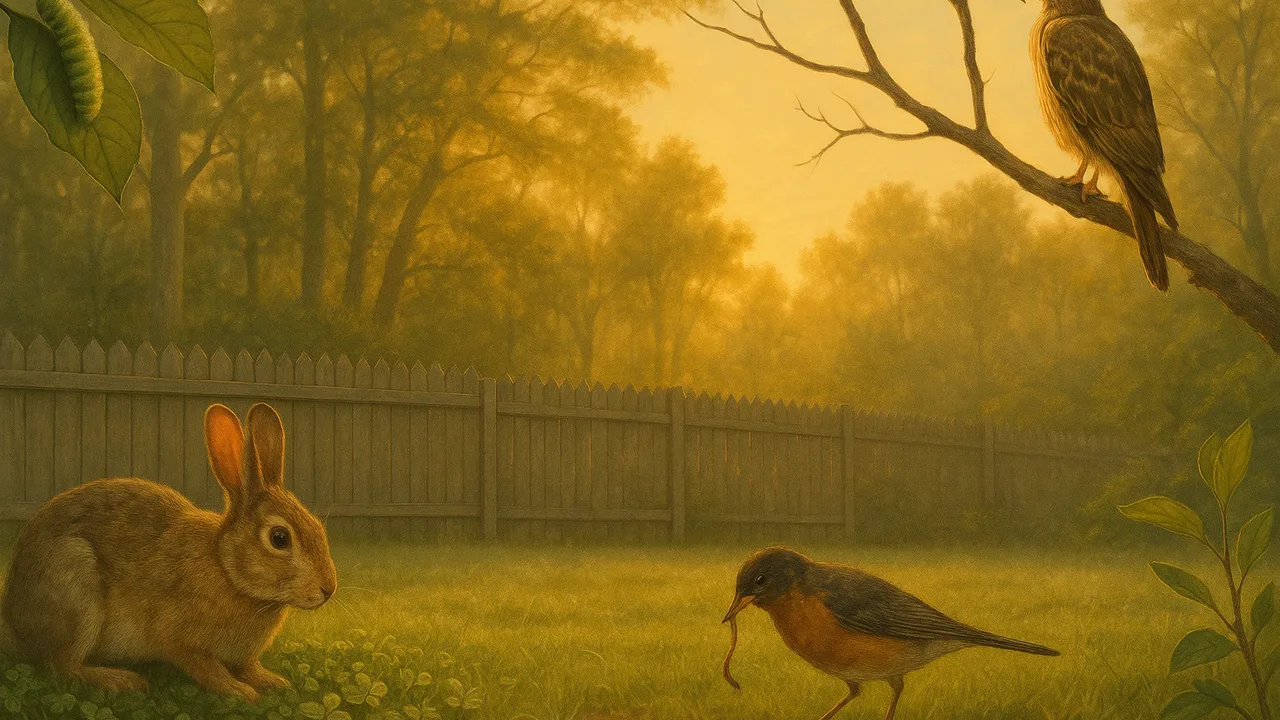
Backyard watch. Picture a backyard at the edge of an eastern forest. A rabbit nibbles clover. A robin tugs a worm from the grass. A hawk circles high above. Who depends on whom?
All the clover in the backyard is mowed down and does not grow back. What happens to the hawk that eats rabbits?
Instruction ~10 min
Explore first. Your team gets a set of organism cards. Each card shows a living thing found in many backyards and forests in our region: oak tree, clover, grass, eastern cottontail rabbit, gray squirrel, white-tailed deer, grasshopper, American robin, earthworm, garter snake, red fox, red-tailed hawk and a mushroom. Read the “What I eat” line on each card.
- Fill in the data table for every card.
- Lay the cards in a line to make a food chain of at least three living things.
- Use yarn to connect every eater to what it eats. Your chains will cross and join into a web.
| Organism | What it eats | What eats it | Makes its own food, eats others, or breaks down dead things? |
|---|---|---|---|
| Clover | |||
| Rabbit | |||
| Robin | |||
| Red fox | |||
| Earthworm | |||
| Mushroom |
Worked example 1: a food chain. Priya makes this chain: clover → rabbit → red fox. Each arrow points from the food to the eater. It shows where the matter goes. The clover’s matter becomes part of the rabbit when the rabbit eats it. Then some of the rabbit becomes part of the fox.
Worked example 2: from chain to web. Jamal notices that red foxes eat rabbits AND squirrels, and hawks eat rabbits too. When he adds those arrows, his chain turns into a web. A web shows that most animals eat more than one thing, and most are eaten by more than one thing.
Don’t forget the leftovers. Where does a fallen oak leaf go, or a robin that dies? Look at the earthworm and mushroom cards. Draw their arrows too. We will study them closely next lesson.
Guided Exercises ~15 min
Use your cards, yarn web and data table to answer these.
Independent Practice ~10 min
Draw your own model.
Draw a food web with at least six backyard or forest organisms. Use arrows from food to eater. Label one producer and two consumers.
How confident are you that you can I can make a model showing how matter moves when animals eat plants or other animals.
Closure ~5 min
Food chains and webs show how matter moves from plants to animals. But where do dead leaves and dead animals go? Next lesson, we set up two experiments to watch decomposers at work.
Exit ticket: write one food chain from today with at least three organisms. Under it, explain what each arrow means.
Teacher notes
Materials: organism cards (one set per team) with a picture and a “What I eat” line, a ball of yarn per team, safety scissors, tape. Rotate team roles today: Materials Manager, Recorder, Tester, Reporter. Each person gets a new job. Teams also record a later height for their Four Cups plants.
Card facts to use: rabbits eat clover and grass; squirrels eat acorns; deer browse plants and acorns; grasshoppers eat grass; robins eat earthworms and insects; garter snakes eat earthworms and small animals; red foxes eat rabbits, squirrels and more; red-tailed hawks eat rabbits, squirrels and snakes; earthworms and mushrooms feed on dead plant matter.
Listen for: arrows pointing the wrong way (“the fox eats the rabbit, so the arrow points to the rabbit”); “the hawk is on top, so it doesn’t need plants” (trace it back). Wait to formally name decomposers until 2.08.
Support / stretch: start some teams with a three-card chain. Stretch: ask what would happen to the web if deer numbers grew very large.