1.23 Blind Test Day: Mystery Samples
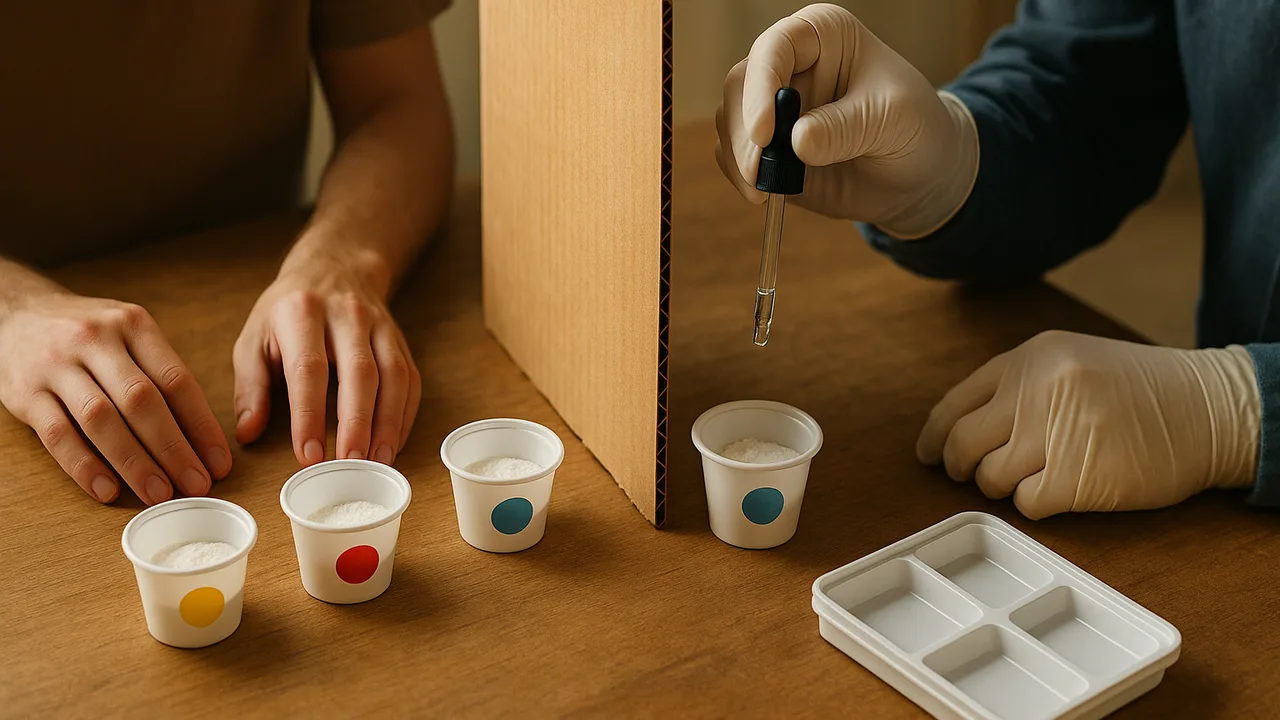
test our kit on coded mystery samples, record the results and judge how well it meets each criterion and constraint.
- I can carry out my investigation and collect and record data by following my plan.
- I can use the data I collected to compare how well each solution meets the criteria and constraints of the problem.
- I can collect and record data about materials, following the investigation plan.
Phase 5: Prove It
Warm-Up ~5 min
Do Now. Today the samples are coded with letters. Only your teacher knows which is which. Some powders may appear twice, and some may not appear at all.
Why might a powder appear twice in a blind test?
Instruction ~10 min
Junior chemists, this is the real test. A blind test means the testers do not know the answers. That is how the pantry will use the kit. The purpose is to find out whether the key works and where it might still fail.
Follow your plan. Use the test plan you wrote in 1.21. The Tester runs the key exactly as written, with no extra hints. The Timer times each sample. The Recorder writes every result. The Reporter checks the “not sure” exit is used honestly.
Worked example 1: Mei’s sample C. Vinegar: no fizz. Water: dissolved, clear. Bulb tester: no glow. Mei’s team wrote “sugar.” Time: 4 minutes. Each step was recorded before the next one began.
Worked example 2: Diego’s sample F. Vinegar: no fizz. Water: cloudy. Few drops of water: a little goopy, a little sticky. The team could not decide between flour and cornstarch. They used the exit: “Not sure, set aside.” That is not a failure of honesty. It is evidence that Box 4 needs work.
| Sample | Vinegar | Water | Box 3 or 4 result | Our ID | Time (min) | Correct? |
|---|---|---|---|---|---|---|
| A | ||||||
| B | ||||||
| C | ||||||
| D | ||||||
| E | ||||||
| F |
Guided Exercises ~15 min
Run the blind test. Pause after samples C and F to check your thinking.
Independent Practice ~10 min
Use the class results chart.
Compare your team's results with two other teams. Which key best met the criteria and constraints? Use numbers.
Name one step that failed or was slow. Explain how your observations show where the key broke down, and what you would change.
Closure ~5 min
The data is in. Next time, we hand the kit to the pantry with our final changes.
Exit ticket: would you trust your kit at the pantry tomorrow? Why or why not? Use one result.
How confident are you that you can I can carry out a test plan and use the data to judge a design.
Teacher notes
Materials: six cups per team coded A–F (include at least one repeat and leave one powder out), each team’s kit and key, timers, a class results chart, goggles.
Setup: keep the answer key in your pocket. Allow 25 minutes for testing and 10 for the results chart. Bag and discard all tested samples; none go to the pantry.
Listen for: teams using elimination instead of the key; testers adding hints that are not on the card; teams treating “set aside” as a failure rather than a safe result.
Support / stretch: give a pre-filled results table with test names. Stretch: add one powder the key was not designed for, such as powdered sugar, and see what the key does.