1.11 Nothing Lost: The Case for Conserved Mass
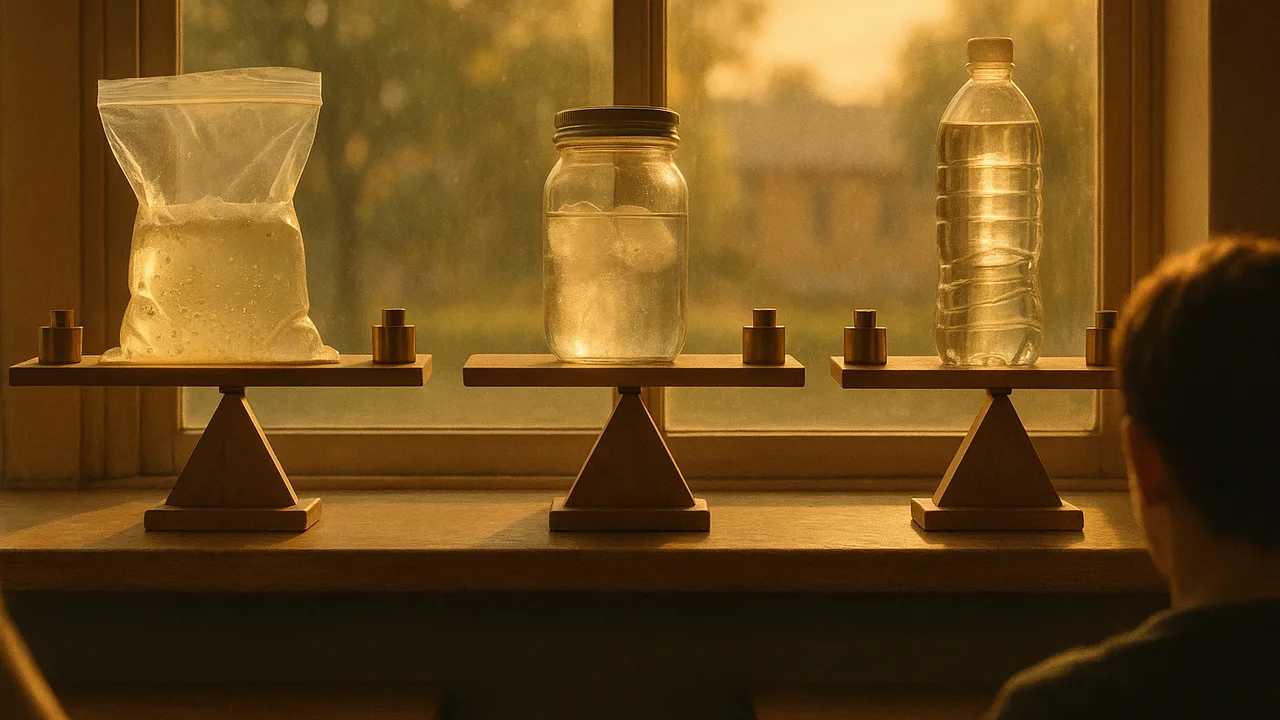
graph our class mass data and use it, with a particle model, to argue that the total mass of matter is conserved when substances are heated, cooled or mixed.
- I can measure the weight of substances before they are heated, cooled, or mixed using standard units.
- I can measure the weight of substances, including any new substances made, after they are heated, cooled, or mixed.
- I can make a graph to show the weights I measured before and after heating, cooling, or mixing substances.
- I can use my measurements and calculations to explain that the total weight of the substances stayed the same, even if their properties changed.
- I can use my measurements and what I know about patterns in nature to give evidence that the total weight of matter is conserved after heating, cooling, or mixing substances.
Phase 3: Make Sense
Warm-Up ~5 min
Do Now. Look at our class chart of before and after masses from every team. Find the biggest difference on the chart. Find the most common difference.
Across every team and every closed test, what is the pattern?
Instruction ~10 min
Now we can name the pattern. In every closed test, the total mass stayed the same. Scientists call this conservation of matter. When substances are heated, cooled or mixed, the total mass of the matter does not change. Matter is not created or destroyed. It can change form, move around, or escape into the air.
Why does it work? Think of the particle model. Particles do not disappear. When sugar dissolves, the same particles spread out. When ice melts, the same particles loosen up. When baking soda and vinegar fizz, the particles rearrange, and some end up in a gas. If the bag is sealed, every particle is still on the scale.
Worked example 1: a class bar graph. Diego’s class graphed four tests. Dissolving: 312 g and 312 g. Melting: 118 g and 118 g. Freezing: 205 g and 205 g. Sealed bag: 58 g and 58 g. Each pair of bars is the same height. A pattern that repeats across different changes is strong evidence. These are sample numbers.
Worked example 2: explaining a 1 gram gap. One team’s sugar test showed 1 g less after. Priya asked whether matter was lost. The class looked for causes. A few drops had splashed onto the table. Small spills and rounding explain 1 gram. The pattern across all teams still shows conservation.
Why the pantry cares. If a volunteer dissolves a sample, the matter is still there in the cup. Our tests use tiny amounts, so almost all the food goes home with families.
Guided Exercises ~15 min
Use the class bar graph and your own data to answer these.
Independent Practice ~10 min
Make your case. Use these sentence starters:
- Claim: When substances are heated, cooled or mixed, the total mass ___.
- Evidence: In the ___ test, the mass was ___ g before and ___ g after. In the ___ test, ___.
- Reasoning: This happens because particles ___.
Write your CER about conservation of matter. Include a bar graph with a before bar and an after bar for at least two tests.
Closure ~5 min
Our data and our model agree: matter is conserved. Next time, we turn the powder data table into a tool that can solve the pantry mystery.
Exit ticket: a sealed jar of 200 g of water is frozen. Predict its mass when frozen and explain using particles.
Teacher notes
Materials: the class before/after chart from 1.05–1.07, graph paper, rulers, colored pencils.
Setup: model one pair of bars together on the board. Keep the y-axis starting at 0 so bar heights are honest.
Listen for: “gas has no weight”; “mass is lost when something dissolves.” Keep the particle talk at the particle scale; no atoms. The words “particles rearrange” are enough; whether a new substance forms is part 2 (5-PS1-4).
Support / stretch: provide a pre-labeled graph. Stretch: design a way to weigh the gas that escaped from the open bag.