1.12 Reading the Powder Table: Which Test Tells Which?
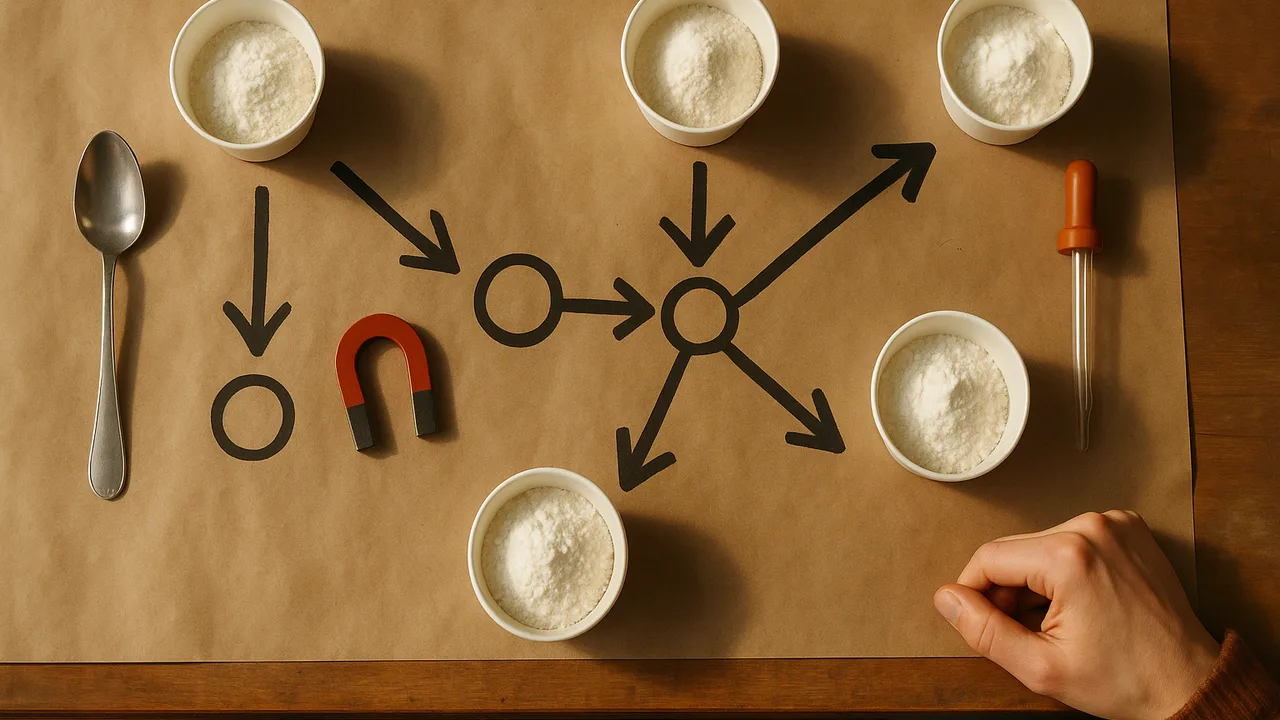
explain how each property test helps identify a powder and turn our data table into a step-by-step sorting key.
- I can explain why we are doing the investigation, including how collecting data helps us show that materials can be identified by their properties.
- I can explain how the observations and measurements I collect will help answer the purpose of the investigation.
- I can describe how the observations and measurements I make will help me identify materials based on their properties.
Phase 3: Make Sense
Warm-Up ~5 min
Do Now. Look at your powder data table. Find one test that gave a different result for only ONE powder. Circle it.
Which single test splits the powders into two groups of two and three?
Instruction ~10 min
How scientists use properties. Every material has its own set of properties. Some properties are shared. All five powders are white, and none are magnetic. Shared properties do not help us tell materials apart. Other properties are different, like whether a powder fizzes in vinegar. Different properties are the clues that identify a material.
Scientists in food labs, crime labs and factories use this same idea. They test an unknown sample, compare it with a table of known results, and look for a match. One test rarely settles it. A set of tests, done in a smart order, usually does.
Worked example 1: a sorting key. A sorting key asks yes/no questions in order. Each answer sends you to the next question. Malik’s team built this key from our table:
- Add iodine (adult only). Does it turn blue-black? Yes → go to step 2. No → go to step 3.
- Rub a gloved pinch. Does it squeak and feel very silky? Yes → cornstarch. No → flour.
- Add vinegar. Does it fizz? Yes → baking soda. No → go to step 4.
- Dissolve in water and test conductivity (adult only). Does the light glow? Yes → salt. No → sugar.
Worked example 2: why order matters. Ava’s team started with color. All five powders were white, so they learned nothing and wasted powder. Starting with a test that splits the group saves time and powder. That helps meet two of our constraints.
Back to our purpose. We collected data to show that materials can be identified by their properties. Our table and key prove it: five white powders, five different sets of properties.
Guided Exercises ~15 min
Use the sorting key and your table to answer these.
Independent Practice ~10 min
Build or improve a key on your own.
Write a different sorting key that starts with the vinegar test instead of iodine. Does it still identify all five powders? How many steps does it need?
How confident are you that you can I can explain how property tests help identify a material.
Closure ~5 min
Our data became a tool. Next time, the five mystery bags come out, and we put our key to the test.
Exit ticket: why does our key need more than one test? Use two powders that share a property as your example.
Teacher notes
Materials: each team’s powder table from 1.09, chart paper for keys, sticky notes.
Setup: model one yes/no question together. Teams draft keys on chart paper and trade with another team to test them on paper.
Listen for: keys that use a test with the same result for all powders; keys that rely on “looks like sugar.” If your tester glowed dimly for everything, compare brightness against plain water.
Support / stretch: give a key with blanks to fill. Stretch: find the key with the fewest tests, and explain why it is the most efficient.