2.23 Test Day: Our Model vs. the Criteria
run our test plan, record the results, and use the data to compare how well each team’s design meets the criteria and constraints.
- I can test each solution in different situations and collect data to see how well it meets the criteria and constraints.
- I can use the data I collected to compare how well each solution meets the criteria and constraints of the problem.
Phase 5: Prove It
Warm-Up ~5 min
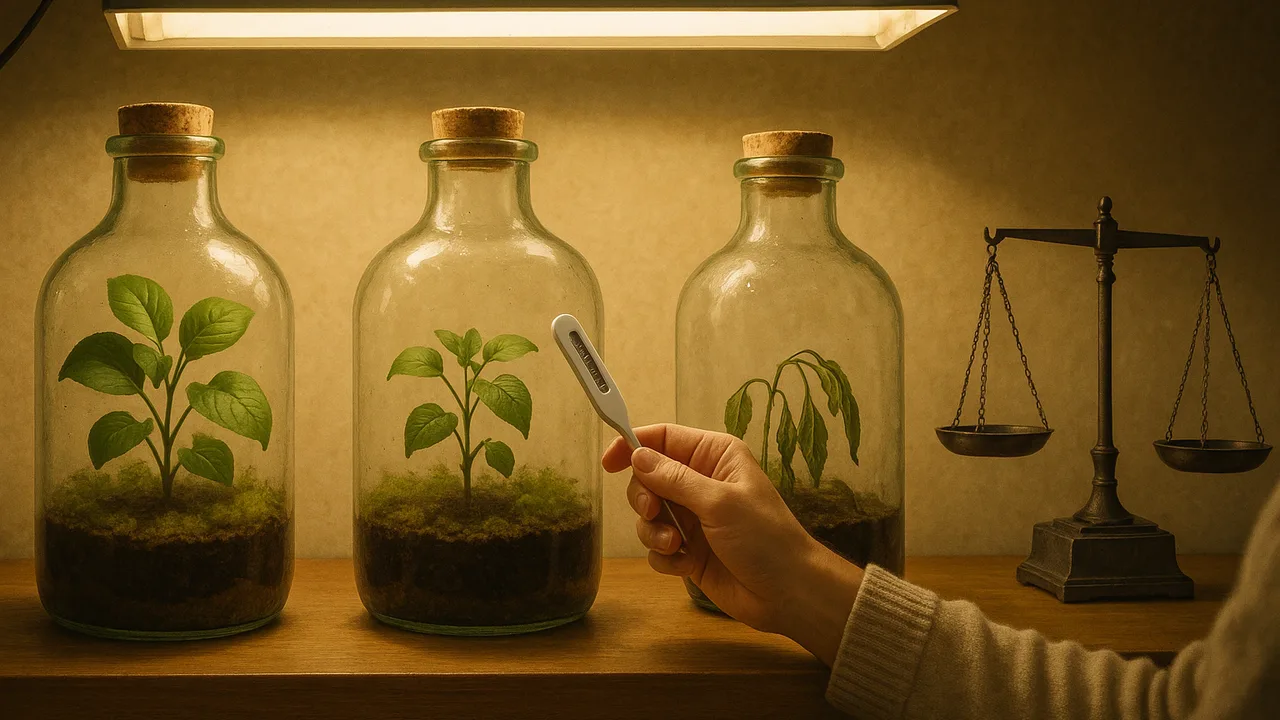
Do Now. Look at your bottle biome one last time before the test. Has the apple peel changed? Are there drops of water on the inside of the bottle?
The peel inside a sealed bottle got smaller and softer. Where did its matter go?
Instruction ~10 min
Garden engineers, it is Test Day. We run the test plan we wrote as soil scientists. Each team tests its own design, then we compare designs across the class.
Step 1: test each criterion. Weigh the bottle biome. Check the plant, the scraps and the water drops. Walk through the garden plan with the scrap list. Time the weekly care jobs.
Step 2: compare with data. Put every team’s results in one class table. A design that passes more rows meets the needs better. If two designs tie, look at the trade-offs.
| Test | Team A | Team B | Team C | Team D |
|---|---|---|---|---|
| Bottle mass the same as Day 1? | ||||
| Plant grew? (cm) | ||||
| Scraps breaking down? | ||||
| Every scrap has a place to go? | ||||
| Weekly care time (minutes) | ||||
| Rows passed |
Worked example 1: Diego’s team. Sample results: their bottle stayed at 605 grams, the radish grew 6 cm, and the peel was soft and fuzzy. Their plan had a place for every scrap. But weekly care took 14 minutes, which failed the 10-minute constraint. They passed 4 of 5 rows.
Worked example 2: comparing two designs. Mei’s team passed all 5 rows. Their bin sat right next to the beds, so care took only 8 minutes. Diego’s team borrowed that idea: moving the bin closer should fix their one failed row.
Guided Exercises ~15 min
Run your test plan. Fill your row in the class table. Then answer.
Independent Practice ~10 min
Make one final revision.
Which row did your design fail or barely pass? Describe one revision and the data you expect after retesting.
Closure ~5 min
Your data tells a clear story, garden engineers. Next time you present your design to the garden club.
Exit ticket: what is the strongest piece of evidence that your design works? Why will the garden club find it convincing?
How confident are you that you can I can use data to compare how well designs meet the criteria and constraints.
Teacher notes
Materials: bottle biomes, the Day 1 data, kitchen scale, rulers, stopwatches, class results table on chart paper, each team’s plan.
Setup: run stations: weighing, plan walk-through and timed care routine. Rotate teams every 7 minutes, then fill the class table.
Listen for: “our design is best because we like it” (use rows of data); “the peel vanished” (its matter moved into decomposers, soil and air).
Support / stretch: give a comparison frame: “Our design passed __ rows. Team __ passed __ rows. The difference was __.” Stretch: rank all designs and justify the ranking.