2.10 Solving the Pumpkin Mystery
use evidence from our plant investigations to write a CER explaining that plants get the materials they need to grow mainly from air and water.
- I can describe evidence that shows plants grow bigger over time.
- I can explain how changes in the weight of soil and water in a closed system show that soil does not provide most of the material for plant growth, and that plants need water to grow.
- I can describe evidence that plants need air to grow and that air is matter.
- I can analyze evidence to decide if plants need air, soil, or water to grow.
- I can use evidence to figure out if air, soil, or water can provide enough matter to explain how a plant’s weight increases as it grows.
- I can use reasoning to explain that soil changes very little in weight while plants grow a lot, and that some plants can grow without soil.
- I can argue that since plants can grow without soil and soil does not lose enough matter as plants grow, soil is not the main source of material for plant growth.
- I can explain that plants need water and air to grow, and since both are matter and enter the plant, they provide the materials plants need for growth.
Phase 3: Make Sense
Warm-Up ~5 min
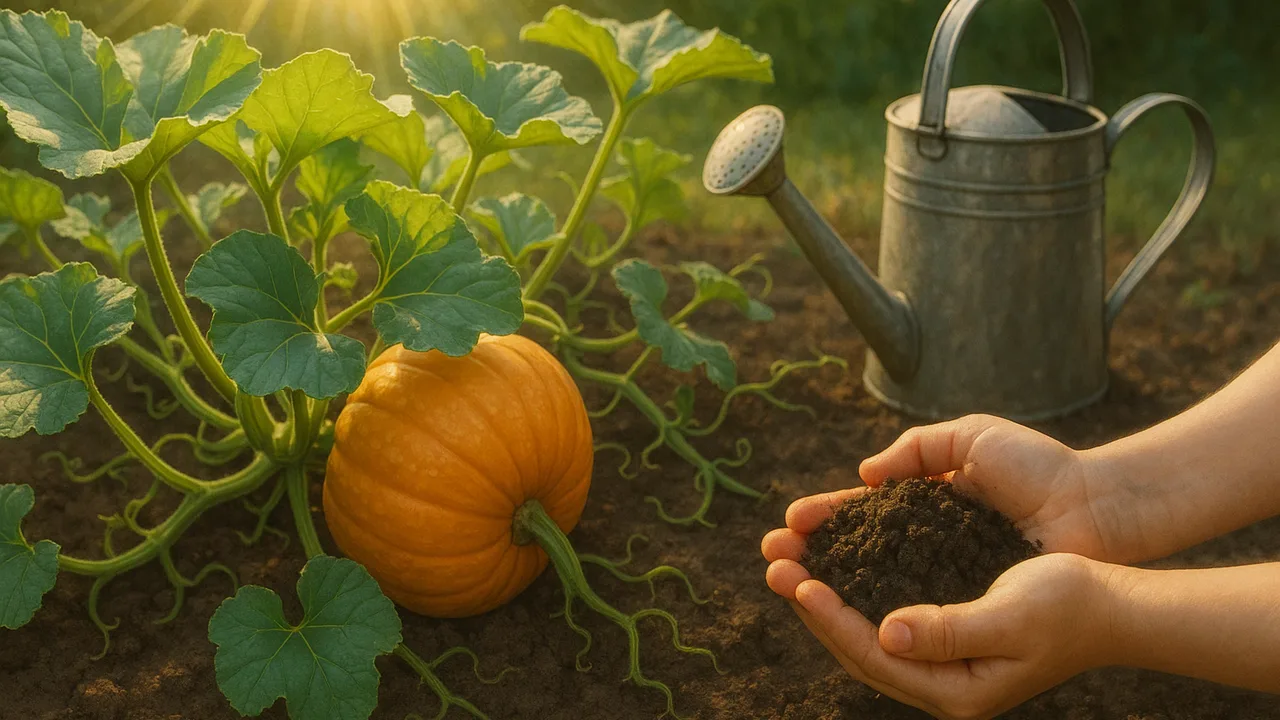
Back to the mystery. A pumpkin seed weighs less than a paper clip. It grows into a pumpkin heavier than you. Today you solve the mystery with your own evidence.
Which piece of evidence shows that soil is NOT the main source of plant matter?
Instruction ~10 min
Reading: where a plant’s matter comes from. For a long time, people believed that plants eat soil. The evidence says otherwise. When a plant grows, the soil around it loses only a tiny amount of mass. Some plants, like green onions and hydroponic lettuce, grow with no soil at all.
So where does the new matter come from? Water enters a plant through its roots. Air enters through tiny openings in its leaves. We showed that water has mass and that air has mass too, so both are matter. The plant uses the energy in sunlight to build its body out of these materials. Sunlight gives the energy, but it is not the material. The soil adds only small amounts of nutrients.
A model of a growing plant. Draw a plant. Draw a blue arrow up through the roots for water. Draw a gray arrow into the leaves for air. Draw a yellow arrow from the Sun to the leaves for energy. Draw a thin brown arrow from the soil for small amounts of nutrients. The thick arrows show where most of the matter comes from.
Worked example 1: a strong CER. Here is Mei’s explanation.
Claim: Plants get most of the materials they need to grow from air and water, not from soil.
Evidence: Our bean plant gained about 9 grams, but the dry soil lost only about 1 gram. A green onion grew new leaves in plain water with no soil. A ball gained mass when we pumped in air.
Reasoning: If plants ate soil, the soil would lose about as much mass as the plant gained. It did not. Water and air are matter, and both go into the plant, so they must supply most of the new matter.
Worked example 2: fixing a weak CER. Jamal first wrote, “Plants grow from water because water is good for them.” His teammate asked, “What is your evidence? And what about air?” Jamal added the soil mass numbers and the ball test. Now his claim names both materials and his reasoning connects the evidence to the claim.
Guided Exercises ~15 min
Use your notebook data from 2.03 to 2.06. Sentence starters: I claim that… My evidence is… This shows that… because…
Independent Practice ~10 min
Write your own CER. Use at least two pieces of evidence.
CER: Where does a pumpkin get most of the materials it needs to grow? Claim: I claim that… Evidence: In our tests… Reasoning: This shows that… because…
How confident are you that you can I can argue from evidence that plants get their materials mainly from air and water.
Closure ~5 min
Mystery solved: plants build their bodies mainly from air and water, using energy from sunlight. Next lesson, we follow that sunlight energy from plants into animals and into us.
Exit ticket: what would you tell the garden club about how much soil their plants really use up?
Teacher notes
Materials: notebooks with data from 2.03 to 2.06, colored pencils (blue, gray, yellow, brown), CER sentence starter strips.
Setup: post the class data from 2.05 so every student can cite the same numbers. This lesson is a formative check of all 5-LS1-1 ideas; use the CER to decide who needs the 2.05 to 2.06 evidence again.
Listen for: “plants get mass from sunlight” (sunlight is energy, not matter); “plants eat a little soil, so soil is the main source” (compare amounts). Stay at the level of air and water as materials; do not introduce chemical equations or how plants make sugar.
Support / stretch: provide a CER frame with one piece of evidence filled in. Stretch: ask students to argue against the soil claim as if they were writing to van Helmont.