1.13 The Mystery Sample Challenge
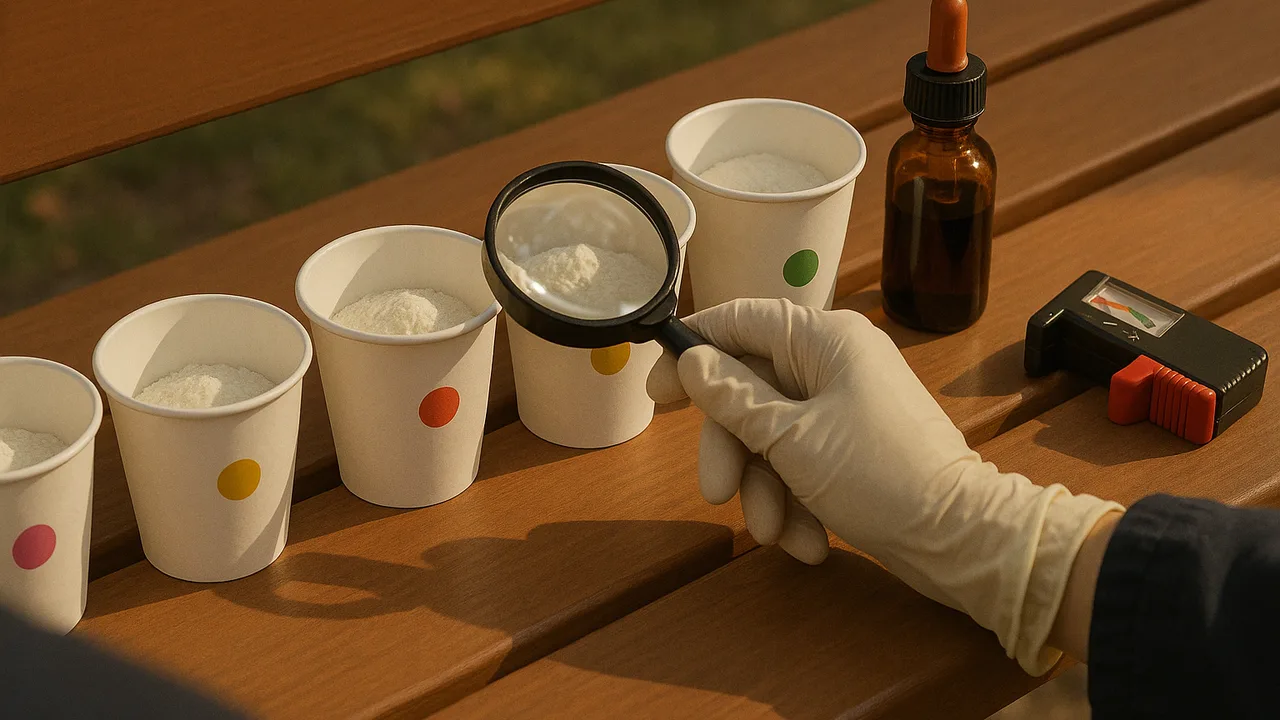
use our sorting key to identify the five unlabeled pantry samples and defend each identification with a claim, evidence and reasoning.
- I can describe how I will collect data, including measuring properties in standard units, observing properties like color and conductivity, and figuring out if materials are conductors or magnetic.
- I can collect and record data about materials, following the investigation plan.
- I can describe how the observations and measurements I make will help me identify materials based on their properties.
Phase 3: Make Sense
Warm-Up ~5 min
Do Now. The five mystery bags from the pantry are on the front table, marked A to E. Your teacher has the answer key in a sealed envelope. Before you test, read your sorting key once with your team.
If two teams test Bag C the same careful way, what should happen?
Instruction ~10 min
Pantry detectives, this is the real test. Today you identify each mystery bag using only property tests. Follow your sorting key step by step. Record every observation in the table. When you finish, write a CER for each bag.
| Bag | Test 1 result | Test 2 result | Test 3 result | Matches which known powder? | How sure are we? (very / somewhat / not) |
|---|---|---|---|---|---|
| A | |||||
| B | |||||
| C | |||||
| D | |||||
| E |
Worked example 1: a CER for one bag. Here is how Jamal’s team identified a practice bag.
- Claim: The practice bag is cornstarch.
- Evidence: With iodine, it turned dark blue-black. When rubbed, it squeaked and felt silky. In water, it stayed cloudy and settled.
- Reasoning: Only flour and cornstarch turned blue-black in our reference table. Only cornstarch squeaked. So its properties match cornstarch.
Worked example 2: when results do not match. Diego’s team found a bag that did not fizz but did light the tester a little. Was it salt or baking soda? They ran the vinegar test again with a fresh sample. This time it fizzed. The first sample had been too small. Repeating a test is what careful scientists do.
Checking the answer. When every team is done, the class compares results. Then your teacher opens the envelope.
Guided Exercises ~15 min
Use your mystery table to answer these together.
Independent Practice ~10 min
Defend your answers.
Write a CER for two of the mystery bags. Use the observations in your table as evidence and our reference table in your reasoning.
Closure ~5 min
You solved the pantry mystery with properties, not taste. Next time, we brainstorm how to turn our method into a kit any volunteer can use.
Exit ticket: which test in your key was most useful today, and why? Which test would you change or remove?
Teacher notes
Materials (per team): goggles, gloves, hand lens, a sample cup of each mystery bag A–E, craft sticks, clear cups or a muffin tin, water, vinegar in a dropper bottle. Teacher: iodine solution, conductivity tester, the sealed answer key.
Setup: assign bags so that flour and cornstarch, and salt and sugar, are not in alphabetical order. Do iodine and conductivity as a rolling teacher station.
Listen for: “we just knew it was sugar” (ask for evidence); teams skipping repeat trials. Fizzing is a property here; its meaning as a new substance waits for part 2.
Support / stretch: let some teams identify three bags with teacher check-ins. Stretch: the teacher mixes a sixth bag of two powders; which tests reveal both?