1.27 Catch-up and Stretch: Properties and Better Designs
practice using properties to identify materials and improve a design, and stretch my kit to new materials.
- I can describe the evidence I will collect, including observations and measurements of properties like color, hardness, reflectivity, conductivity, response to magnets, and solubility.
- I can describe how I will collect evidence about how well my model or prototype meets the criteria and constraints.
- I can identify and describe specific parts of my model or prototype that do not meet the criteria or constraints.
- I can explain which parts of my model or prototype could be improved to better meet the criteria and constraints.
- I can come up with at least two possible solutions to a problem using what I know about science.
Phase 5: Prove It
Warm-Up ~5 min
Do Now. Name as many properties as you can in one minute. Then circle the ones our kit used.
Which of these is NOT a property of a material?
Instruction ~10 min
Junior chemists, last choice board of the unit. Pick at least two squares. Everyone does the final check.
| Square | Type | What you do | Done? |
|---|---|---|---|
| A. Property match | Catch-up | Match 6 materials to their property cards: hardness, color, reflectivity, conductivity, magnetism, solubility. | |
| B. Broken key | Catch-up | Run a powder through a “broken” flowchart key. Find the failure point and fix it. | |
| C. Two fixes | Catch-up | Write two different solutions for your kit’s weakest step. Compare them with the criteria. | |
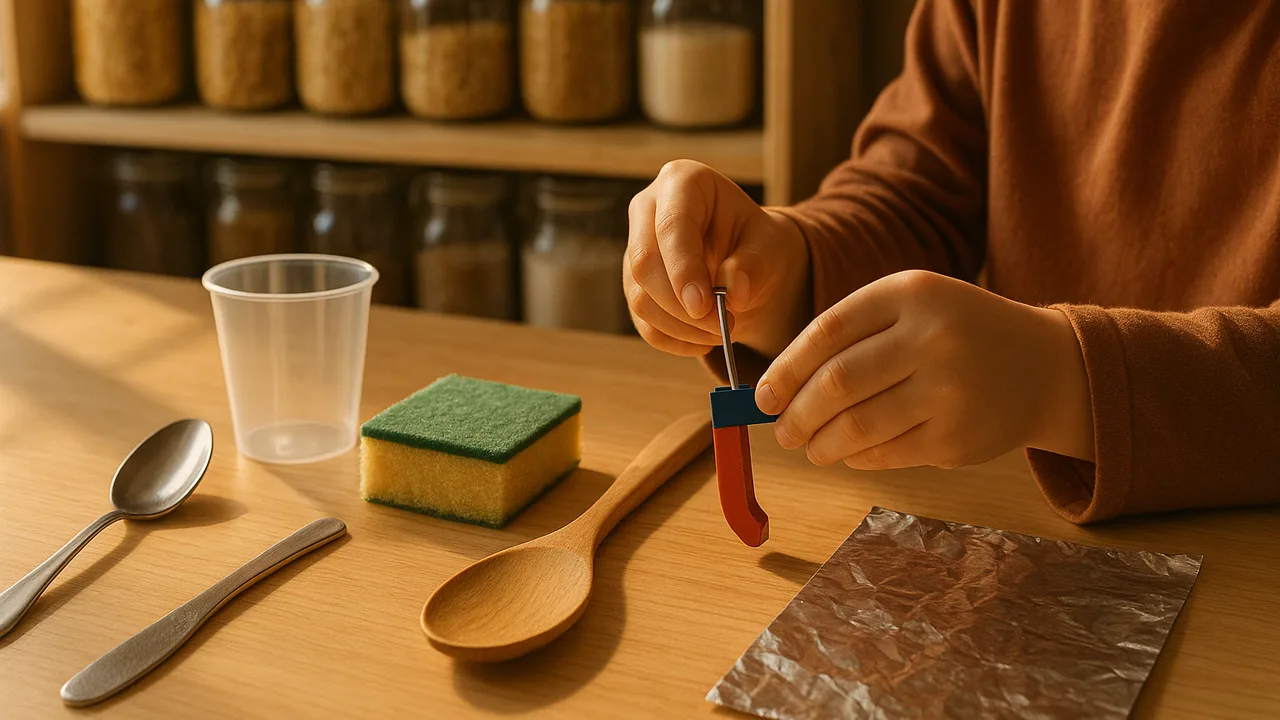
| D. Metal sorter | Stretch | Use a magnet and the bulb tester to sort a steel paper clip, aluminum foil, a plastic button and a wooden craft stick. | |
| E. Powdered sugar twist | Stretch | Run powdered sugar through your key. Read its ingredients. Explain the result and update the key. |
Worked example 1: square B. The broken key said, “Is it white? Yes → sugar.” Priya noticed every powder is white, so this step can never sort them. That is the failure point. She replaced it with the vinegar test.
Worked example 2: square D. Malik predicted foil would stick to the magnet because it is metal. It did not. The paper clip did. Both metals let the bulb glow, but the plastic and wood did not. His lesson: “metal” does not always mean magnetic. Test, do not assume.
Guided Exercises ~15 min
Final check for everyone. Answer after your choice board squares.
Independent Practice ~10 min
Plan the next version.
Write two possible solutions for your kit's weakest step. Explain how each one would solve the problem, and which one the data favors.
Closure ~5 min
Unit 1 is complete, junior chemists. You can now explain where the sugar goes, and you built a tool that helps real people.
Exit ticket: what is the most important thing you learned about matter this unit? What is one thing you still wonder?
How confident are you that you can I can identify materials by their properties and use data to improve a design.
Teacher notes
Materials: property cards and 6 sample materials for A, printed broken keys for B, magnets, the bulb tester, steel paper clips, aluminum foil, plastic buttons, craft sticks, powdered sugar, goggles.
Setup: group students from the checkpoint results. Students who missed property items start at A; design items start at B or C.
Listen for: “all metals are magnetic”; “white is a good test”; choosing a fix without data.
Support / stretch: give picture-and-word property cards for A. Stretch: square E students write a version 3 key card and give it to the pantry with the others.