1.09 The Powder Lab: Building Our Property Data Table
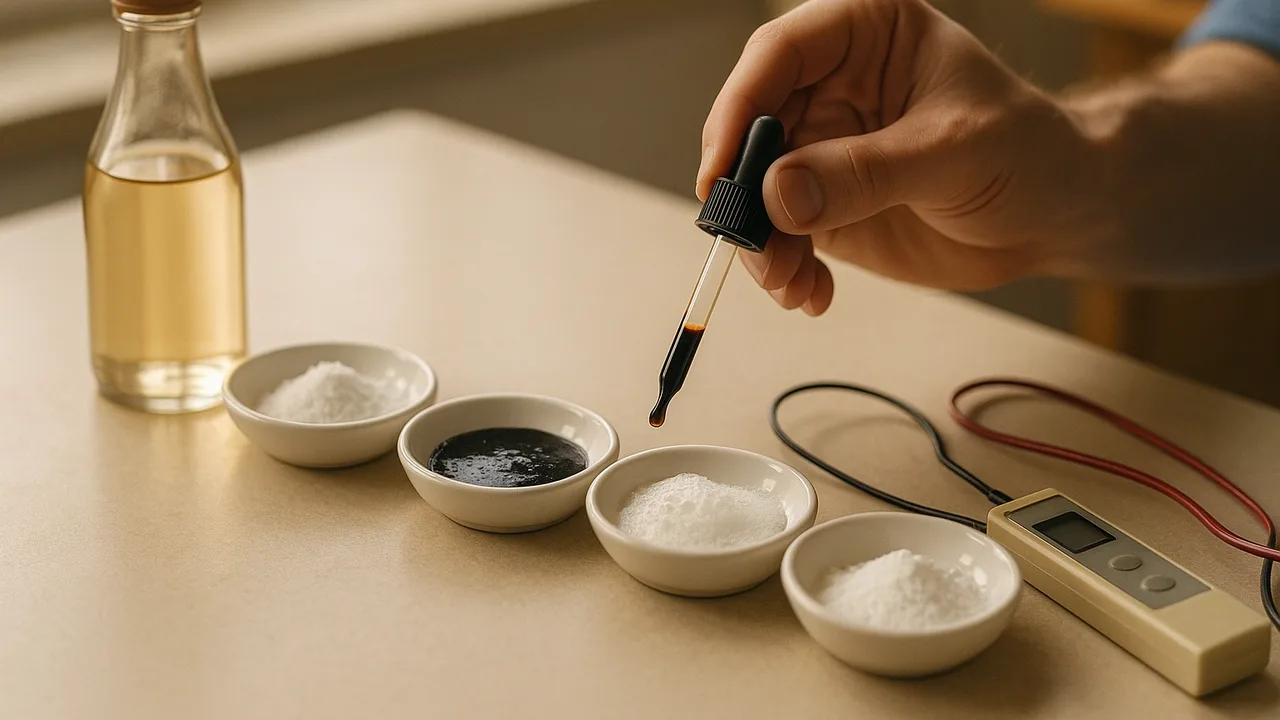
follow our plan to test five labeled powders with water, vinegar, iodine and a conductivity tester, and record the results in a property data table.
- I can explain how the observations and measurements I collect will help answer the purpose of the investigation.
- I can describe how the observations and measurements I make will help me identify materials based on their properties.
- I can collect and record data about materials, following the investigation plan.
Phase 2: Investigate
Warm-Up ~5 min
Do Now. Today the five powders come with labels. We test the KNOWN powders first and build a reference table. Later, we use that table to solve the mystery bags. Look at the five labeled cups with a hand lens.
Salt and sugar both look like white grains. Which test might tell them apart?
Instruction ~10 min
Pantry detectives, follow the plan. Each station tests all five labeled powders. Use a clean craft stick for each powder so they do not mix. Use about a quarter teaspoon each time, to respect our constraint.
- Look and feel: use a hand lens. Are the grains crystals or fine dust? Wearing a glove, rub a pinch between two fingers. Gritty, smooth, or squeaky?
- Water: stir the powder into 2 spoonfuls of water. Does it dissolve and turn clear, or stay cloudy and settle? This property is solubility.
- Vinegar: add 10 drops of vinegar to a fresh sample. Fizz or no fizz?
- Iodine (teacher only): your teacher adds one drop of iodine solution to each sample. Does it stay yellow-brown or turn dark blue-black?
- Conductivity (teacher only): your teacher dips the tester into each water mixture. Does the light glow?
| Powder | Look and feel | Water: dissolves clear or stays cloudy? | Vinegar: fizz? | Iodine: color | Conductivity: light glows? |
|---|---|---|---|---|---|
| Flour | |||||
| Sugar | |||||
| Salt | |||||
| Baking soda | |||||
| Cornstarch |
Worked example 1: how the data answers our question. Mei’s team noticed that only one powder fizzed with vinegar: baking soda. So if a mystery bag fizzes, they have strong evidence it is baking soda. One clear difference can identify a powder.
Worked example 2: when two powders match. Jamal saw that iodine turned both flour and cornstarch dark blue-black. That test alone cannot split them. But under the hand lens, and when rubbed, they felt different. Cornstarch squeaked. Recording every test, even the ones that match, helps us find the one that is different.
Record exactly. Write what you see in words, like “cloudy, settled to the bottom.” Do not write a powder’s name as a result. A careful table is the heart of our test kit.
Guided Exercises ~15 min
Use your team’s finished table to answer these.
Independent Practice ~10 min
Check your table for gaps and patterns.
Is every cell of your table filled in with an observation? Circle any result your team should test again, and explain why.
How confident are you that you can I can collect and record property data by following a plan.
Closure ~5 min
Our reference table is built. Next time, we shrink down and explain all our invisible-matter evidence with a particle model.
Exit ticket: name two powders that look alike, and the one test from today that tells them apart.
Teacher notes
Materials (per team): goggles, gloves, a hand lens, 5 labeled cups of powder, 15 small clear cups or a muffin tin, craft sticks, measuring spoons, water (distilled is best for the conductivity test), white vinegar in a dropper bottle. Teacher: iodine solution (from a pharmacy) in a dropper bottle and a conductivity tester or a battery-and-LED tester.
Expected results: flour: fine, soft, off-white; cloudy and settles; no fizz; blue-black with iodine; little or no glow. Sugar: shiny crystals; dissolves clear; no fizz; stays yellow-brown; no glow. Salt: small cube-shaped crystals; dissolves clear; no fizz; stays yellow-brown; glows. Baking soda: fine, slightly gritty; much of it dissolves, but the water may stay a little cloudy; fizzes; stays yellow-brown or fades; glows. Cornstarch: very fine, squeaks when rubbed; cloudy and settles; no fizz; blue-black; little or no glow. Pilot your own tester: tap water conducts a little, so a dim glow may appear for every sample.
Listen for: “salt and sugar are the same because they both disappear.” Whether the vinegar fizz makes a new substance is part 2’s question (5-PS1-4); here it is only a property to record.
Support / stretch: run stations with a pre-filled example row. Stretch: test a sixth kitchen powder, like powdered milk, and predict its row first.