1.21 Revise and Retest: Version 2 of the Key
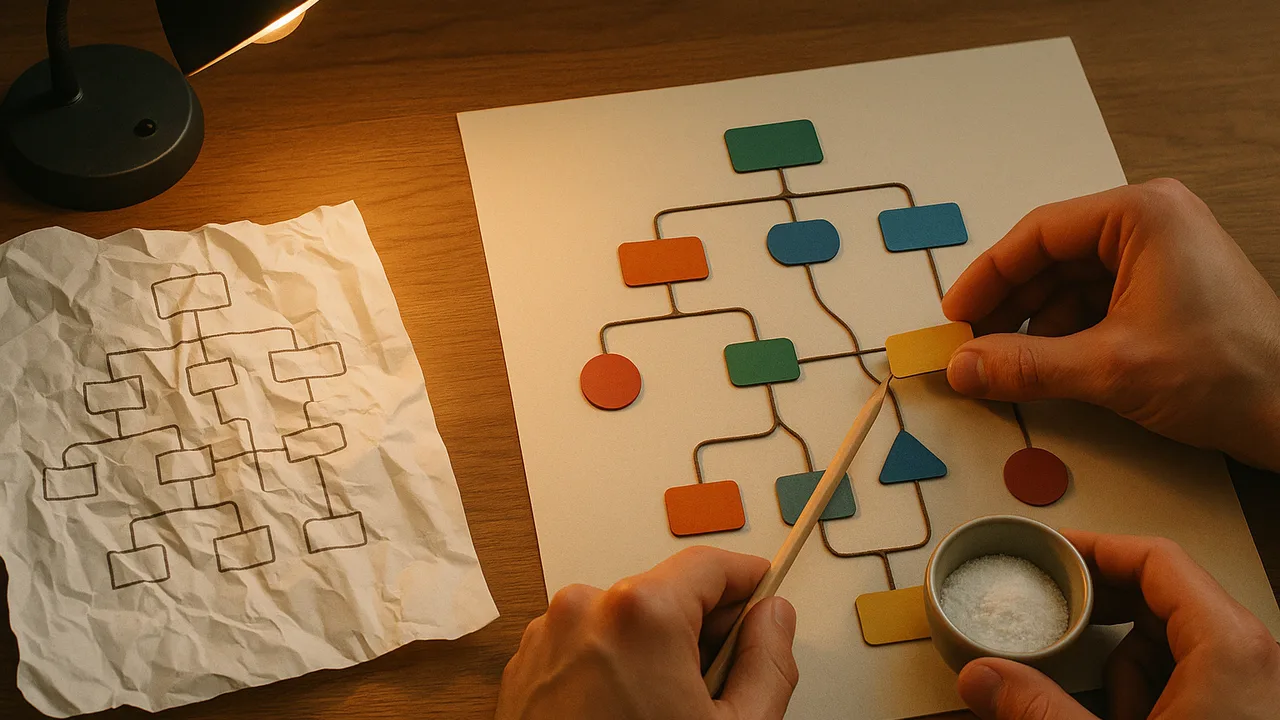
improve one failure point in our key, retest it and use data to compare version 1 with version 2.
- I can test each solution in different situations and collect data to see how well it meets the criteria and constraints.
- I can use the data I collected to compare how well each solution meets the criteria and constraints of the problem.
- I can carry out my investigation and collect and record data by following my plan.
Phase 4: Build
Warm-Up ~5 min
Do Now. A team changes three steps of its key at once. The key works better. Do they know which change helped?
What is the problem with changing many steps at once?
Instruction ~10 min
Junior chemists, today you revise. Pick the failure point from your critique notes. Change that one step. Then retest version 2 the same way you tested version 1.
Test in different situations. A key might work for the person who wrote it but fail for a new reader. Test it with a teammate, then with someone from another team. Test it with a fresh sample, too.
Worked example 1: Malik’s fix. Version 1 used the magnifier to split sugar from salt. 3 of 6 testers got it right. Version 2 used the bulb tester instead. 6 of 6 testers got it right. Malik’s data showed version 2 met the “identifies all 5” criterion much better. These are sample numbers.
Worked example 2: Sofia’s trade-off. Sofia’s version 2 added a second check for flour: a sticky dough test. Accuracy went up, but the full test now took 12 minutes. That breaks our 10-minute constraint. Her team kept the dough test but cut a slow step somewhere else. Then they timed it again: 9 minutes.
| Check | Version 1 | Version 2 |
|---|---|---|
| Correct IDs (out of 5 known powders) | ||
| Testers who finished without help | ||
| Time for a full test (minutes) | ||
| Supplies still fit in a shoebox? | ||
| The one step we changed |
Guided Exercises ~15 min
Revise, retest and record. Use these checks along the way.
Independent Practice ~10 min
Make the case for your revision.
Use your data to compare version 1 and version 2. Which one better meets the criteria and constraints? Give numbers.
Write your test plan for Test Day: one test for each criterion or constraint, what you will measure, and what you will keep the same.
Closure ~5 min
Your key is getting stronger. Next, we meet real people who test unknown powders for a living.
Exit ticket: what one change made the biggest difference to your key? How do you know?
Teacher notes
Materials: kits and key cards, known powder samples, fresh index cards for version 2, timers, the optional bulb or LED tester.
Setup: 10 minutes to revise, 15 to retest with at least two testers, 5 to compare. Pair teams that had similar failure points so they can share fixes.
Listen for: teams rewriting the whole key; teams declaring version 2 “better” without numbers.
Support / stretch: pre-mark the one step to revise for teams that need it. Stretch: run a third version and graph accuracy across all three.